Shining 3D FreeScan Lineup Compared: Which Metrology Scanner Fits Your Shop
Combo, Trio, UE Pro2, Omni, Trak Nova or UE Nova? How to pick a Shining 3D FreeScan metrology scanner by part size, markers, surfaces and where you scan.
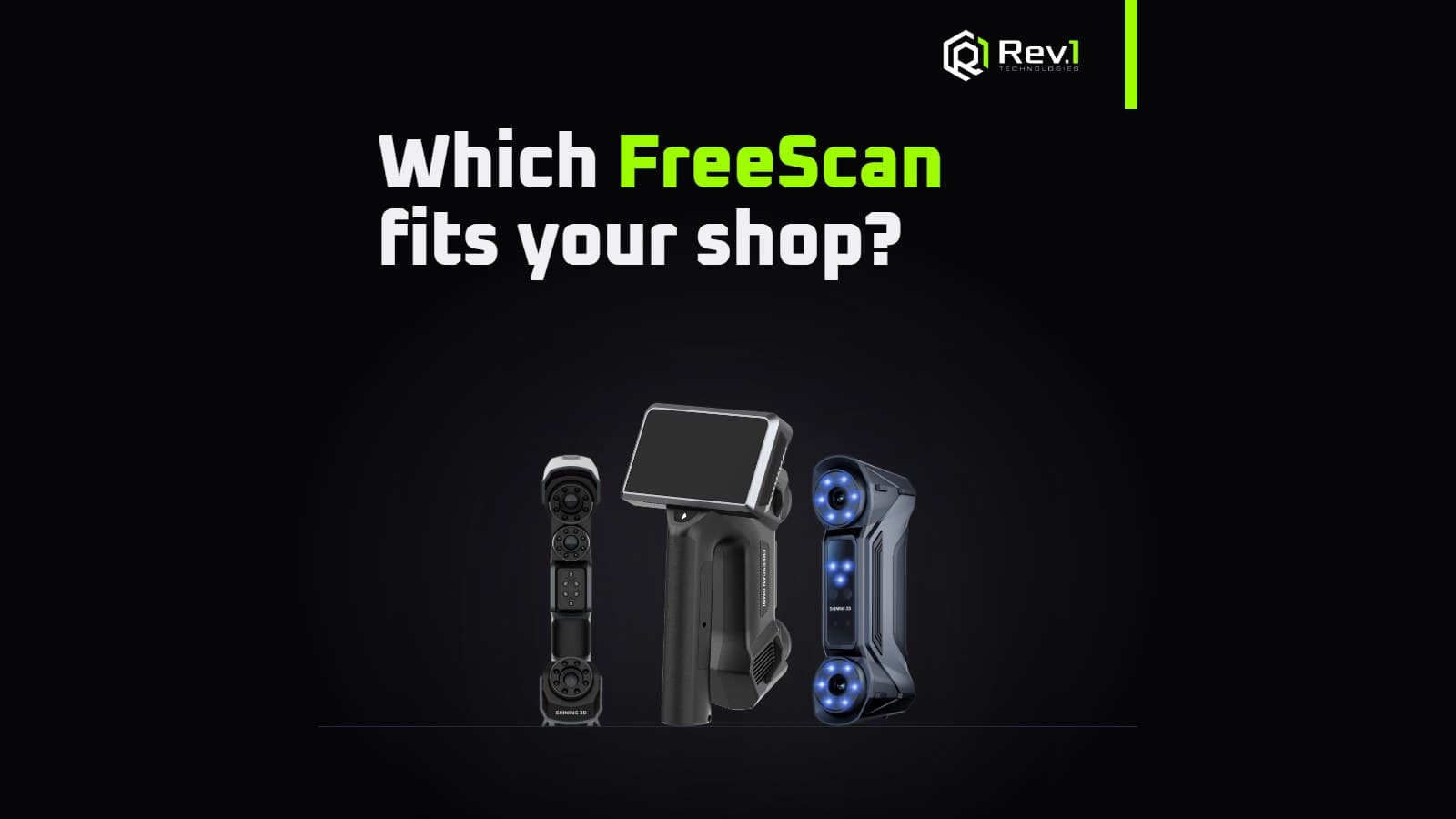
Shining 3D now sells seven FreeScan metrology scanners, and on paper most of them quote the same headline number: 0.02 mm. That number is real, but it is not what separates them. What separates them is how big your parts are, where the parts live, whether the scanner needs a cable to a PC, and how much of the part it can see before accuracy starts to drift.
This guide sorts the lineup the way we sort it when a customer calls us: by the job, not by the spec sheet. Every figure below comes from the Shining 3D specification for that model, certified to VDI/VDE 2634 Part 3 and ISO 10360 in an ISO/IEC 17025 accredited lab.
The short answer
- Small to mid-size parts, tight budget, bench next to a PC: FreeScan Combo or FreeScan Trio.
- Mixed work on the shop floor, no cable, one scanner for everything: FreeScan UE Pro2 or FreeScan Omni.
- Car bodies, castings, fixtures and anything you cannot put markers on: FreeScan Trak Nova, the optical tracking system.
- Very large parts measured in meters, indoors or outside: FreeScan UE Nova.
Why "0.02 mm" is only half the story
Every handheld metrology scanner publishes two accuracy numbers. The first, single-point accuracy, is how well it measures what it can see in one frame. The second, volumetric accuracy, is how much error accumulates as you move across a larger part and the scanner stitches frames together. Volumetric accuracy is written as a base value plus an amount per meter of part length, and that second term is the one that matters on anything bigger than a shoebox.
A worked example: on a 2 m part, a scanner rated 0.02 + 0.03 mm/m can drift up to 0.08 mm end to end. The same scanner with video photogrammetry (VPG) switched on is rated 0.02 + 0.015 mm/m, or 0.05 mm over the same part. If your tolerance band is plus or minus 0.1 mm, that difference decides whether the scan can sign off a first article or only guide a rework.
So the useful question is not "how accurate is it?" but "how accurate is it over my largest part, and how does it keep that accuracy?" The FreeScan models answer that in three different ways: markers on the part, built-in photogrammetry, or an external optical tracker.
The lineup side by side
| Model | Volumetric accuracy | Max speed | Weight | Connection | Best for |
|---|---|---|---|---|---|
| FreeScan Combo / Combo+ | 0.02 + 0.033 mm/m | 1.86 / 3.6 M pts/s laser, 2.25 M pts/s IR | 620 g | USB 3.0 to PC | Entry metrology, dark and soft surfaces via IR |
| FreeScan Trio | 0.02 + 0.015 mm/m with VPG | 3.01 M pts/s | 985 g | USB 3.0 to PC | Marker-free inspection on a budget |
| FreeScan UE Pro2 | 0.02 + 0.015 mm/m with VPG | 3.46 M pts/s | 950 g | Wi-Fi 6, USB fallback | Wireless all-rounder, deep holes |
| FreeScan Omni | 0.02 + 0.015 mm/m with VPG | 7.62 M pts/s | 1.1 kg or less | Wireless, onboard screen | Fastest handheld, inspection on the scanner itself |
| FreeScan Trak Nova | 0.062 mm over 12 m³; 0.046 + 0.012 mm/m with VPG | 6.14 M pts/s | 1.2 kg (TE head) | Wi-Fi 6 or fiber | Large parts with no markers, fixtures, car bodies |
| FreeScan UE Nova | 0.072 + 0.012 mm/m with VPG | 4.6 M pts/s | 1.6 kg | Wireless, fiber option | Hulls, blades, mining and rail equipment |
Bench and small parts: Combo and Trio
The FreeScan Combo is the entry point to certified metrology. At 620 g it is the lightest scanner in the family, and it pairs a blue laser (26 lines on the Combo, 50 on the Combo+) with an infrared mode that scans without markers. The IR mode is the reason to pick it: black rubber, dark plastics and soft goods that make blue lasers struggle scan cleanly in IR. It is tethered to a Windows PC over USB 3.0, so it suits a bench or a cart rather than a walk around a large part.
The FreeScan Trio adds a third 5 MP camera and built-in video photogrammetry, which is what lifts its volumetric rating to 0.02 + 0.015 mm/m without placing a single target. It also has a 98-line mode for large surfaces with no markers. If most of your parts are under a meter but you are tired of sticking and peeling targets, the Trio is the one to look at. Like the Combo, it runs tethered.
The wireless all-rounders: UE Pro2 and Omni
Most shops we work with end up here, because these two scanners cover inspection, reverse engineering and field work with one tool and no cable.
The FreeScan UE Pro2 weighs 950 g and runs over Wi-Fi 6, with USB 3.0 as a fallback. It has three laser modes: 50 crossed lines for speed, 7 parallel lines for fine detail and a single line for deep holes and slots. That single-line mode matters on castings and molds, where the feature you need to measure sits at the bottom of a pocket other scanners cannot see into. With VPG it holds 0.02 + 0.015 mm/m.
The FreeScan Omni is the flagship handheld. It combines a blue laser with an IR VCSEL engine, reaches 7.6 million points per second (the fastest in the family), and carries a 5.5 inch touchscreen with Shining 3D Inspect on board. That last point changes the workflow: an inspector can scan, align and check a feature against the CAD model at the part, without walking back to a workstation. Batteries are hot-swappable, so a shift does not stop for charging.
Choose the UE Pro2 if you want a proven wireless metrology scanner at a lower price. Choose the Omni if throughput and inspection at the machine are the point.
Large parts without markers: Trak Nova
The FreeScan Trak Nova works differently. A stationary optical tracker watches the scan head and supplies the global reference, so accuracy does not depend on markers stuck to the part or on how carefully the operator overlaps frames. The system is rated 0.062 mm across a 12 m³ volume, and the tracker has a markerless range of up to 3.5 m with VPG.
That makes it the tool for jobs where markers are impractical or banned: painted car bodies, finished aerospace skins, fixtures and jigs in daily use, and parts that have to be measured quickly and put back into production. It ships with two heads, the TE Nova (1.2 kg, 170 to 550 mm depth of field) for detail and the UE Nova head for long range, and packs into a single case for on-site work.
Very large and outdoor: UE Nova
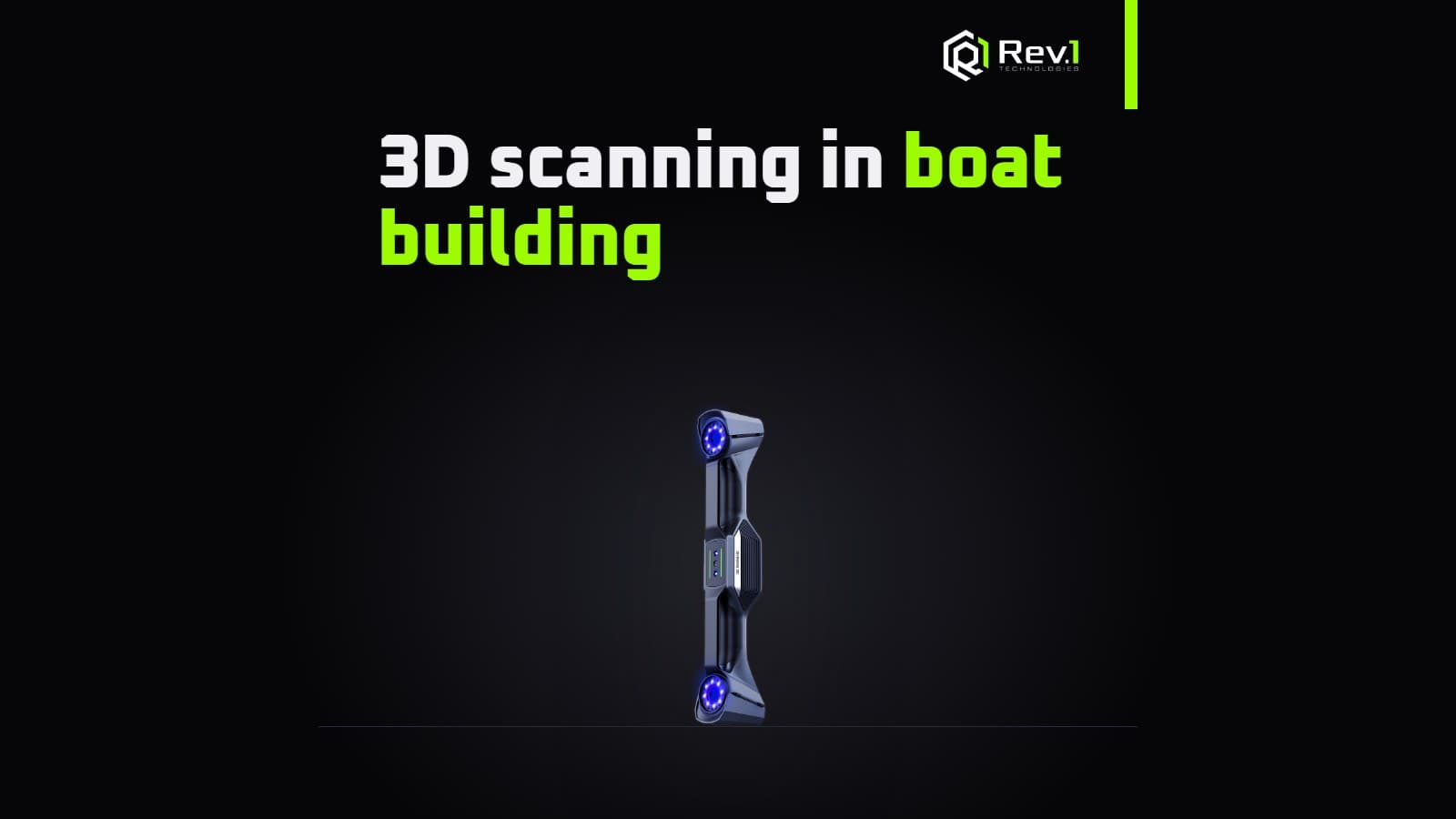
The FreeScan UE Nova trades a little base accuracy (0.072 mm) for reach. It captures a field of view up to 2.6 by 2.2 m at up to 2.6 m standoff, with near, standard and far ranges, and works on normal, black and reflective surfaces indoors and outdoors. Customers use it on ship hulls, wind turbine blades, rail vehicles and mining equipment, where the part is the size of a room and the alternative is a laser tracker and a crew.
Five questions that pick the right model
- What is your largest part? Under a meter: Combo, Trio or UE Pro2. One to three meters: Omni or Trak Nova. Bigger: UE Nova or Trak Nova with VPG.
- Can you put markers on it? If not, you need VPG (Trio, UE Pro2, Omni) or the Trak Nova tracker.
- Where does the scanning happen? At a bench next to a PC, tethered is fine. On the floor, at a supplier or in the field, go wireless.
- What are the surfaces? Dark, soft or shiny parts favor the IR modes on the Combo and Omni. Mirror-finished parts may still need a light coat of vanishing spray.
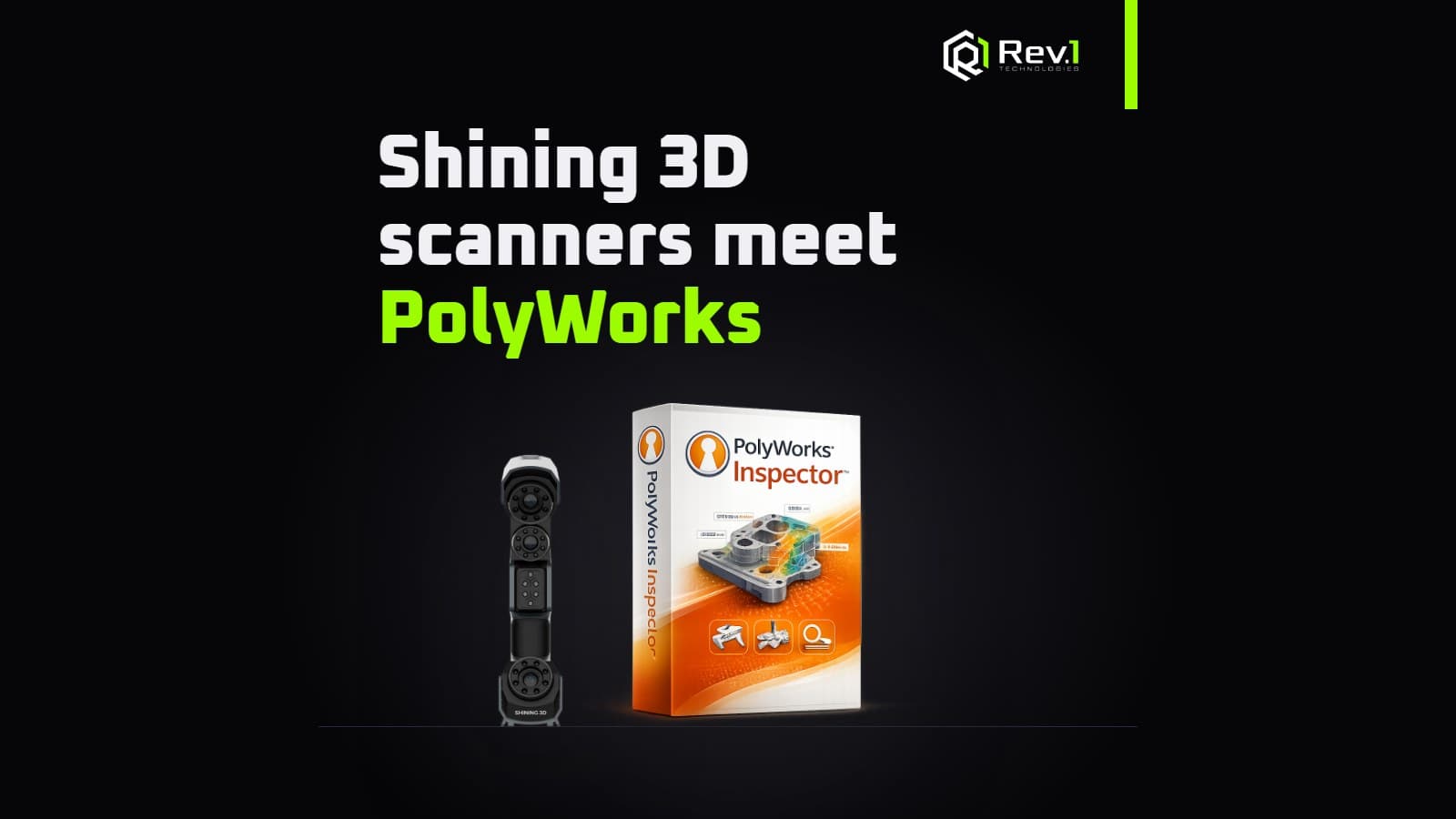
- What does the data feed? All FreeScan models export standard formats (STL, OBJ, PLY and more) into Geomagic Design X for reverse engineering and PolyWorks Inspector for inspection, so the scanner choice does not lock your software.
Try it on your part before you buy
Spec sheets are measured on reference artifacts. Your part is not a reference artifact. As an authorized Shining 3D partner, Rev1 Technologies will scan a sample part for you, or bring the scanner to your shop, so you can compare models on your own geometry and surfaces before committing. Every system we sell includes installation and hands-on training from our team in Auburn Hills, Michigan.
Request a demo or a sample scan and tell us your largest part, your tolerance and where it will be measured. We will tell you which FreeScan fits, and which one does not.
Ready to put this into practice?
From prototypes to production parts and metrology, our team in Auburn Hills can help you scope the right process and materials.