Lyten PA1205 3D Graphene™ Reinforced Nylon Filament
3D Graphene™ Reinforced Nylon Filament
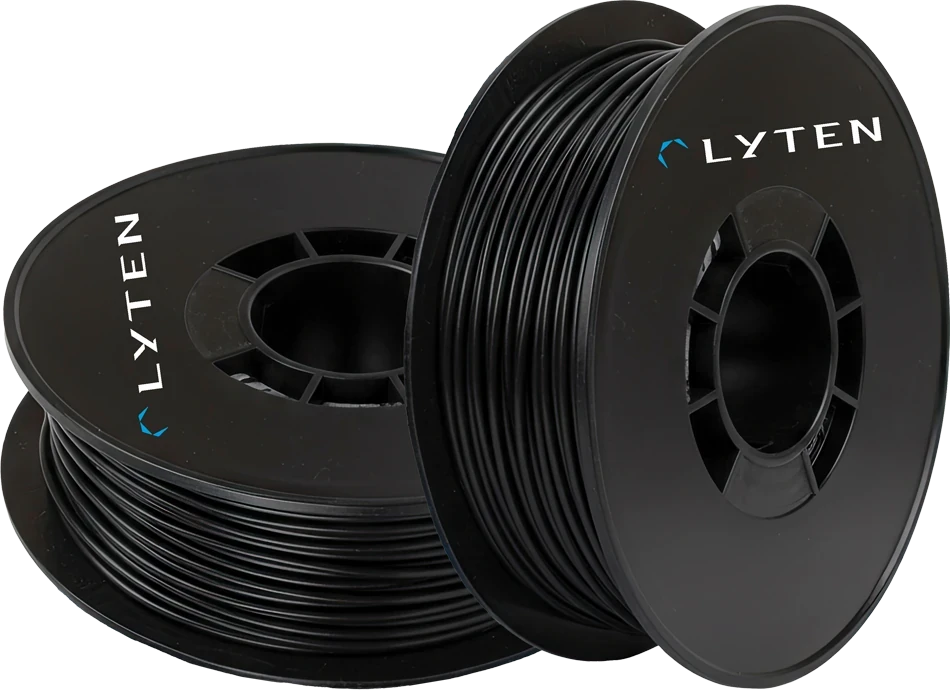
A Nylon 12 filament reinforced with Lyten 3D Graphene™ instead of relying on carbon fiber alone — built for the load-bearing parts that motorsports, aerospace, UAV, and robotics teams used to machine. Lyten’s data sheet puts it at 127 MPa XY tensile strength, 60 MPa between layers, and 162 °C heat deflection, at a density of just 1.08 g/cm³. Full specifications →
Single format: Black, 1 kg spool. Need several spools or a qualification sample for a program? Call (248) 707-2950 and we’ll quote it.
Supermaterial-reinforced nylon, backed by published test data.
Lyten publishes a full technical data sheet for PA1205: mechanical properties in both the XY and Z orientations, thermal data, and the exact print conditions used. Rev1 Technologies supplies it from Auburn Hills, Michigan, with materials support from people who print engineering nylons every day.

Graphene where other nylons use only carbon fiber.
Chopped carbon fiber makes nylon stiff in the plane it was printed in, but parts still tend to fail between layers. Lyten builds PA1205 on a Nylon 12 base reinforced with its own 3D Graphene™ supermaterial, tuned to raise strength in every direction — including the Z axis — while keeping the part light and tough. Lyten’s stated target is structural parts and functional prototypes that previously needed machined composites or metal.
Plug-and-play on hardware you already own.
No special machine required — Lyten designs PA1205 for consistent extrusion, fewer clogs, and good bed adhesion on high-performance FDM printers. Run it hot, keep the part fan off, and print fast.
Strength, stiffness, and toughness on the data sheet.
Dry, typical values from Lyten’s technical data sheet (575-00017 REV 03), measured on specimens printed at 100% infill in the stated orientation. Typical values are guides, not specifications.
ASTM D638 on printed specimens — Lyten reports roughly double a standard PA12-CF.
Layer-to-layer strength, where most printed parts fail first. Lyten reports +43% over standard PA12-CF.
Stiffness for brackets and housings that must not flex, with 8,700 MPa flexural modulus (ISO 178).
ISO 179 at 23 °C, XY. Lyten reports about 50% more impact resistance than standard PA12-CF.
122 °C at 1.8 MPa (ISO 75/B) — engine bays, under-hood mounts, battery housings.
ASTM D792. Lighter than typical carbon-fiber nylons, for weight-sensitive drone and race parts.
Where PA1205 Goes to Work
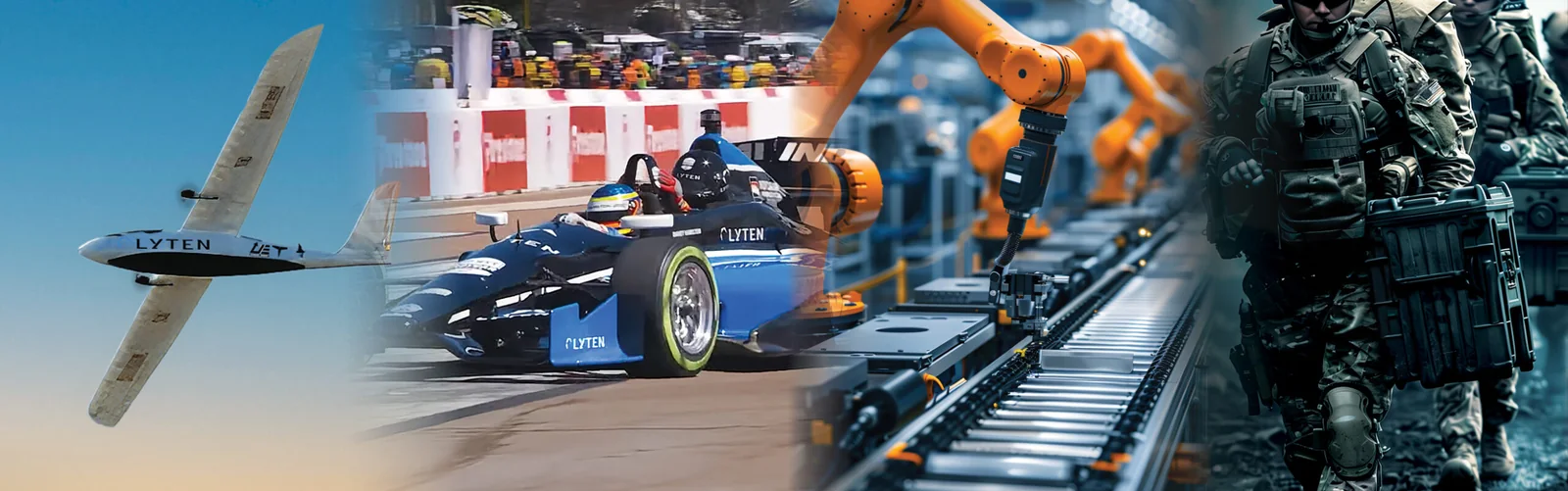
Aerospace, Motorsports, Autonomous Systems, Defense
Lyten engineers PA1205 for load-bearing parts in the markets that punish weight and heat: UAV airframes and battery housings, race-car brackets and ducting, robot end-effectors, and rugged field hardware.
Lyten’s recommended printing conditions.
From the PA1205 data sheet and Lyten’s print guide (575-00016 REV 01). Like every nylon, PA1205 is hygroscopic — drying before printing is not optional.
Through a 0.6 mm nozzle. As with any reinforced nylon, we recommend hardened steel to resist wear.
Smooth PEI sheet with glue stick or liquid glue — Lyten lists the adhesive as required.
Off for all layers except overhangs and bridges, to protect layer bonding.
Lyten reports roughly 20% faster printing than competing materials at comparable quality.
Dry the spool before use and print from a dry box for long jobs.
Use a brim on large prints, sharp corners, and parts close to the edge of the bed.
Strong parts that still look finished.
Lyten reports that PA1205 outperformed top competitors in blind surface-quality tests. These are Lyten’s own side-by-side close-ups of the top surface of a printed wall.
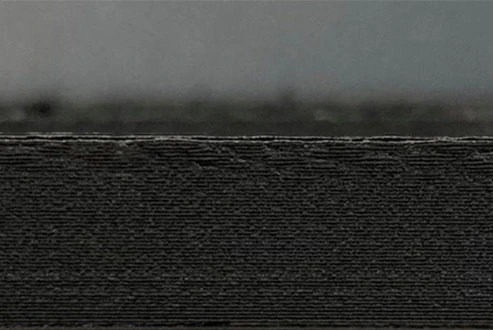
Even layers, clean top edge.
Fine detail and consistent extrusion at speed.
Lyten’s comparison print shows uniform layer lines and a flat, intact top surface. The graphene reinforcement lets Lyten use less carbon fiber, which helps both surface finish and layer adhesion.
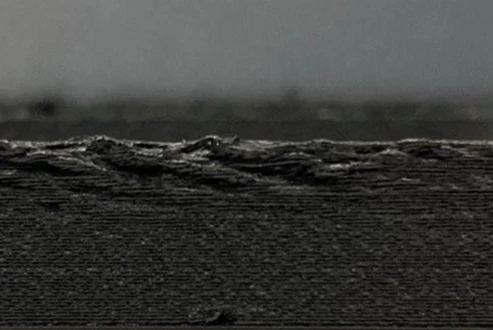
The same test in a competing filament.
Rough, wavy top surface on the comparison print.
Lyten shows the same geometry printed in a competing brand, which it does not name. We haven’t reproduced the test ourselves — ask us for a sample spool and judge it on your own printer.
PA1205 against a standard PA12-CF.
Lyten’s published figures next to the advantage Lyten reports over a standard carbon-fiber PA12. The comparison column is Lyten’s claim, not a Rev1 measurement.
| Lyten PA1205 (TDS REV 03) | Vs. standard PA12-CF (Lyten’s claim) | |
|---|---|---|
| XY tensile strength | 127 MPa | About +100% |
| Z tensile strength | 60 MPa | About +43% |
| Charpy notched impact | 44 kJ/m² | About +50% |
| Print speed | Up to 200 mm/s | About 20% faster |
| Reinforcement | Lyten 3D Graphene™ | Chopped carbon fiber |
| Best for | Load-bearing parts that fail between layers | Stiff parts loaded in-plane |
Comparative figures are Lyten’s published claims against an unnamed standard PA12-CF; confirm against your own testing. Lyten 3D Graphene is a trademark of Lyten, Inc.
Lyten PA1205 — Technical Data
RESOURCES
Datasheets & Print Support
Everything you need to qualify and print Lyten PA1205.
WHY REV1 TECH
Engineering Nylons, Supported From Michigan.
Rev1 Technologies supplies Lyten PA1205 from Auburn Hills, MI, with real process help for high-performance nylons.
We help you pick the right engineering nylon for the part, dial in settings, and keep spools flowing to your floor.
FAQ
Lyten PA1205 — Common Questions
What is Lyten 3D Graphene™?
Lyten’s proprietary three-dimensional graphene supermaterial. In PA1205 it reinforces a Nylon 12 base so parts gain strength in every direction, including between layers, while staying light.
How strong is it?
Lyten’s TDS lists 127 MPa tensile strength in XY and 60 MPa in Z (ASTM D638), with 9,260 MPa XY tensile modulus and 44 kJ/m² notched Charpy impact. Typical values, not specifications.
Do I need a hardened nozzle?
Lyten specifies a 0.6 mm nozzle at 270–300 °C. As with any reinforced nylon, we recommend hardened steel so the nozzle doesn’t wear.
Does it need to be dried?
Yes. Lyten recommends 70 °C for 10 hours. Nylon absorbs moisture from the air, so keep the spool in a dry box while printing.
What bed setup works?
A smooth PEI sheet at 100 °C with glue stick or liquid glue, which Lyten lists as required. Add a brim for large parts, sharp corners, and parts near the bed edge.
Should the part cooling fan be on?
No — Lyten recommends the part fan off for all layers except overhangs and bridges, which keeps layer bonding strong.
What colors and sizes are available?
Lyten supplies PA1205 in one format: Black, 1 kg spool. Graphene-reinforced nylon is inherently black, so there are no other color options.
How hot can parts get?
Heat deflection is 162 °C at 0.45 MPa and 122 °C at 1.8 MPa (ISO 75/B), so parts stay stiff in engine bays and battery enclosures.
Can I get help qualifying it for my part?
Yes. Tell us the part, load case, and printer, and we’ll help with settings and quote quantities. Use the quote form and we’ll reply within one business day.