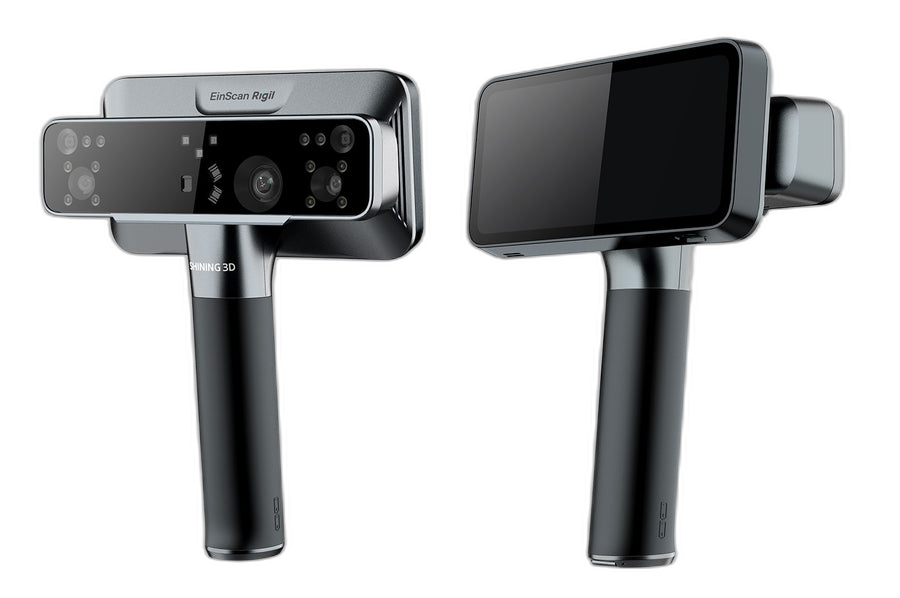
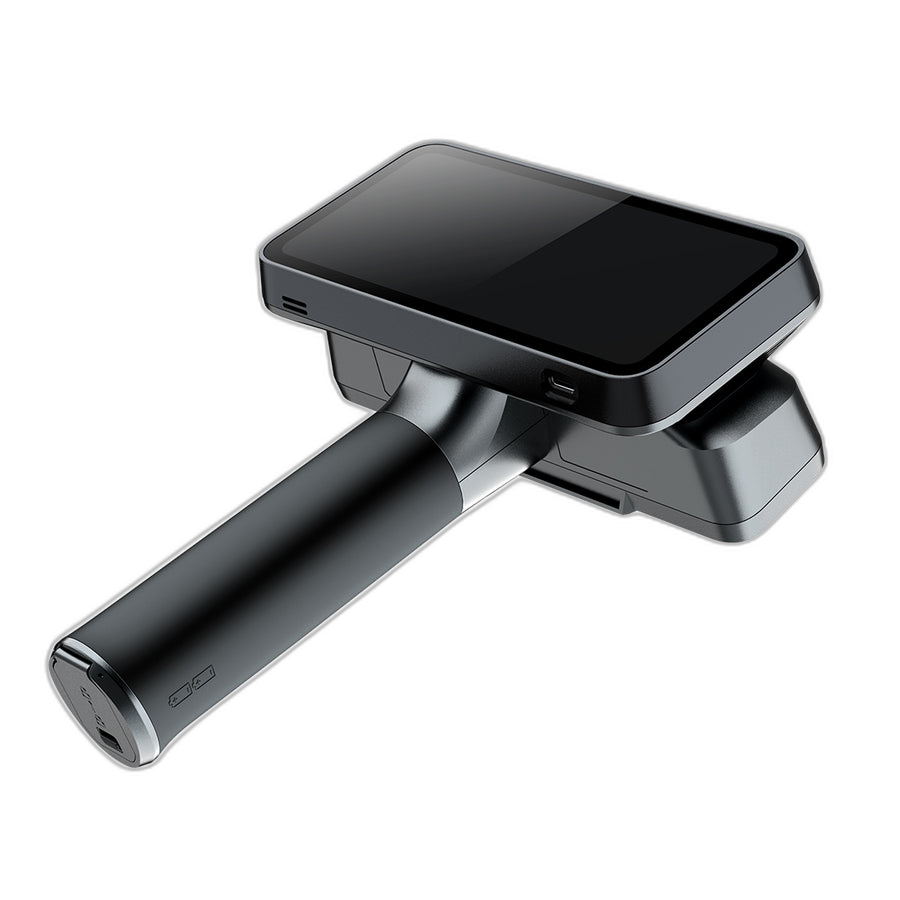
EinScan Rigil All-in-One Laser & IR 3D Scanner
All-in-One Laser & IR 3D Scanner
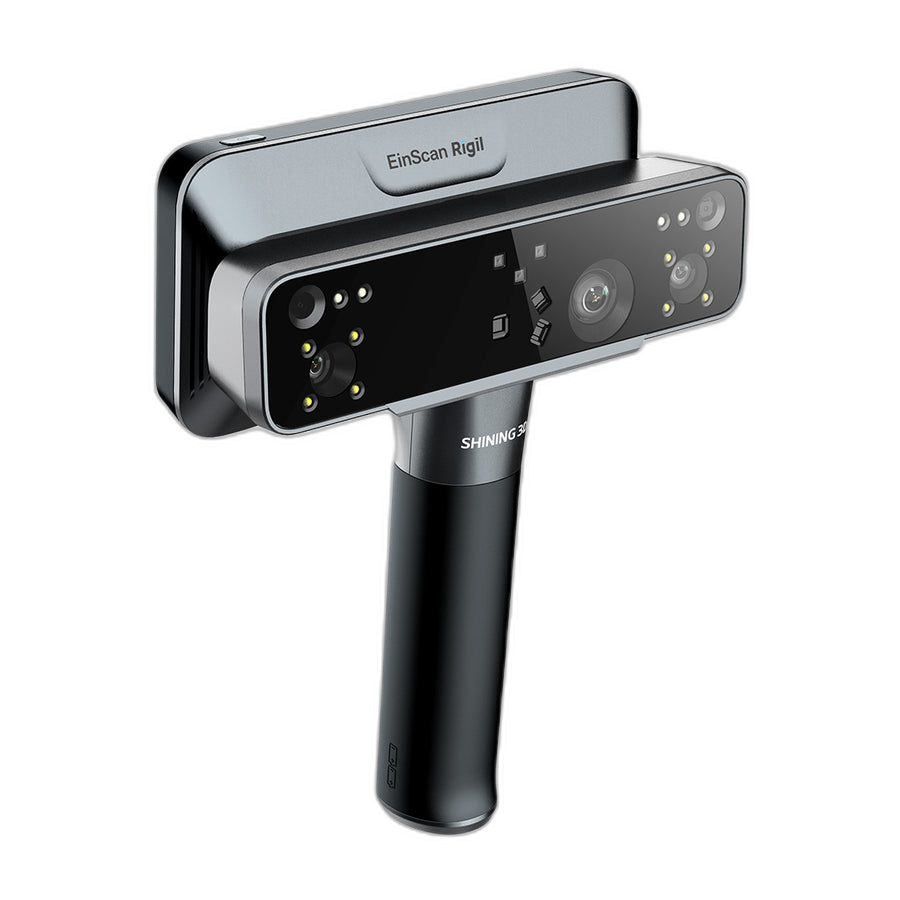
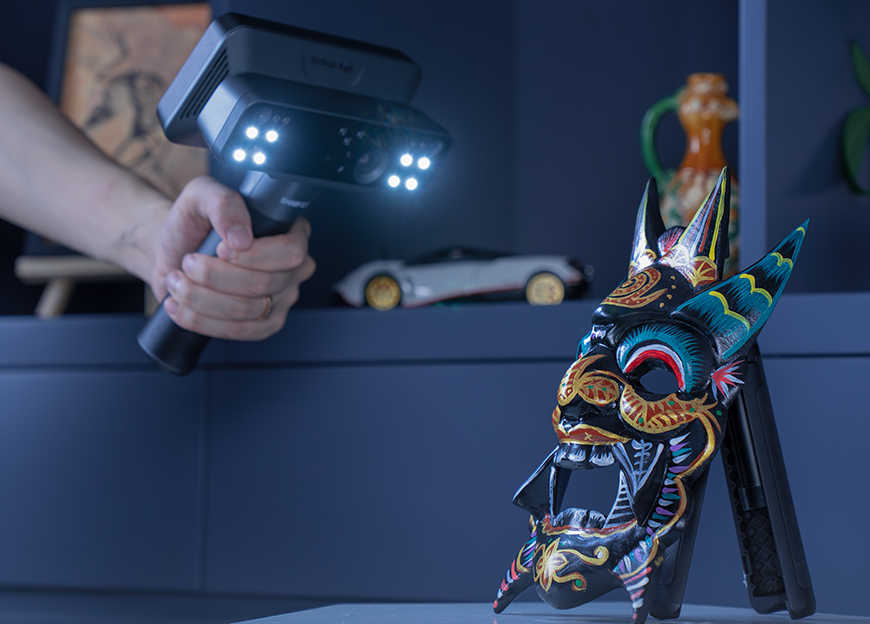
The EinScan Rigil is a professional all-in-one 3D scanner combining blue laser and IR VCSEL light sources in a single handheld device. Switch between Laser HD mode for 0.04 mm/m volumetric accuracy and IR Rapid mode for full-body scanning at up to 16 million points/second — without changing hardware or recalibrating. Three work modes (Standalone, Wireless PC, Wired PC) let your team scan in the field, on the bench, or in complex RF environments. iF Design Award 2026 winner. Full specifications →
An Authorized EinScan Reseller & Support Partner in the USA.
Rev1 Technologies is an authorized EinScan reseller backed by SHINING 3D. Application engineering, scan workflow setup, training, and software guidance are delivered from Auburn Hills, Michigan. Phone: (248) 707-2950.
Two Scan Technologies. One Scanner.
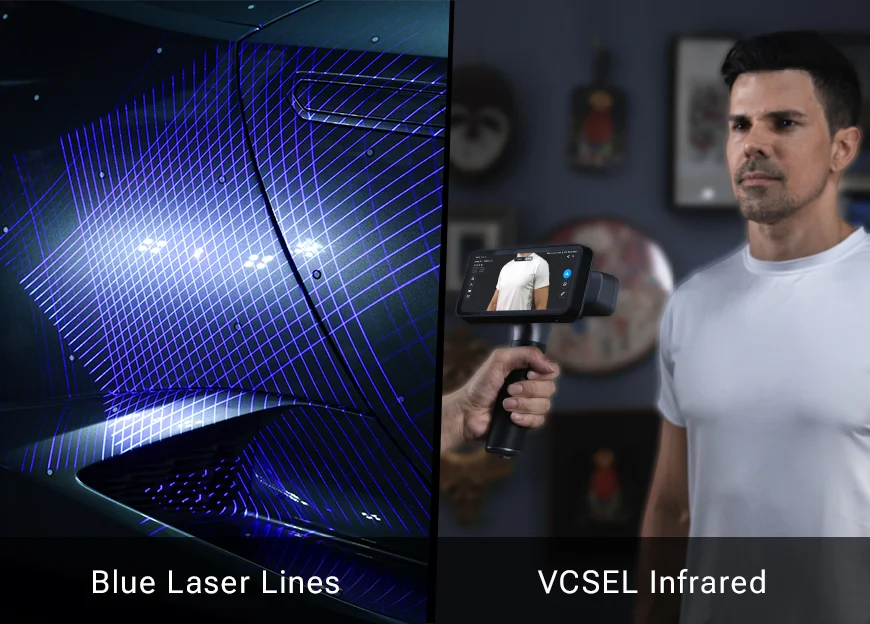
The EinScan Rigil integrates blue laser and IR VCSEL into a single handheld body — a dual-camera architecture that keeps both imaging systems optically independent so you can switch modes mid-project and merge the data without re-registration.
Laser HD — 0.04 mm/m Volumetric Accuracy
The blue laser camera group fires 25 crossed lines + 25 crossed lines for dense, high-precision point capture. Laser HD mode reaches 4.8 million points per second at 0.05 mm geometric resolution and 0.04 + 0.06 mm/m volumetric accuracy — ideal for tight-tolerance reverse engineering and inspection-ready mesh generation.
IR Rapid — 16 Million Points per Second
The IR VCSEL camera group unlocks full-body scanning rates up to 16 million points per second across a working range from 160 mm to 1,500 mm. IR Rapid mode handles large assemblies, automotive body panels, and human-scale objects where throughput matters more than sub-0.1 mm precision — capturing your full part envelope before switching to Laser HD for detail patches.
Dynamic Mode Switching — One Project, Both Engines
Unlike scanners that require two separate devices or a hardware swap, the Rigil lets you switch between Laser HD and IR Rapid during a single scan session. Both data streams merge into one project in EXScan Pro — no separate alignment, no duplicate registrations. Use IR Rapid for the first-pass body envelope, switch to Laser HD for feature-critical zones, and export a single unified mesh.
Marker-Free Laser Scanning at 0.04 mm/m
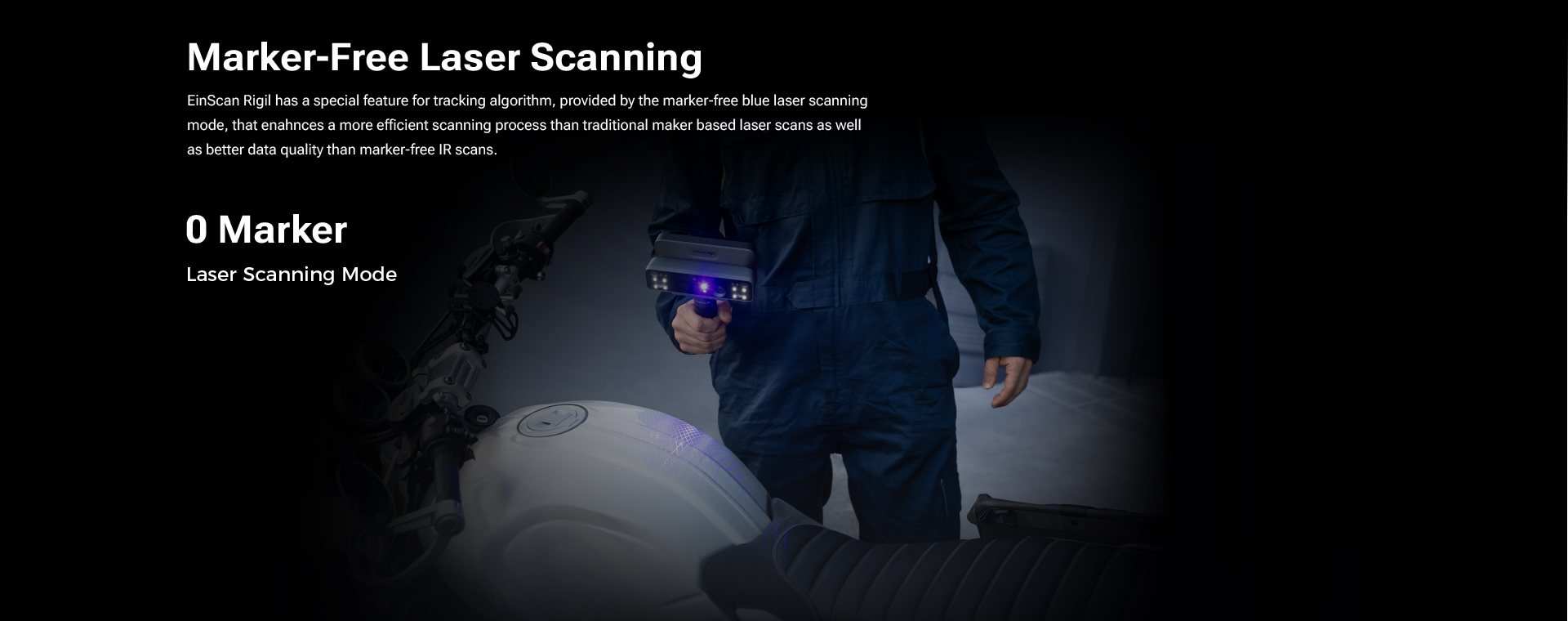
The Rigil's Hybrid Tracking algorithm unlocks marker-free scanning in blue laser mode — combining the positional accuracy of laser triangulation with the freedom of feature-based tracking. No targets, no spray, no consumables on most surfaces.
Marker-Free Laser Scanning
Traditional structured-light scanners require adhesive targets for high-accuracy laser scanning; the Rigil's Hybrid Tracking algorithm removes that requirement on most parts. The scanner tracks its own position using a blend of feature geometry and surface texture, achieving 0.04 + 0.06 mm/m volumetric accuracy without a single target dot — reducing prep time on large assemblies by 80% or more.
Four Alignment Modes — Adapt to Any Surface
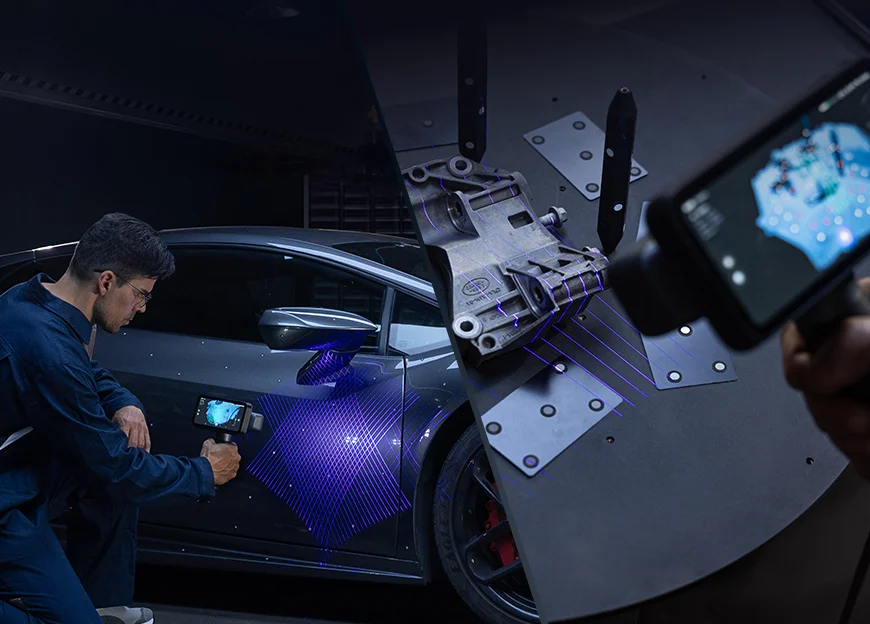
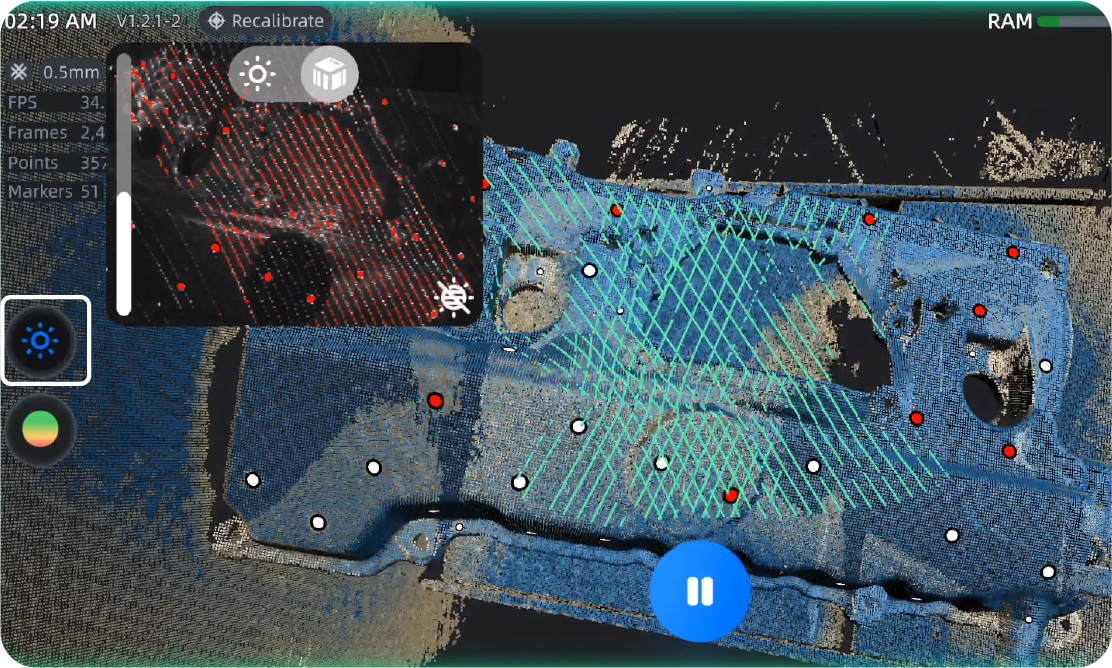
The Rigil ships four distinct alignment strategies: Global Markers (photogrammetric target field for highest accuracy), Markers (local target patches), Features (markerless on geometry-rich parts), and Texture (markerless on textured surfaces). Hybrid mode automatically blends the best available signals frame-by-frame — so the scanner handles smooth organic surfaces, shiny metals, and feature-sparse panels in a single workflow.
Multi-Project Alignment in Standalone Mode

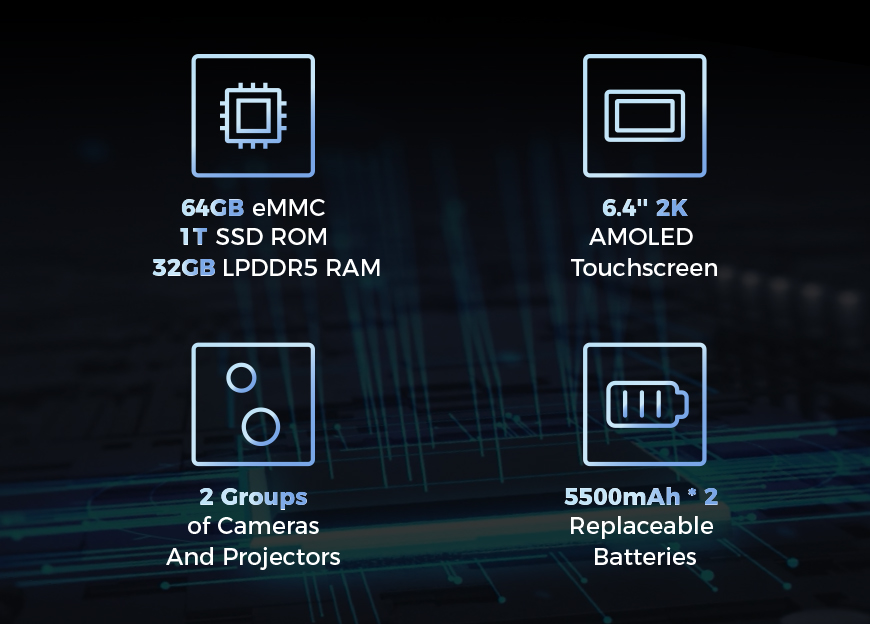
Rigil v1.2 adds multi-project alignment directly on the scanner's onboard display — combine scans from separate sessions without returning to a PC. Scan the front of a car door on Monday, the rear on Tuesday, merge them in the field on Wednesday. The scanner's 32 GB LPDDR5 + 1 TB SSD carries large projects without offloading, and the 6.4-inch 2K AMOLED display gives you a clear preview of registration quality before you commit the merge.
Three Work Modes — Field, Lab, and Everything Between
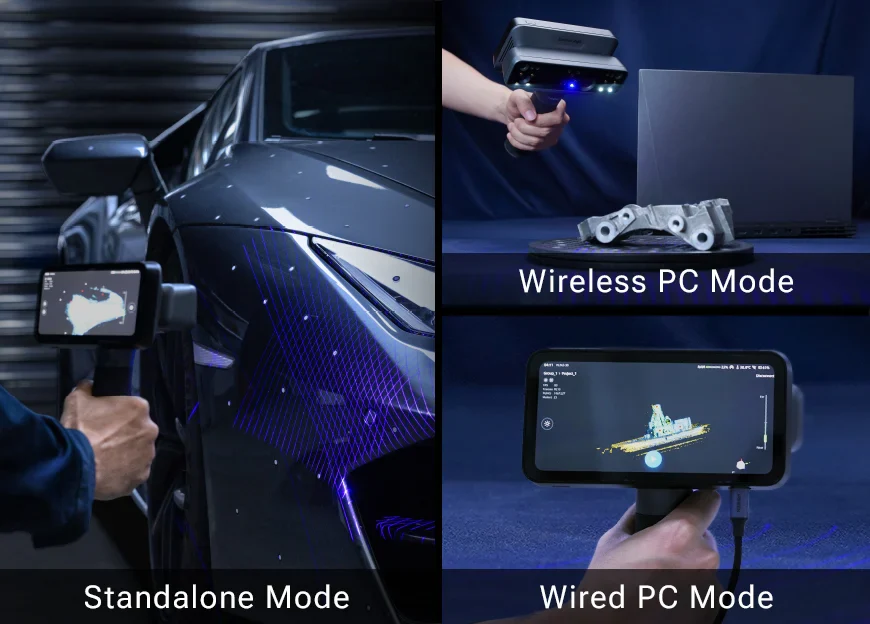
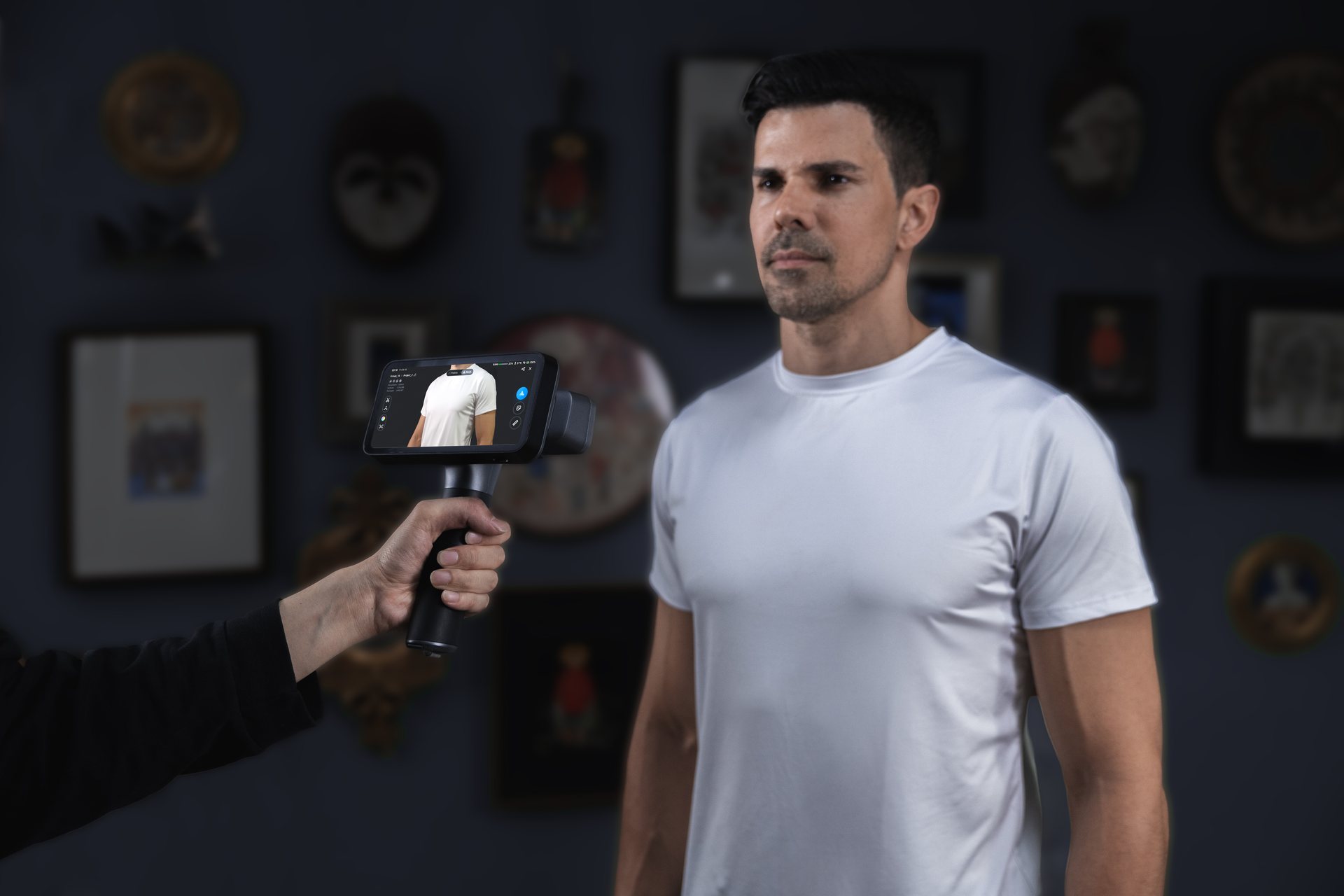
The Rigil is the first EinScan with a fully independent onboard computer — scan, process, and export without a tethered PC. Switch to PC modes when you need maximum processing power or tight network integration.
Standalone — Scan Without a PC
In Standalone mode the Rigil's onboard 32 GB RAM computer handles real-time point-cloud processing while you scan. Use the 6.4-inch 2K AMOLED touchscreen to review coverage, adjust settings, and export OBJ/STL/PLY directly to the 1 TB SSD — no laptop, no cable, no desk. The dual 5,500 mAh hot-swap battery system provides continuous runtime: swap one battery while the other powers the scanner.
Wireless PC — Heavy Processing Without the Cable
Wireless PC mode streams compressed scan data over Wi-Fi 6 to a connected workstation for GPU-accelerated processing. Keep the scanner light in your hand while EXScan Pro on the PC handles dense global registration and mesh fusion. Wi-Fi 6 throughput handles large automotive-scale projects without the latency of older wireless standards. The Rigil also supports wireless screen casting to a secondary monitor — useful for multi-person review sessions.
Scene-Adaptive Scanning — Handles Dark & Shiny Metals
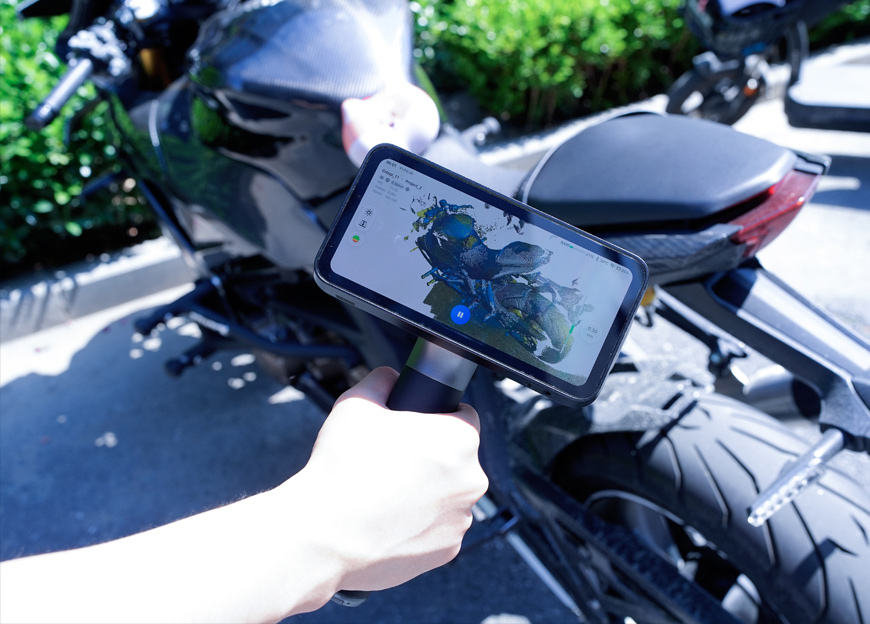
Rigil v1.2 introduces scene-adaptive exposure: the scanner analyzes surface reflectivity frame-by-frame and adjusts laser intensity automatically. Dark matte plastics, polished aluminum, and carbon fiber composite — all captured in one pass without anti-glare spray. The outdoor ambient-light tolerance means the Rigil performs in direct sunlight, eliminating shade-tent setups for exterior automotive scans or on-site architectural surveys.
Up to 16 Million Points per Second — Clean First-Pass Mesh
The Rigil's IR Rapid mode captures full-body scan envelopes at production speed. Onboard high-efficiency noise reduction processes points in real time, delivering a cleaner mesh with less post-processing in Geomagic or Wrap.
High-Efficiency Noise Reduction — Onboard, Real Time
Raw point clouds at 16 million points per second accumulate noise — especially on curved, shiny, or fine-textured surfaces. The Rigil v1.2 onboard processor runs high-efficiency noise reduction in real time, flagging and filtering outlier points before they reach the registration step. The result is a cleaner first-pass mesh that requires less post-processing in Geomagic Design X or Wrap — reducing scan-to-CAD cycle time on complex organic parts.
Scan Rewind & Resume — No Lost Progress
A missed capture or tracking-loss event no longer means starting over. EXScan Rigil's Scan Rewind lets you step back through the scan timeline to the last good frame and resume from there — preserving all aligned data captured before the interruption. Combined with Resume Edited Data Scanning, you can re-open a partially processed scan, remove problem regions, and re-scan just those areas without breaking the existing registration.
0.05 mm Geometric Resolution — Capture Every Feature
In Laser HD mode the Rigil resolves features down to 0.05 mm — threads, knurling, micro-undercuts, and thin wall edges that define product fit and function. The 25+25 crossed laser lines + 7 parallel lines pattern ensures dense, evenly distributed coverage even on curved and freeform surfaces.
Complex Machined Parts — Threads & Bores at 0.05 mm
Machined components with tight tolerances demand the highest resolution the Rigil can deliver. In Laser HD mode the 25+25 crossed line pattern generates a dense point cloud across convex and concave geometry — capturing M3 thread profiles, counter-bore edges, and precision fits with enough fidelity to drive a Geomagic Design X deviation analysis or a CATIA V5 parametric rebuild directly from the mesh.
Organic & Heritage Shapes — Surface Texture at Sub-Millimeter
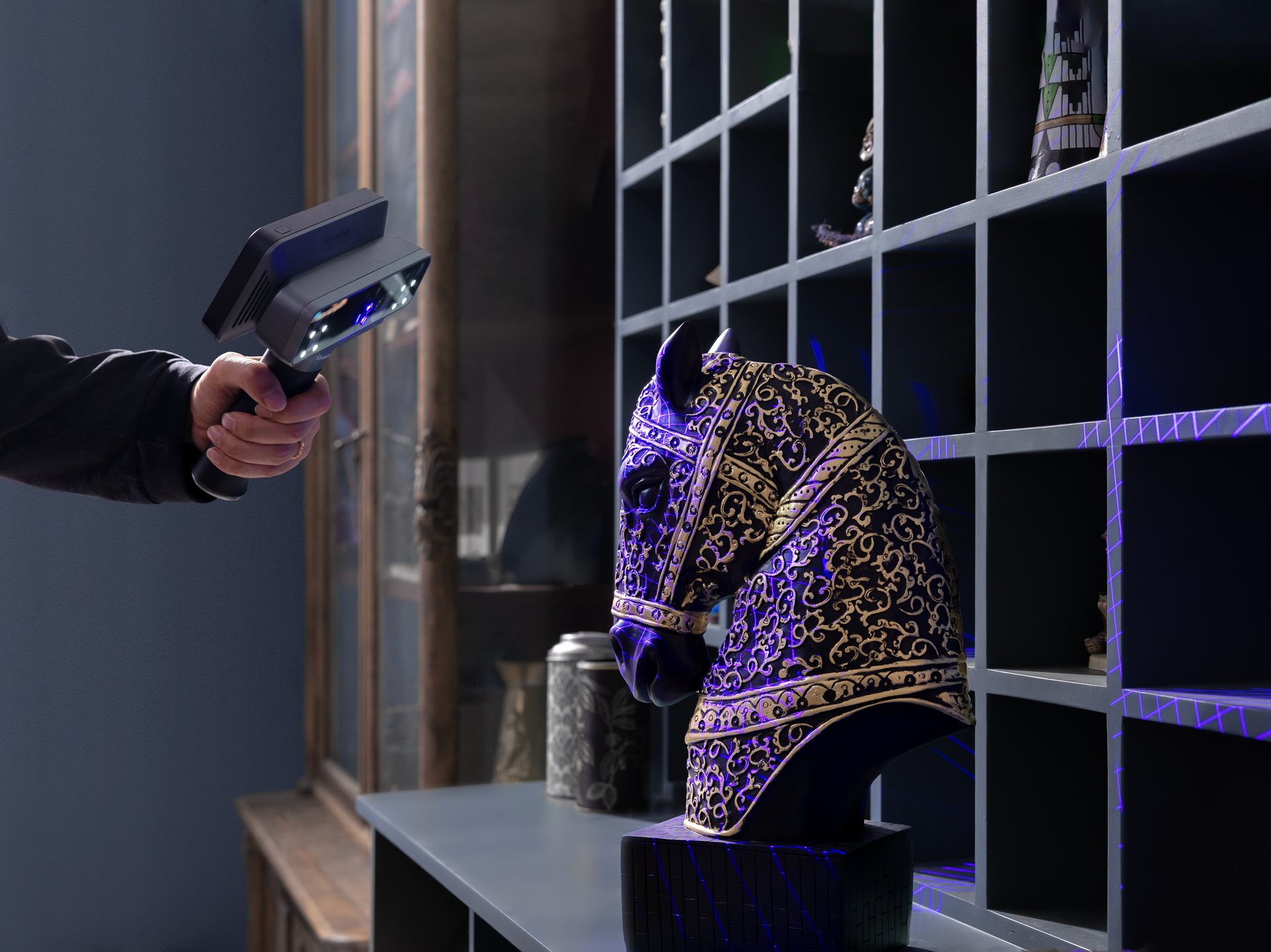
The Rigil's Laser HD mode captures organic freeform geometry with the same 0.05 mm resolution floor regardless of curvature. Heritage documentation, prosthetic socket scanning, and organic product design all benefit from the dense, evenly distributed point cloud the blue laser produces — and the Texture mode alignment means no adhesive targets mar the artifact surface during capture.
Interactive 3D — Honda Motorcycle, Markerless Laser
This Sketchfab model shows an actual Honda motorcycle captured with the EinScan Rigil using markerless blue laser mode — no adhesive targets on the painted fairing or chrome frame. Rotate and zoom to inspect the mesh density across the engine case, frame welds, and bodywork. The scan was completed in a single session using the Rigil's Hybrid Tracking algorithm. Click to load the interactive viewer.
5MP Full-Color Texture — Photorealistic Mesh Capture
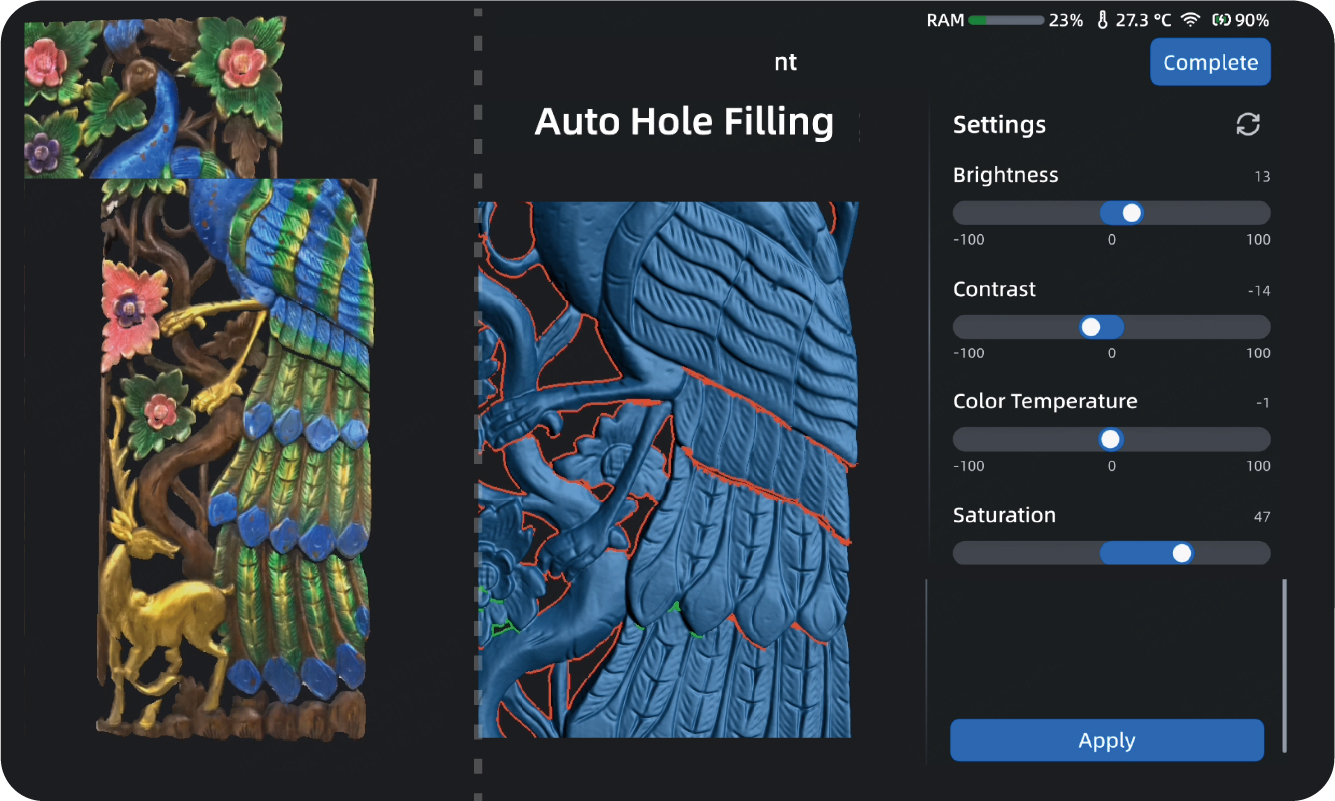
The Rigil's 5MP HD camera captures color texture simultaneous with geometry — producing color-mapped meshes for digital twin documentation, visualization, and heritage preservation without a separate photogrammetry pass.
Simultaneous Geometry + Color — One Pass
Many scan workflows require a separate color pass — a photogrammetry rig, studio lighting, and a second alignment step. The Rigil's 5MP camera captures texture in the same pass as the geometry, registered automatically. Exports include color-mapped OBJ (with MTL) and PLY for use in Blender, 3ds Max, Unity, or any visualization pipeline. Ideal for product design reviews, ergonomic part documentation, and cultural heritage digitization.
High-Fidelity Color Reproduction
The 5MP color camera resolves paint gradients, logo silk-screens, and material boundaries clearly enough to support brand-compliance documentation and litigation-support deliverables. Color data is stored per-vertex or as a UV-mapped texture atlas depending on export format — compatible with the full Geomagic and SOLIDWORKS Visualize pipeline. For prosthetics and medical applications, the color map supports patient communication and cast-from-scan fabrication workflows.
Interactive 3D — BMW Motorcycle, IR Rapid Mode
This Sketchfab model captures a complete BMW motorcycle using the Rigil's IR Rapid mode — demonstrating full-body scan coverage at scale without marker targets. Inspect the frame tube mesh density, fairing curvature, and wheel spoke geometry. IR Rapid's 16 million points per second let the operator complete the full motorcycle envelope in a single session, then transition to Laser HD for engine case features. Click to load and explore.
From Scan to CAD — Geomagic Design X + SOLIDWORKS
The Rigil's 0.04 mm/m accuracy in Laser HD mode is within the tolerance budget for most reverse engineering projects — producing mesh data clean enough to drive direct NURBS surface fitting or semi-automatic solid reconstruction in Geomagic Design X.
Automotive Reverse Engineering — Panels, Brackets & Assemblies
Automotive RE shops use the Rigil for door skins, bumper fascias, seat foam, and structural brackets — capturing the full assembly in IR Rapid, then refining mounting feature geometry in Laser HD. The merged mesh imports directly into Geomagic Design X for sketch-to-solid construction or Geomagic Wrap for organic surface patching. EXScan Pro exports SOLIDWORKS-compatible parasolid and STEP files when using Design X as a bridge.
Interactive 3D — BMW E34 Front Section, Markerless Laser
This Sketchfab model shows the front section of a BMW E34 captured with EinScan Rigil's markerless blue laser mode. The hood, headlight housings, grille, and bumper assembly are captured in a single registration — a workflow that previously required a large-format structured-light system and a full marker field. Inspect the mesh density at the character line crease and headlight surround. Click to load and rotate.
EXScan Pro Software — Cutting Plane, Mirror & Noise Tools
EXScan Rigil ships with EXScan Pro, which adds Cutting Plane (trim mesh at a defined section), Mirror (complete symmetric parts from a half-scan), Flip Normal (fix inverted polygon normals in one click), and Remove Small Floating Parts (clean orphan clusters without manual selection). The software also handles X-Y-Z System Alignment and Model Measurement directly in the scan environment — reducing the number of third-party tools in the RE workflow.
From Automotive to Heritage — Where the Rigil Works
The EinScan Rigil's dual light source and three work modes cover an unusually broad application range — from tight-tolerance precision manufacturing to on-site architectural surveys and patient-specific medical fabrication.
Automotive & Transportation
Automotive RE and inspection is the Rigil's strongest commercial use case. Body panel reverse engineering, bumper fascia redesign, seat foam scanning for ergonomic analysis, bracket digitization for NVH studies — all captured without moving the vehicle off the shop floor. The Rigil's markerless laser and IR Rapid modes work directly on painted exterior surfaces, eliminating prep sprays and target installation on vehicle fleets.
Industrial Manufacturing & Quality
Precision manufacturing environments use the Rigil to digitize legacy parts with no CAD, create first-article inspection meshes, and document tooling wear over production runs. The Laser HD mode's 0.04 mm/m volumetric accuracy covers most inspection-adjacent applications where CMM-level traceability is not required. Combined with Geomagic Control X, the Rigil output supports color-mapped deviation analysis and GD&T reporting against nominal CAD.
Medical, Prosthetics & Cultural Heritage
The Rigil's markerless operation and full-color texture capture make it ideal for patient-facing workflows where adhesive targets are unacceptable. Prosthetic socket scanning, orthotics fitting, and stump documentation benefit from Texture mode alignment (no markers) and the 5MP color capture (skin tone documentation). Heritage institutions use the Rigil for artifact digitization — the compact form factor lets operators scan in cases and vitrines without moving the object, and the IR Rapid range covers sculptures from a safe working distance.
What the Rigil Captures — Real-World Scan Gallery
Every mesh below was captured with an EinScan Rigil in real-world conditions. Rotate each model to judge surface quality, mesh density, and feature definition for yourself — no vendor renders.
Machined & Precision Parts
Laser HD mode captures threaded bosses, precision bores, and thin-wall edges at 0.05 mm resolution. These scan results demonstrate the mesh density available for direct import into Geomagic Design X or SolidWorks 2024 reverse engineering workflows. No smoothing or artificial mesh refinement applied — raw EXScan Pro output.
Complex Curved Assemblies
IR Rapid mode at 16 million points per second handles full assemblies and large-format parts that would overwhelm a single-mode scanner's throughput. The multi-project alignment feature lets operators break a large assembly into sessions and merge them into one watertight mesh — even when scanning across multiple days or site visits.
EinScan Rigil vs. Professional Handheld Scanners
The Rigil competes against single-technology handheld scanners in the $4,000–$8,000 price range. Its dual-source architecture sets it apart on versatility — most alternatives force a choice between laser accuracy and IR speed at purchase.
| Feature | EinScan Rigil $4,999 |
Artec Leo 2 ~$7,980/yr lease |
Revopoint RANGE 3 ~$1,499 |
|---|---|---|---|
| Light Source | Blue Laser + IR VCSEL | Structured light (white) | IR structured light |
| Volumetric Accuracy | 0.04 + 0.06 mm/m (Laser HD) | 0.1 mm | 0.1 + 0.3 mm/m |
| Min Resolution | 0.05 mm | 0.1 mm | 0.2 mm |
| Peak Point Rate | 16M pts/s (IR Rapid) | Up to 3M pts/s | 3M pts/s |
| Marker-Free Laser | Yes (Hybrid Tracking) | N/A (no laser) | Partial |
| Standalone Mode | Yes (onboard 32 GB, 1 TB SSD) | Yes (onboard Wi-Fi) | No |
| Color Camera | 5MP HD | 4MP | 12MP (photogrammetry) |
| Wireless | Wi-Fi 6 | Wi-Fi 5 | USB / Wi-Fi |
| Native Software | EXScan Pro (included) | Artec Studio (subscription) | Revo Scan 5 |
| Max Working Dist. | 1,500 mm (IR Rapid) | 700 mm | 3,000 mm |
| iF Design Award | 2026 | — | — |
EinScan Rigil Technical Data
RESOURCES
Downloads & Technical Support
Everything you need to evaluate and deploy your EinScan Rigil with confidence.
WHY REV1 TECH
Authorized EinScan Reseller. 3D Scanning & RE Specialists.
Rev1 Technologies is an authorized EinScan reseller headquartered in Auburn Hills, MI, with direct expertise in 3D scanning, reverse engineering, and inspection workflows.
Rev1 Technologies serves designers, engineers, and manufacturers across the USA. We don’t just ship boxes — we set up your scan-to-CAD pipeline, train your team, and support you so your EinScan Rigil delivers from day one. Call us at (248) 707-2950.
FAQ
EinScan Rigil — Frequently Asked Questions
Laser HD mode uses the Rigil's blue laser camera group — 25 crossed lines + 25 crossed lines + 7 parallel lines — to achieve 0.05 mm geometric resolution and 0.04 + 0.06 mm/m volumetric accuracy at up to 4.8 million points per second. It is optimized for precision parts where reverse engineering or inspection-quality data is required, over a working range of 170–550 mm.
IR Rapid mode switches to the VCSEL infrared camera group, reaching up to 16 million points per second across a working range of 160–1,500 mm. Resolution drops to 0.2 mm and volumetric accuracy to 0.1 + 0.3 mm/m — suitable for full-body scanning, large assemblies, and human-scale objects where throughput matters more than sub-0.1 mm precision. You can switch modes mid-scan and merge both data streams in a single EXScan Pro project.
Not on most surfaces. The Rigil's Hybrid Tracking algorithm supports four alignment modes: Global Markers (photogrammetric target field for highest global accuracy), local Markers, Features (marker-free on geometry-rich surfaces), and Texture (marker-free on textured surfaces). In hybrid mode the scanner automatically blends the best available tracking signal frame by frame.
On smooth, low-texture surfaces (flat painted panels, bare metal sheets) the Features and Texture modes may lose tracking — in those cases a sparse local marker field restores registration. Rev1 can advise which mode suits your specific parts before purchase.
Yes. Standalone mode uses the Rigil's onboard 32 GB LPDDR5 computer to process point clouds in real time. The 6.4-inch 2K AMOLED touchscreen lets you monitor coverage, adjust settings, and review alignment quality without a laptop. Completed scans export to the built-in 1 TB SSD in OBJ, STL, or PLY format for transfer via USB-C or Wi-Fi 6.
For large or complex projects where GPU-accelerated global registration is preferred, Wireless PC mode streams compressed data to EXScan Pro on a connected workstation over Wi-Fi 6 while keeping the scanner cable-free in your hand. Wired PC mode is available for high-throughput environments where Wi-Fi reliability is a concern.
The Rigil ships with EXScan Pro — SHINING 3D's scan processing application that handles alignment, mesh fusion, noise reduction, color texture mapping, and export. EXScan Rigil adds Cutting Plane, Mirror, Flip Normal, and Remove Small Floating Parts tools specific to the Rigil workflow.
For reverse engineering, EXScan Pro meshes import directly into Geomagic Design X (parametric RE) or Geomagic Wrap (organic surface patching). From Design X, SOLIDWORKS, CATIA V5, NX, and Creo models are generated as first-class parametric parts. For inspection, Geomagic Control X supports color-mapped deviation analysis and GD&T reporting against nominal CAD from the same mesh output.
The EinScan Rigil Lite uses a reduced blue laser line count — 17 crossed lines + 17 crossed lines — compared to the Rigil's 25 + 25, which reduces point density in Laser HD mode. Onboard RAM drops from 32 GB LPDDR5 to 24 GB, and storage from 64 GB eMMC + 1 TB SSD to 512 GB ROM. Laser HD accuracy (0.04 + 0.06 mm/m) and IR Rapid speed (16M pts/s) are the same.
The Lite is suited for workflows where full-body IR Rapid coverage is the primary use case and the highest-density laser detail is a secondary need. Rev1 recommends the standard Rigil for engineering and RE environments where Laser HD point density is routinely needed.
The Rigil v1.2 introduces scene-adaptive exposure — the scanner analyzes surface reflectivity per frame and adjusts laser output intensity automatically. Dark matte plastics, carbon fiber, and anodized aluminum are captured without anti-glare spray in most conditions. Highly specular surfaces (polished chrome, bare mirror-finish stainless) may still require a light scan powder or matte spray in some areas, but the threshold is significantly higher than first-generation structured-light scanners.
The outdoor ambient light tolerance also allows scanning in direct sunlight — useful for exterior automotive work, on-site architectural surveys, and field digitization projects where setting up shade tents is impractical.
The Rigil uses dual 5,500 mAh batteries in a hot-swap configuration — one powers the scanner while the other is removed and replaced. This means continuous runtime without powering down or interrupting a scan session. Battery life per charge varies by scan mode and processing load; SHINING 3D has not published a specific hour figure, but the hot-swap design eliminates the single-battery runtime limitation that affects competing standalone scanners.
Spare batteries are available through Rev1 as accessories. Contact Rev1 for current pricing and lead time on spare battery packs for the Rigil.
Yes. The Laser Class II designation means the Rigil is eye-safe for operator use without protective eyewear in normal operating conditions, and the markerless capture modes mean no adhesive targets need contact with a patient. Prosthetic and orthotic workflows — stump scanning, socket digitization, dynamic foot scanning — benefit from the Texture alignment mode (no markers on skin), the 5MP color camera (skin-tone documentation), and the portable standalone operation.
Rev1 can connect you with prosthetics-focused case studies and workflow documentation. The EinScan Medixa (a sibling product) is purpose-built for clinical environments; contact Rev1 if a dedicated medical scanner is a better fit for your regulatory requirements.
EXScan Pro exports: OBJ (with or without color texture MTL), STL, PLY (color per-vertex), ASC (point cloud), 3MF, and P3 (SHINING 3D's proprietary project format for re-opening in EXScan). Color-mapped exports in OBJ+MTL and PLY are compatible with Blender, Geomagic, SolidWorks Visualize, Unreal Engine, and standard PLY import pipelines in Python and MATLAB.
Geomagic Design X and Wrap can receive EXScan meshes directly through the SHINING 3D bridge plugin, which also imports P3 project files for iterative refinement without re-exporting.
Yes. Rev1 offers two pre-purchase paths: (1) a free sample scan — ship us your part and we'll return the OBJ/STL mesh captured on a Rigil with the settings appropriate for your application, so you can import it into your CAD tools and judge the quality yourself before committing; (2) an in-person demo at our Auburn Hills, MI facility or a scheduled on-site visit where we scan your actual parts under your conditions.
Call or use the quote form to schedule either option. Rev1 validates application fit — we confirm the Rigil is the right scanner for your workflow before the purchase, not after. Phone: (248) 707-2950.