Bambu Lab P1S Enclosed, Filtered, ABS-Ready CoreXY Speed
Enclosed, Filtered, ABS-Ready CoreXY Speed
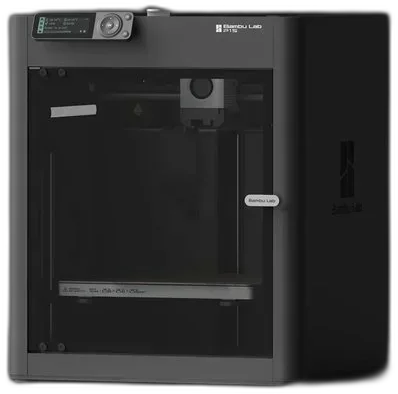
The Bambu Lab P1S is the fully enclosed member of the P1 series — the same high-speed CoreXY motion and 300°C all-metal hotend as before, now wrapped in a sealed chamber with an activated-carbon filter and closed-loop cooling fans. That enclosure is what unlocks ABS, ASA and other warp-prone, odor-prone materials the open-frame machines struggle with. Fast, fully assembled, AMS-ready for 16-color printing, and quiet enough for an office or classroom. Full specifications →
In stock in the USA — ships from Rev1. Need help choosing between the P1S, the X1-Carbon, and AMS configurations? Call (248) 707-2950.
Genuine Bambu Lab Hardware, Supplied & Supported in the USA.
Rev1 Technologies supplies genuine Bambu Lab printers and filament to makers, schools and engineering teams across the United States. Setup guidance, material selection, Klarna financing, and US-based phone and video support are delivered from Auburn Hills, Michigan.


CoreXY speed, now with a chamber that earns its keep.
The P1S is what most people should buy when they want fast, reliable Bambu printing and the ability to run engineering materials. It keeps the P1 series’ high-speed CoreXY motion, 300°C all-metal hotend and automatic calibration, and adds the one thing the open-frame machines lacked: a fully enclosed, filtered chamber. That sealed, temperature-stable environment is what lets ABS, ASA and other warp-prone materials print cleanly without cracking, while the activated-carbon filter handles the odor those materials give off. Fully assembled, app-connected, and AMS-ready for 16-color work, the P1S hits the sweet spot between the open-frame entry models and the flagship X1-Carbon. Here is what it brings.
A fully enclosed chamber with an activated-carbon filter and closed-loop cooling fans — stable heat for ABS and ASA, with odor contained.
Flagship-class CoreXY motion at 500 mm/s and 20,000 mm/s², kept clean by vibration compensation and pressure advance.
A 300°C all-metal hotend with a direct-drive extruder runs PLA, PETG, TPU, ABS, ASA, PC and PA — the full everyday-to-engineering range.
Add the AMS for automatic multi-color and multi-material printing — up to four units for 16 colors with RFID recognition.
Automatic bed leveling, vibration compensation and pressure advance dial the printer in for you — reliable prints with no fuss.
Genuine Bambu Lab hardware with US warehouse stock, fully-assembled delivery, and setup and materials help from Rev1.
The chamber that unlocks ABS and ASA.
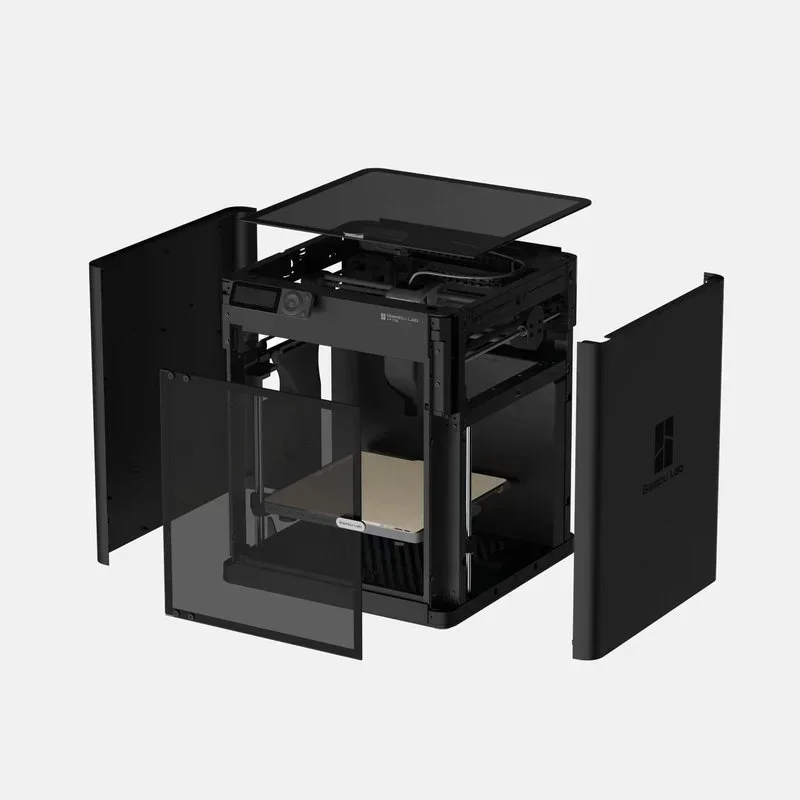
Warp-prone materials, printed clean.
The P1S wraps the CoreXY platform in a fully enclosed chamber with glass panels, an activated-carbon filter, and a set of closed-loop fans — a hotend fan, part-cooling fan, chamber regulator and control-board fan that work together to hold a stable internal temperature.
ABS and ASA are the materials hobbyists most often want and most often fail at, because they crack and lift the moment a draft cools one corner faster than another. An enclosure fixes that: the sealed chamber traps process heat and keeps the whole build warm and even, so big ABS parts stay bonded layer-to-layer instead of splitting. The activated-carbon filter addresses the other half of the problem — the odor and particulates these styrenic materials emit — making the P1S far more pleasant to run in a shared office, classroom or home than an open machine. The closed-loop cooling keeps the electronics and the print itself in their happy zones at high speed. It is the single upgrade that turns a fast PLA printer into one you can trust with real engineering materials.
A 300°C all-metal hotend with direct drive.
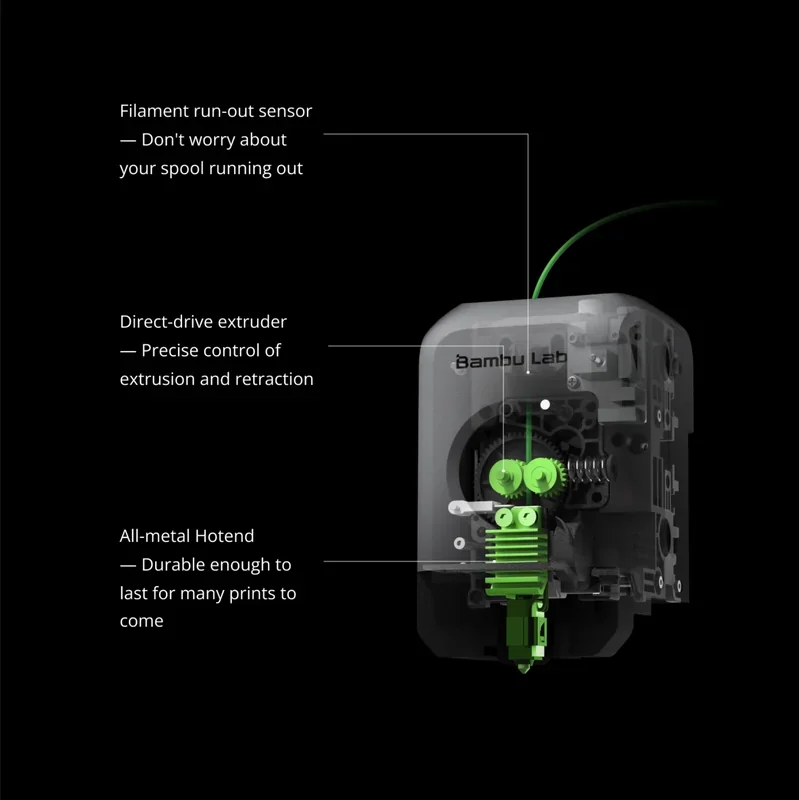
Built to run real materials, reliably.
A direct-drive dual-gear extruder grips filament close to the nozzle for precise extrusion and retraction — including flexible TPU — while the all-metal hotend reaches 300°C for engineering materials. A filament run-out sensor pauses cleanly so a finished spool never ruins a long print.
The direct-drive layout keeps the distance filament travels under load short, which is what makes flexibles printable and keeps stringing and oozing under control during fast moves. The all-metal hot end removes the PTFE liner that caps cheaper printers at low temperatures, opening up ABS, ASA, PC and nylon. The standard 0.4 mm nozzle swaps for 0.2, 0.6 or 0.8 mm to trade detail for throughput, and a hardened nozzle option lets the P1S handle abrasive carbon- and glass-filled composites too. With filament run-out detection and power-loss recovery built in, long unattended prints survive the interruptions that would otherwise waste a spool. It is flagship-grade hardware on a mid-range machine — the part of the printer that most often limits an entry model is, here, built to last.
500 mm/s CoreXY — a Benchy in ~18 minutes.
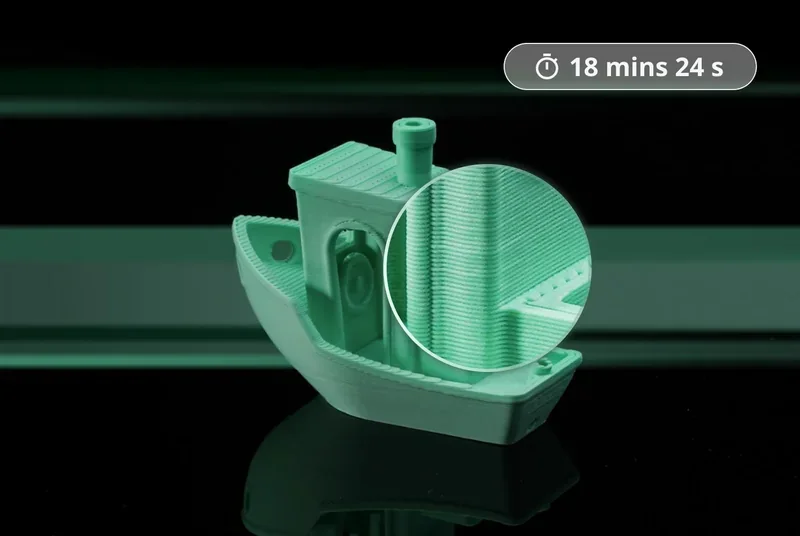
Fast, and clean at speed.
The P1S’s CoreXY motion reaches 500 mm/s with 20,000 mm/s² acceleration — printing a 3DBenchy in roughly 18 minutes — while motion algorithms keep the surface quality high.
CoreXY moves a light toolhead on a rigid frame, which is what lets the P1S accelerate hard without the wobble that limits a bed-slinger. Bambu’s vibration compensation measures the machine’s resonances and cancels the ringing that high speed normally causes, and pressure advance keeps corners sharp and walls even. The payoff is real time saved: jobs that tie up an entry-level printer overnight finish on the P1S in a few hours, and iterative design becomes a same-afternoon activity. Because the calibration is automatic, you get that speed-with-quality without hand-tuning resonance or flow — the machine characterizes itself and applies the corrections every print.
Detailed prints at production speed.
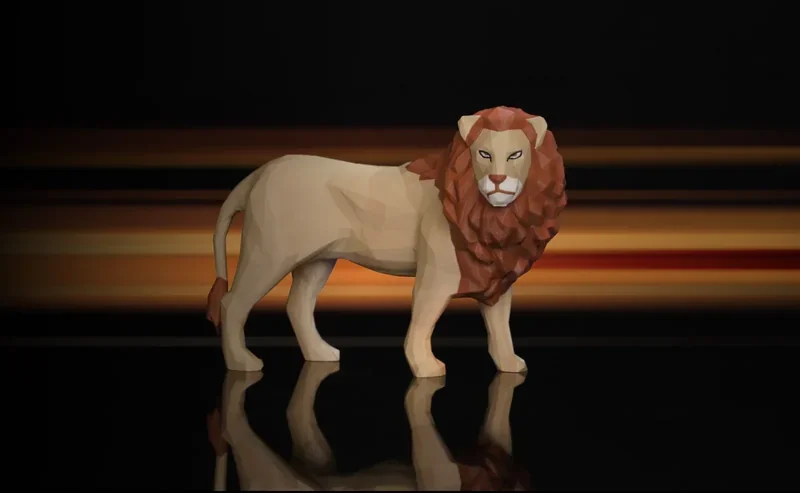
Models, miniatures, and functional parts.
From crisp display models and miniatures to functional ABS brackets, fixtures and enclosures, the P1S turns out clean, dimensionally consistent prints at speeds that make iteration painless — and the enclosed chamber means the engineering-material parts come out strong, not warped. Add the AMS and the same machine produces multi-color models and multi-material parts, including soluble supports, in one job. Whether you are prototyping for engineering, printing for a classroom, or running a small print farm, the P1S delivers repeatable results print after print. The flexible textured PEI plate releases finished parts with a simple flex — no scraping, no glue residue — so the machine is ready for the next job in seconds. Rev1 can help you match nozzle size, material and settings to the parts you make most.
Up to 16 colors, fully automatic.
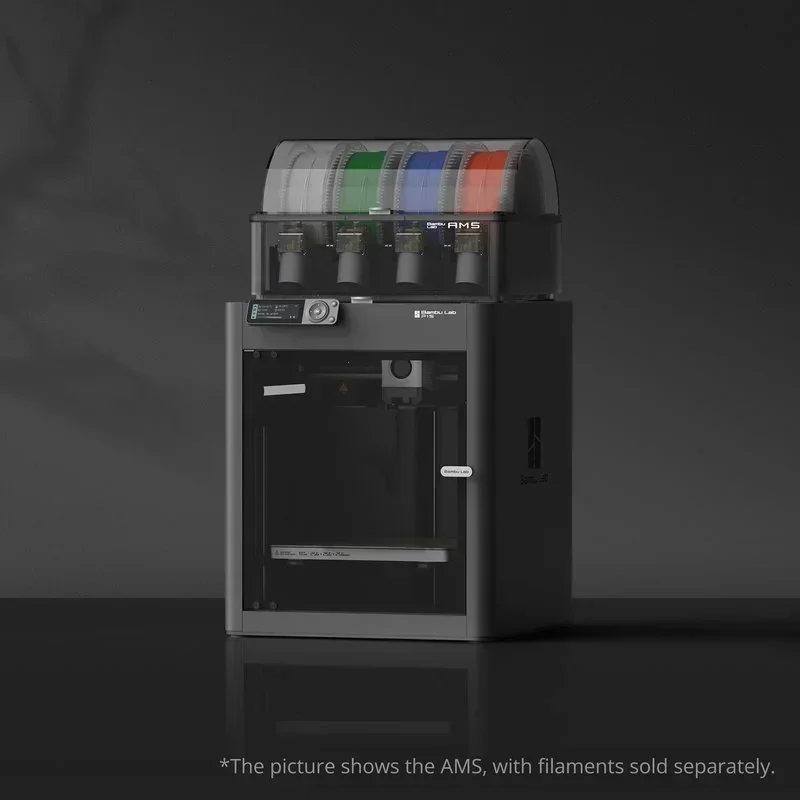
Automatic color and material switching.
The P1S is AMS-ready. One Automatic Material System holds four spools and switches between them mid-print; chain up to four for 16 colors, with RFID recognition that loads each filament’s settings automatically.
The AMS makes the P1S a true multi-material platform. It feeds and swaps spools without intervention, reads filament type and color from RFID so profiles load themselves, and keeps spools sealed and dry in an enclosed bay. That enables full-color models, multi-material parts with dissolvable supports, and long unattended jobs that never pause to change filament. Because it is a modular add-on, you can buy the printer now and add the AMS — or the AMS 2 Pro with active drying — when a project calls for it. Rev1 can spec the right AMS configuration and a starter material set for the work you plan to do.
Fully assembled, auto-calibrated, app-connected.
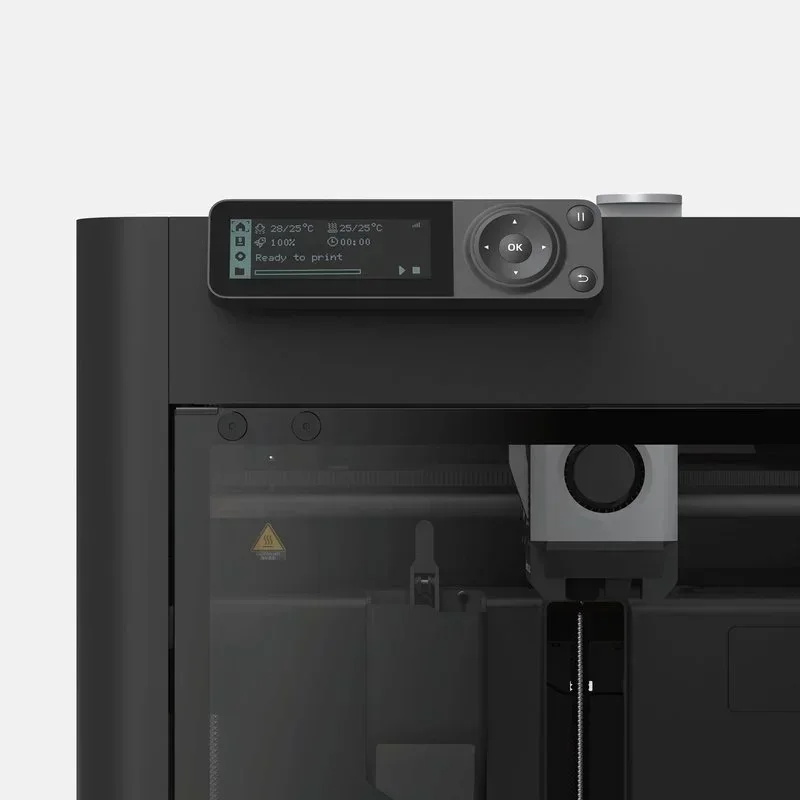
Out of the box to first print, fast.
The P1S arrives fully assembled and auto-calibrates during setup, so first-layer setup is hands-off. A 2.7″ screen with a control knob handles on-machine operation, Bambu Studio slices over Wi-Fi, and the Bambu Handy app plus cloud and LAN control let you start and monitor prints remotely.
Getting started is deliberately simple: unbox, run the guided calibration, and the printer measures its bed, resonance and flow automatically. Bambu Studio gives you a capable slicer with tuned profiles and per-object settings, while the Handy mobile app and cloud account let you send a print from your phone and check on it from anywhere — with a LAN-only mode for keeping everything local. A built-in 1080p, low-rate camera supports remote monitoring and timelapse so you can keep an eye on a job or a small fleet, and the flexible textured PEI plate releases finished prints with a flex. It is a workflow built so a newcomer succeeds on day one and a power user never feels boxed in. Rev1 can walk your team through setup and slicing so the first print is a good one.
From everyday PLA to engineering ABS and PC.
Because it is enclosed and runs a 300°C all-metal hotend, the P1S prints the everyday filaments fast and adds the warp-prone engineering materials the open-frame machines can’t handle well. It is an open system, so you can run genuine Bambu Lab filament with automatic RFID settings or any standard 1.75 mm spool. This is the P1 model to choose when ABS, ASA or PC are part of the job.
PLA, PETG, TPU, PVA and PET print fast and clean — the bulk of model, prototype and functional work.
ABS, ASA, PC and PA run in the warm, sealed chamber that keeps these warp-prone materials flat and strong.
Reinforced composites print with a hardened-nozzle upgrade for stiff, dimensionally stable functional parts.
How the P1S compares.
| Capability | Bambu Lab P1S | Bambu Lab X1-Carbon | Creality K1 |
|---|---|---|---|
| Enclosure + filter | Yes — carbon filter | Yes — carbon filter | Yes |
| LiDAR / flow calibration | No | Yes — Micro LiDAR | No |
| AI failure detection | Basic camera | Yes — AI camera | AI camera |
| Multi-color path | AMS — up to 16 | AMS — up to 16 | Limited |
| Hotend | 300°C all-metal | 300°C hardened | 300°C |
| Approx. price | ~$699 | ~$1,449 | ~$599 |
Comparison sourced from published manufacturer data at build time; prices are approximate and vary with promotions, tariffs and bundles. The P1S delivers the enclosed, filtered, AMS-ready Bambu experience at a mid-range price — the same chamber and 16-color path as the X1-Carbon without the LiDAR sensor suite. Step up to the X1-Carbon when you want LiDAR auto-calibration and AI failure detection; the P1S is the value pick when the enclosure and speed are what matter. Match the model to how hands-off and how precise you need the machine to be.
Bambu Lab P1S Technical Data
RESOURCES
Downloads & Technical Support
Everything you need to set up and run your Bambu Lab P1S with confidence.
WHY REV1 TECH
Genuine Bambu Lab Hardware. Additive Manufacturing Specialists.
Rev1 Technologies is an additive-manufacturing supplier headquartered in Auburn Hills, MI, with hands-on expertise across FDM printers, engineering materials and production workflows.
Rev1 Technologies serves makers, schools and engineering teams across the USA. We don’t just ship boxes — we help you choose the right configuration, dial in engineering materials like ABS and ASA, and keep the machine producing on genuine Bambu Lab hardware and filament.
Bambu Lab P1S questions.
What is the difference between the P1S and the P1P?
They share the same CoreXY motion, 300°C all-metal hotend and electronics. The P1S adds a fully enclosed chamber, an activated-carbon filter and extra cooling fans — which is what lets it print warp-prone, odor-prone materials like ABS and ASA reliably. The open-frame P1P has been discontinued; the P1S is the current enclosed model and the one to choose if engineering materials matter.
What is the difference between the P1S and the X1-Carbon?
Both are fully enclosed CoreXY printers with a 300°C hotend, carbon filter and AMS support. The X1-Carbon adds the flagship sensor suite — Bambu Micro LiDAR for calibration and first-layer inspection, AI failure detection, and a larger 5″ touchscreen. The P1S delivers the same enclosure, speed and 16-color path without LiDAR at a lower price. Choose the X1-Carbon for the sensors and the most hands-off setup; choose the P1S for the best value.
Can it really print ABS and ASA well?
Yes — that is the main reason to choose it over an open-frame printer. The sealed chamber traps process heat to keep big ABS and ASA parts from warping and cracking, and the activated-carbon filter handles the odor those materials emit. It also runs PC and PA, and reinforced carbon- and glass-fiber composites with a hardened-nozzle upgrade. For materials like ABS, good room ventilation is still recommended.
How fast is it?
Its CoreXY motion reaches 500 mm/s with 20,000 mm/s² acceleration — printing a 3DBenchy in roughly 18 minutes and finishing typical jobs several times faster than an entry-level bed-slinger. Vibration compensation and pressure advance keep those fast moves accurate.
Can I print multiple colors?
Yes, with the AMS. The P1S is AMS-ready; one Automatic Material System holds four spools and up to four chain together for 16-color printing, with automatic switching and RFID recognition of genuine Bambu Lab filament. The AMS 2 Pro adds active filament drying. You can start single-color and add the AMS later.
Does it have LiDAR or AI failure detection like the X1-Carbon?
The P1S has a built-in low-rate camera for remote monitoring and timelapse, but it does not include the X1-Carbon’s Bambu Micro LiDAR or its AI failure detection. If automatic flow calibration, first-layer inspection and AI monitoring are important to you, the X1-Carbon is the model that adds them. Rev1 can help you decide whether those features are worth the step up for your work.
Is it a good choice for a print farm or classroom?
Yes — it is one of the most popular machines for both. Fast CoreXY throughput, automatic calibration, an enclosure that contains noise and odor, and cloud or LAN fleet control let one person manage several machines. The fully-assembled, self-calibrating setup gets new units producing quickly, and the mid-range price keeps per-unit cost down at quantity. Rev1 quotes multi-unit and education orders with setup support.
How does Rev1 support the purchase?
Rev1 ships genuine, fully-assembled Bambu Lab hardware from US stock, helps you choose the right configuration and engineering materials, and supports setup, slicing and troubleshooting. Education and multi-unit pricing and Klarna are available for larger orders.