Professional 3D Scanners • EinScan • REV1 TECH

EinScan Medixa Wireless O&P 3D Scanner

Wireless 3D Scanner Purpose-Built for Orthotics & Prosthetics
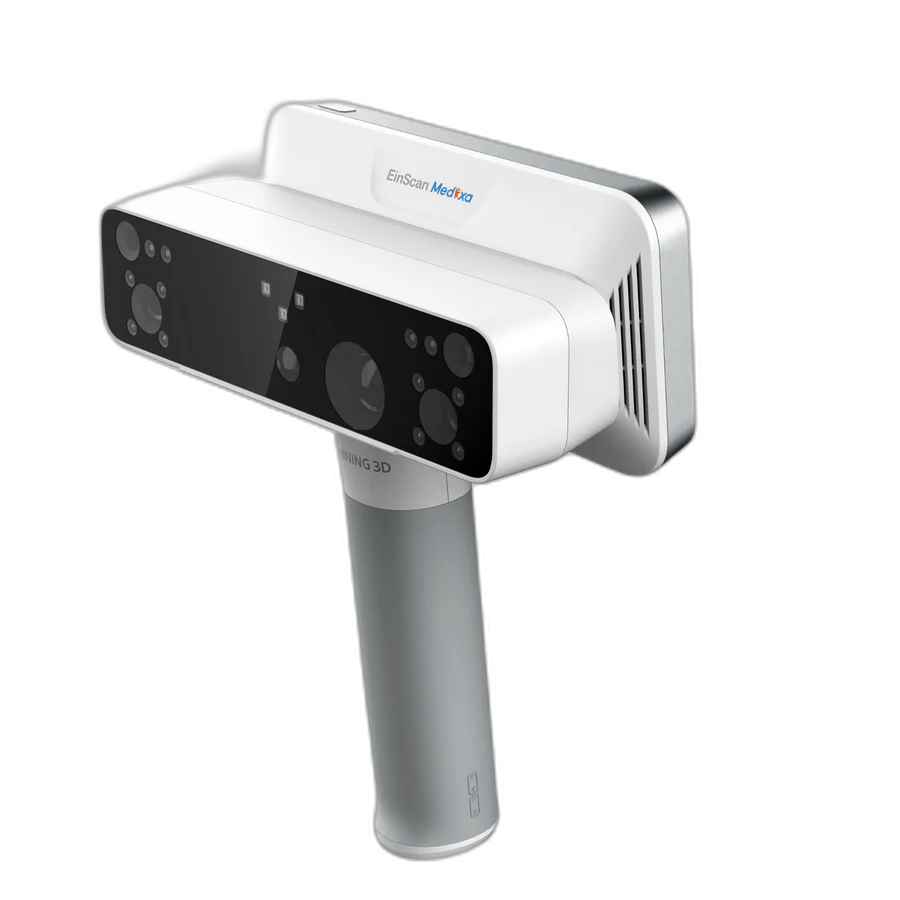
EinScan Medixa wireless O&P 3D scanner

A wireless, all-in-one professional 3D scanner designed from the ground up for O&P clinics — prosthetic sockets, cranial helmets, AFO/KAFO orthoses, foot orthotics, and custom seating. Nine clinical scan presets, dual eye-safe light source with movement compensation, a 5 MP texture camera, and onboard processing in a 953 g handheld — no laptop in the exam room. Full specifications →

< 0.3 mmRMS Accuracy
9 PresetsClinical Modes
< 2 minFull Body Region
953 gWireless Handheld
Light Source
White Structured LightEye-Safe IR VCSELContact-FreeMovement Compensation
Clinical Presets
CranialSocketAFO / KAFOFeetSeating+4 More
Onboard
Standalone (No PC)Onboard Touchscreen2× Hot-Swap Battery5 MP Texture Camera
Software
EXScan (Onboard)O&P CAD/CAM CompatibleSTL / OBJ / PLYSDK for Clinic Systems

Rev1 validates clinic fit, software-integration plan, and patient-population presets before purchase. Authorized EinScan reseller and factory-trained support partner in the USA. Volume, education, and clinic-bundle pricing available on quote — call (248) 707-2950.

EinScan Medixa wireless O&P 3D scanner — front view
USA Customers · Service & Support

An Authorized EinScan Reseller and Factory-Trained Support Partner.

Rev1 Technologies is an Authorized EinScan Reseller and a factory-trained SHINING 3D support partner. Clinical application review, software-stack guidance, on-site or remote calibration assistance, and engineering consultation are delivered from Auburn Hills, Michigan — not routed through grey-market importers.


US Phone & Video Support Ships From US Warehouse Authorized Repairs & Calibration
Medixa Highlights

Purpose-built for O&P. Contact-free, plaster-free, laptop-free — from infant cranial helmets to adult prosthetic sockets.

The EinScan Medixa is the first dedicated O&P scanner in the EinScan line — a wireless, all-in-one professional 3D scanner designed for orthotists, prosthetists, and clinicians working in cranial remolding, socket fabrication, AFO/KAFO orthoses, foot orthotics, and custom seating. A dual light source (white structured + eye-safe IR VCSEL) is fully contact-free, and movement compensation handles infants, pediatrics, and motion-sensitive patients. Nine clinical scan presets (Face, Cranial, Torso, Upper Limb, Lower Limb, Feet, Socket, Seating, Foam Box) replace generic capture menus with the patterns clinicians actually use. A 5 MP texture camera captures the clinician's pen marks — trim lines and pressure zones — alongside the geometry. Wireless and standalone: no laptop in the exam room, no cart, no cable. The vendor case for the scanner is an 80% case-time reduction (5 hr → 1 hr per case) and a 400% throughput increase (1.6 → 8 patients/day).

9 Presets
Clinical Scan Modes
Face, Cranial, Torso, Upper Limb, Lower Limb, Feet, Socket, Seating, Foam Box — clinician workflows, not generic capture menus.
< 0.3 mm
RMS Accuracy
Vendor-published RMS accuracy below 0.3 mm — appropriate for socket fit, cranial remolding tolerance, and AFO/KAFO trim-line precision.
Contact-Free
Plaster-Free Capture
Replaces messy plaster casting with dual white-light + eye-safe IR VCSEL scanning. No skin contact, no mess, no plaster cleanup.
Movement-OK
Motion Compensation
Algorithmic correction for involuntary patient motion — infants, pediatrics, elderly, breathing. The scanner adapts; the patient does not have to hold still.
5 MP
Texture Camera
Pen marks (trim lines, pressure zones, anatomical references) carry into the digital model 1:1 with the geometry — no second photo pass.
No PC
Standalone Wireless
953 g handheld with onboard touchscreen and processing. No laptop, no tablet, no cart in the exam room — cleaner clinic, faster turn-around.
Clinical Workflow Engine

Nine clinical presets. Dual eye-safe light source. Built for the exam room, not the shop floor.

Nine clinical scan presets — pick the patient region, not the algorithm

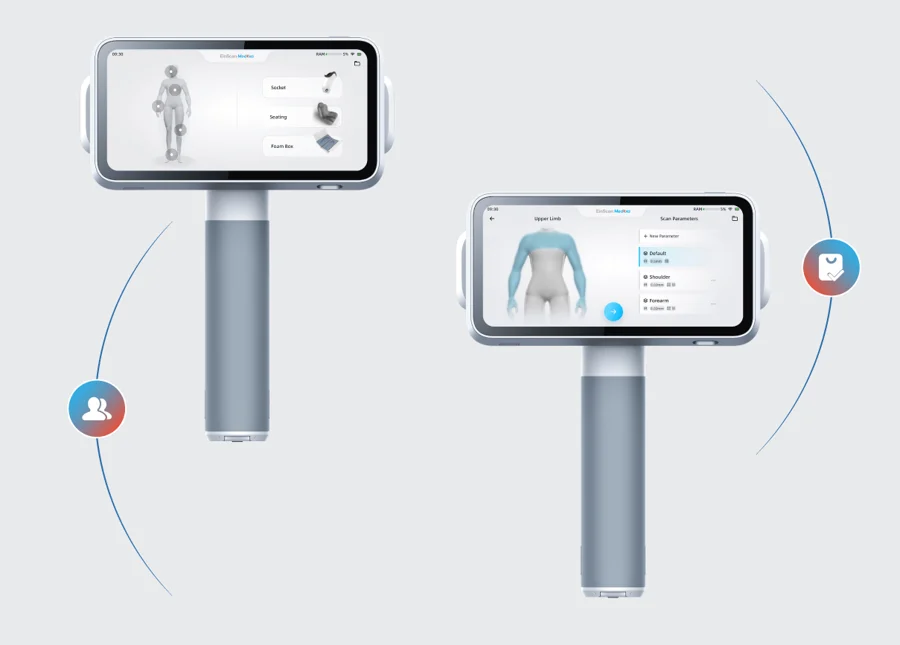
Face. Cranial. Torso. Upper Limb. Lower Limb. Feet. Socket. Seating. Foam Box. Each preset tunes the scanner for the patient region and the clinical use case — cranial remolding for pediatric helmets, lower-limb prosthetic socket capture, AFO/KAFO orthotic scanning, custom seating impressions, foot orthotic insoles. The clinician picks the region; the scanner handles the optics, alignment, and reconstruction settings underneath.
9 Presets
Clinical Workflows
< 2 min
Full Body Region
EinScan Medixa onboard touchscreen showing clinical scan presets — Socket, Seating, Foam Box, Upper Limb parameters

Dual light source — white structured + eye-safe IR VCSEL

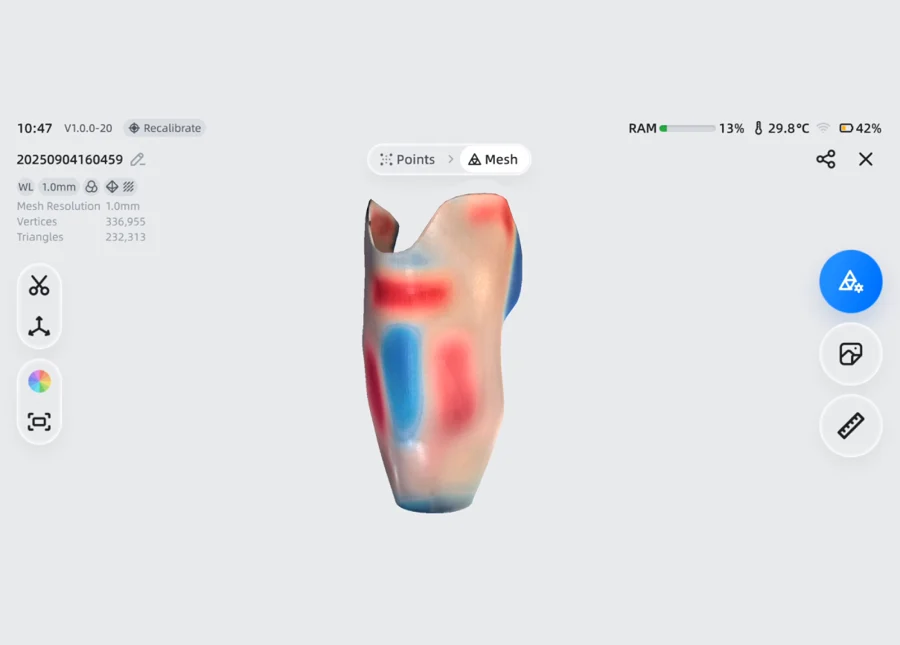
White structured light at 475 × 360 mm FOV for clinical detail; eye-safe IR VCSEL at 1090 × 1260 mm FOV for full-body and large-region capture. Both modes are contact-free — no skin contact, no plaster, no mess. The IR VCSEL is eye-safe at clinical working distance, so the patient can blink, breathe, and move; the scanner's movement-compensation algorithm corrects for involuntary motion in infants and pediatric patients.
1090 × 1260 mm
Max FOV (IR VCSEL)
Eye-Safe
Contact-Free Capture
EinScan Medixa onboard display showing a prosthetic socket scan with a red/blue pressure heatmap mesh
Clinical Validation
Not sure which Medixa preset fits your patient population or O&P workflow?
Send Rev1 your clinic mix — pediatric cranial vs. socket fabrication vs. AFO/KAFO orthotic vs. seating — and your downstream CAD/CAM design platform. We will validate the preset coverage, integration path, and operator-training scope before you quote.
Professional Accuracy & Repeatability

Clinical-grade RMS accuracy — appropriate for socket fit, cranial remolding, and AFO trim-line tolerance.

An O&P scanner does not need lab-cert metrology accuracy — it needs the right accuracy for socket fabrication, cranial remolding tolerances, AFO/KAFO trim lines, and seating impressions. The Medixa publishes RMS accuracy below 0.3 mm at clinical working distances with movement compensation for involuntary patient motion. Crucially, the same accuracy holds in the exam room (no calibration table, no controlled lighting, possibly with a wriggling pediatric patient) as it does in a manufacturer demo. The Medixa is also a Class 1 eye-safe device by design — the IR VCSEL light source is safe at clinical working distance, so the patient can blink, breathe, and look around.

RMS < 0.3 mm in the exam room, not just on a calibration bench

Movement compensation handles involuntary patient motion (breathing, infant micro-movements, geriatric tremor) so the published accuracy holds in real clinical conditions — not only when the patient holds perfectly still. Clean STL, OBJ, and PLY exports flow into the O&P CAD/CAM design platforms most clinics already use, with no proprietary lock-in. And the throughput math is the real business case: a vendor-claimed 80% case-time reduction (5 hr → 1 hr per case) and a 400% patient-throughput increase (1.6 → 8 patients/day) vs. plaster casting.
80%
Case-Time Reduction
400%
Throughput Increase
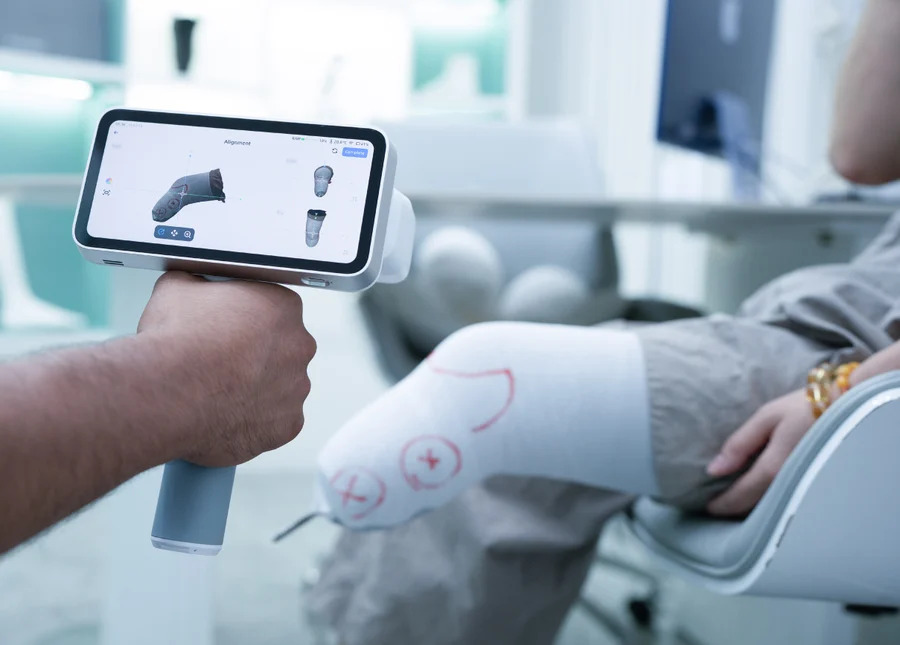
Clinician scanning a patient's residual limb with pen-marked trim lines and pressure zones using the EinScan Medixa
Honest clinical spec
RMS < 0.3 mm at clinical working distance with movement compensation. Appropriate for socket fit, cranial helmets, AFO/KAFO orthoses, foot orthotics, and seating impressions — not pitched as a metrology tool.
Eye-safe, contact-free
Dual white structured light + IR VCSEL designed for clinical use; the patient does not need to hold still or stop breathing. Replaces messy plaster casting end-to-end.
Open output formats
STL, OBJ, and PLY exports drop into the O&P CAD/CAM design platforms in everyday clinical use — Vorum, Rodin4D, Standard Cyborg, Mecuris, and others.
Designed by workflow
A scanner designed by O&P workflow, not adapted from an industrial sensor — from infant cranial helmets to adult prosthetic sockets and custom seating.
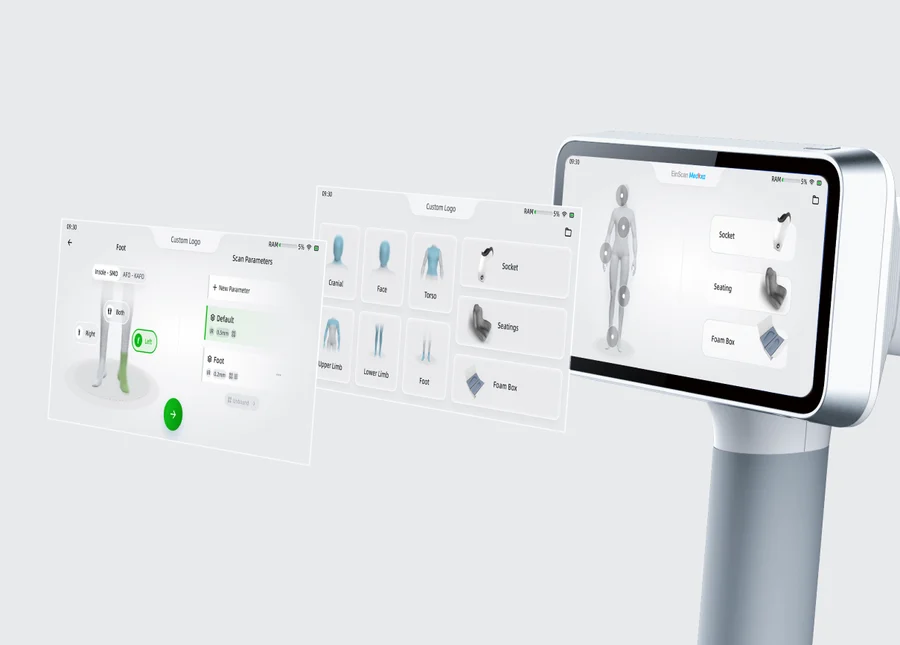
EinScan Medixa onboard integration and customization UI — clinical preset and scan-parameter screens
Onboard integration & customization
Clinical UI on the device itself. Pick the patient region, set custom presets, and run the scan — no laptop, no separate workstation.
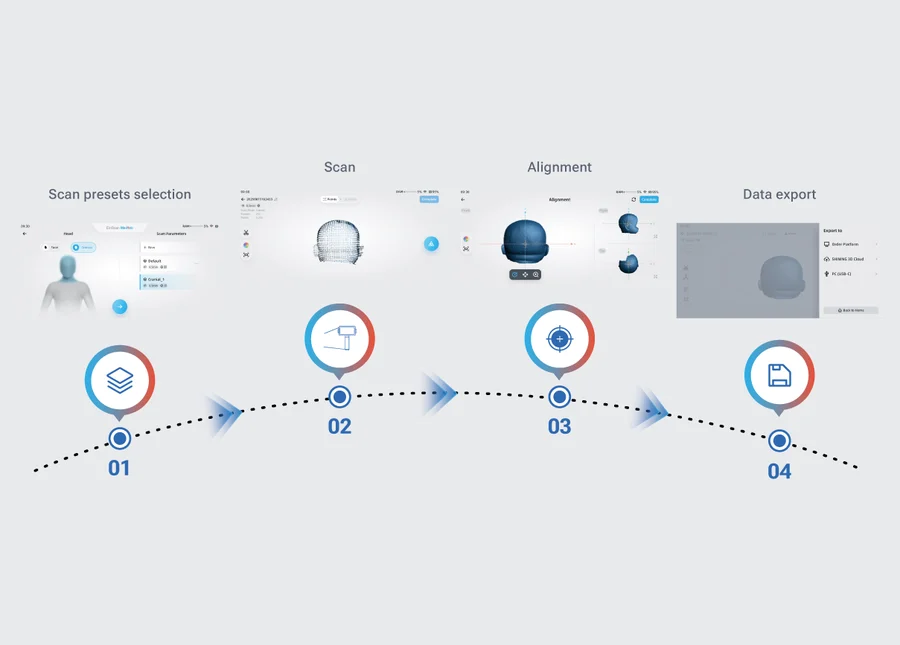
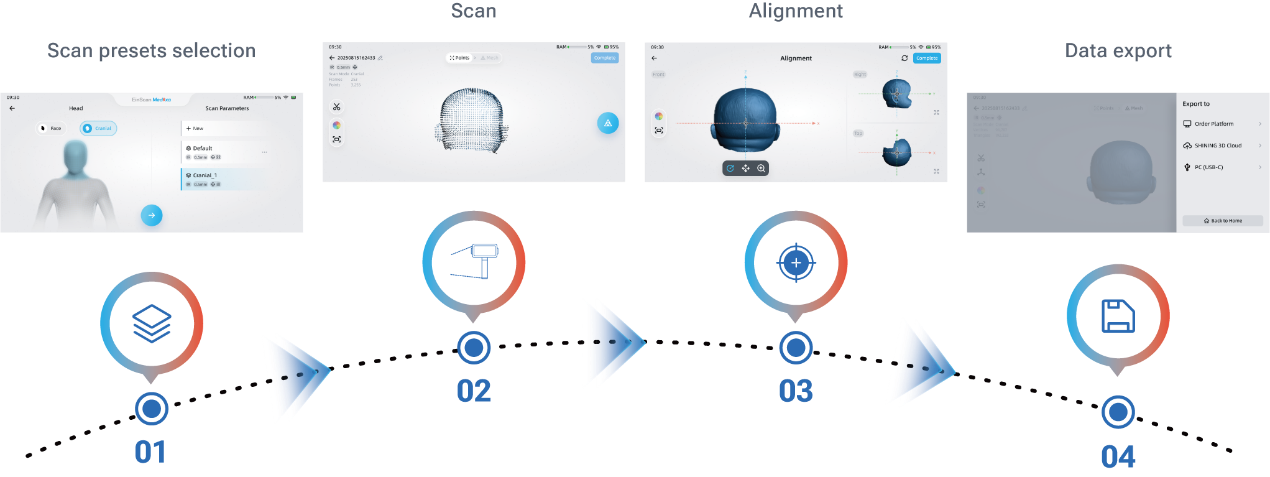
EinScan Medixa tailored four-step clinical workflow — Scan Preset, Scan, Alignment, Data Export
Tailored 4-step workflow
Scan Preset → Scan → Alignment → Export. Designed for the clinical operator, not the engineer.
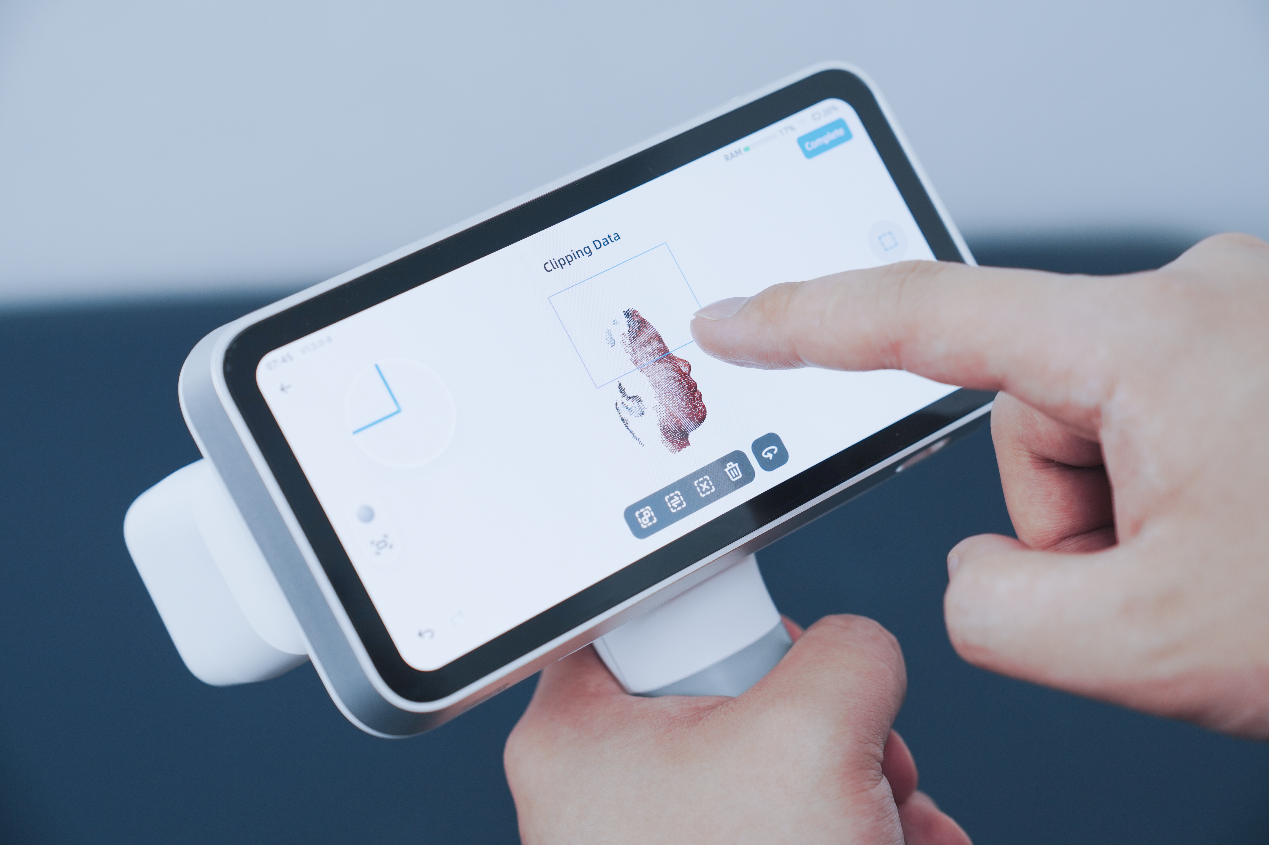
Clinician's hand operating the EinScan Medixa onboard touchscreen during a scan
Designed for the clinical operator
The Medixa replaces engineer-grade menus with patient-region presets, so the clinician picks the workflow — not the algorithm.
Clinical Workflow

No laptop. No cart. No plaster. The clinic gets cleaner, the clinician gets faster.

The Medixa is built for the exam-room workflow, not the engineering bench. Onboard touchscreen and onboard processing mean no laptop, no tablet, no powered cart between the clinician and the patient. Two hot-swap battery packs (5500 mAh each, ~3 hours continuous) plus USB-C charge-while-use keep the scanner running through a full clinic day. The plaster-casting workflow disappears: no slurry, no setup time, no patient-comfort issue, no cleanup, no shipped negatives. The clinician spends time with the patient and the digital model — not with a sink full of plaster.

The whole O&P care workflow on one wireless handheld

Efficient, precise, comfortable — the Medixa was created for O&P care from the ground up. The clinician scans the patient region directly, reviews the mesh on the onboard touchscreen, edits if needed, and exports to the O&P CAD/CAM design platform. No plaster room, no shipping negatives to a fabricator, no waiting on a physical cast to set.
1 hr
Per Case (vs. 5 hr)
8 / day
Patients (vs. 1.6)
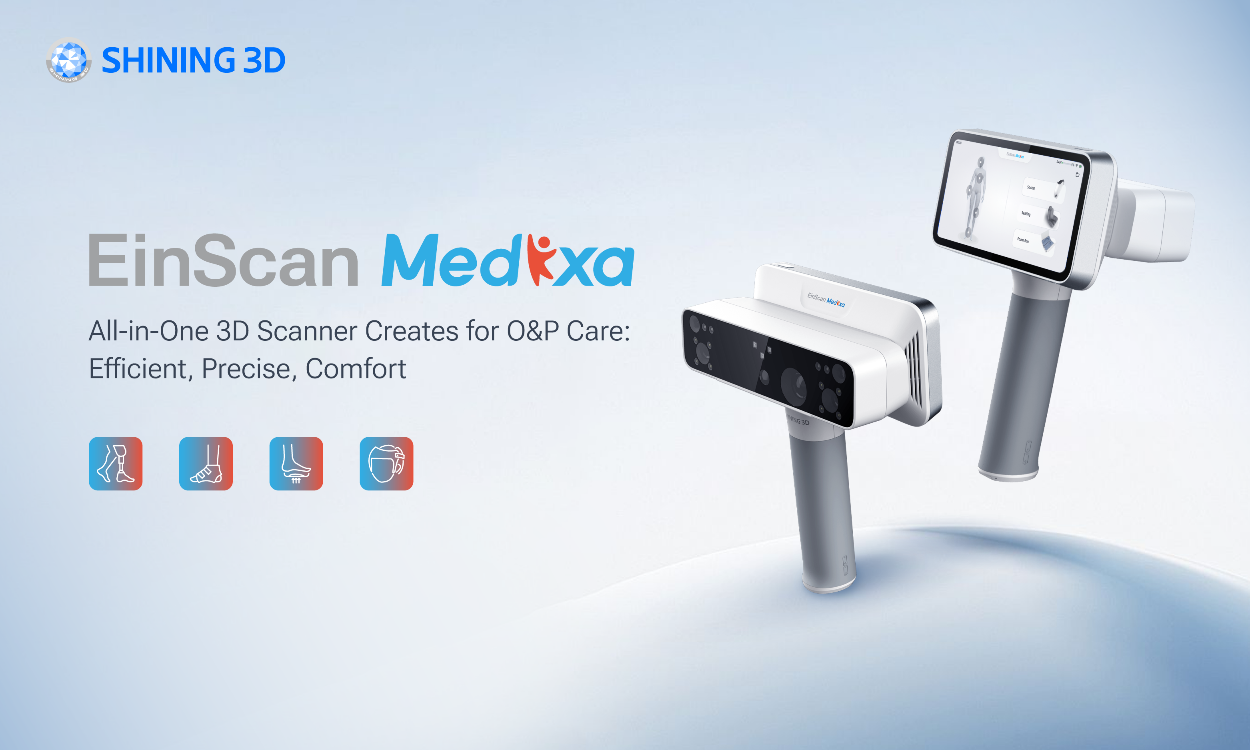
EinScan Medixa — All-in-One 3D Scanner created for O&P care: efficient, precise, comfortable
Plaster-Free
No Casting Mess
Replaces the entire plaster casting workflow: no slurry, no setup, no patient-comfort issue, no cleanup, no shipped negatives. Clinic stays clean; clinician stays productive.
Standalone
No PC in the Exam Room
Onboard touchscreen and onboard processing handle capture, preset selection, alignment, and export. No laptop, no tablet, no cart between you and the patient.
All-Day
Hot-Swap Battery System
Two 5500 mAh battery packs (~3 hr continuous each) plus USB-C charge-while-use. Swap packs between patients; never plug the scanner in mid-session.

Watch the demos

See the contact-free, plaster-free, no-laptop O&P workflow — straight from SHINING 3D.

Medixa in action

The full clinical capture-to-export workflow on the device: pick the patient-region preset, scan contact-free with the dual eye-safe light source, review the mesh on the onboard touchscreen, and export STL/OBJ/PLY to your O&P CAD/CAM design platform — no laptop, no plaster, no cart.

Fast, accurate foot scanning

Bind the Medixa with FootStation2 to capture both feet contact-free in seconds — clean plantar geometry for custom foot orthoses, no foam box and no plaster.

Socket design made simple

Capture the residual limb and carry the scan straight into socket design — the 5 MP texture pass preserves the clinician's pen marks and landmarks alongside geometry for a faster, more accurate fit.

Seamless transfer to riiForm

Export the digital cast directly into riiForm — the standalone wireless workflow moves O&P scans into your downstream CAD/CAM platform without a cart, a PC, or a re-scan.

Purpose-Built for O&P

The first dedicated O&P scanner in the EinScan line — designed for clinics, not adapted from an industrial sensor.

A clinical handheld, not a re-skinned industrial scanner

Every design choice in the Medixa was made for the exam room: the ergonomic clinical-grip chassis, the eye-safe IR VCSEL light source, the movement compensation for pediatric and motion-sensitive patients, and the standalone wireless workflow that keeps the clinic clear of carts and cables. The same proven EinScan optical-engine architecture and EXScan software path that field-deployed operators already trust — rebuilt around how O&P practitioners actually work.
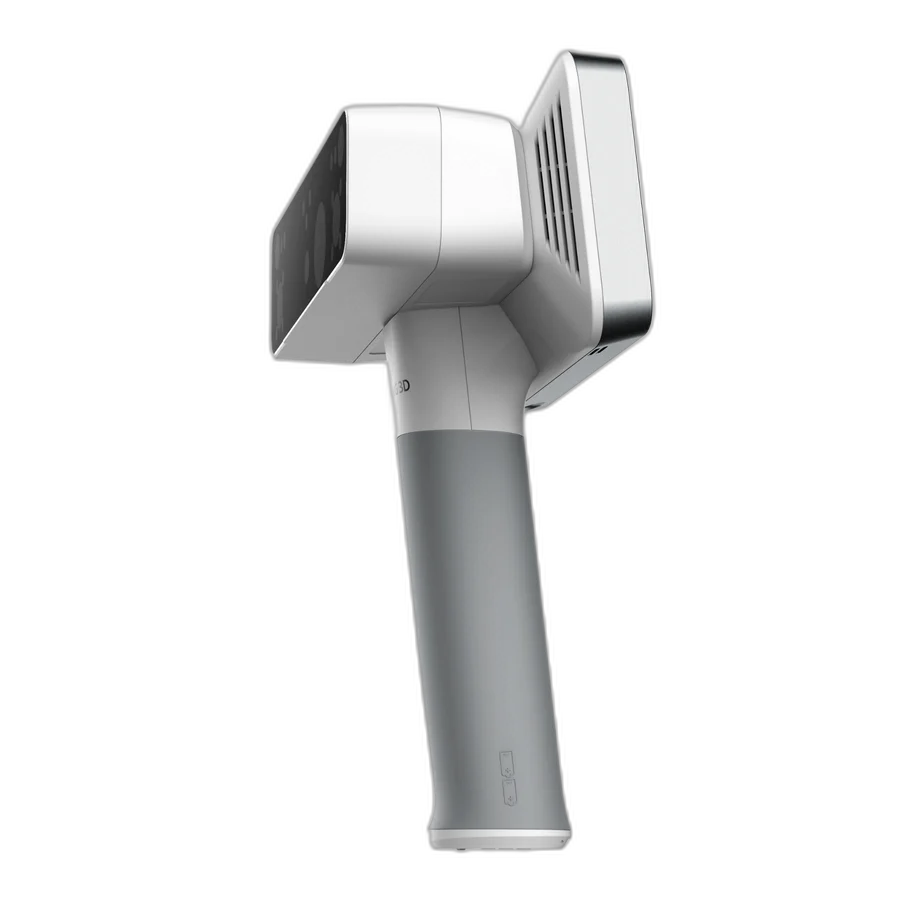
First
Dedicated O&P EinScan
Eye-Safe
IR VCSEL by Design
EinScan Medixa side-angle view — ergonomic clinical-grip wireless handheld

Proven optical-engine architecture, redesigned for the O&P clinical workflow

EinScan has shipped wireless, all-in-one professional handheld scanners to thousands of operators worldwide — the same optical-engine architecture and EXScan software path that runs on the field-deployed Libre and the tethered Rigil. The Medixa is the first member of the line designed specifically for O&P from the ground up: nine clinical scan presets (not industrial spec menus), an eye-safe IR VCSEL light source (not a blue laser pointed at a patient), movement compensation for pediatric and motion-sensitive populations, and a 5 MP texture camera that captures the clinician's pen marks alongside geometry. Not a re-skinned industrial scanner.
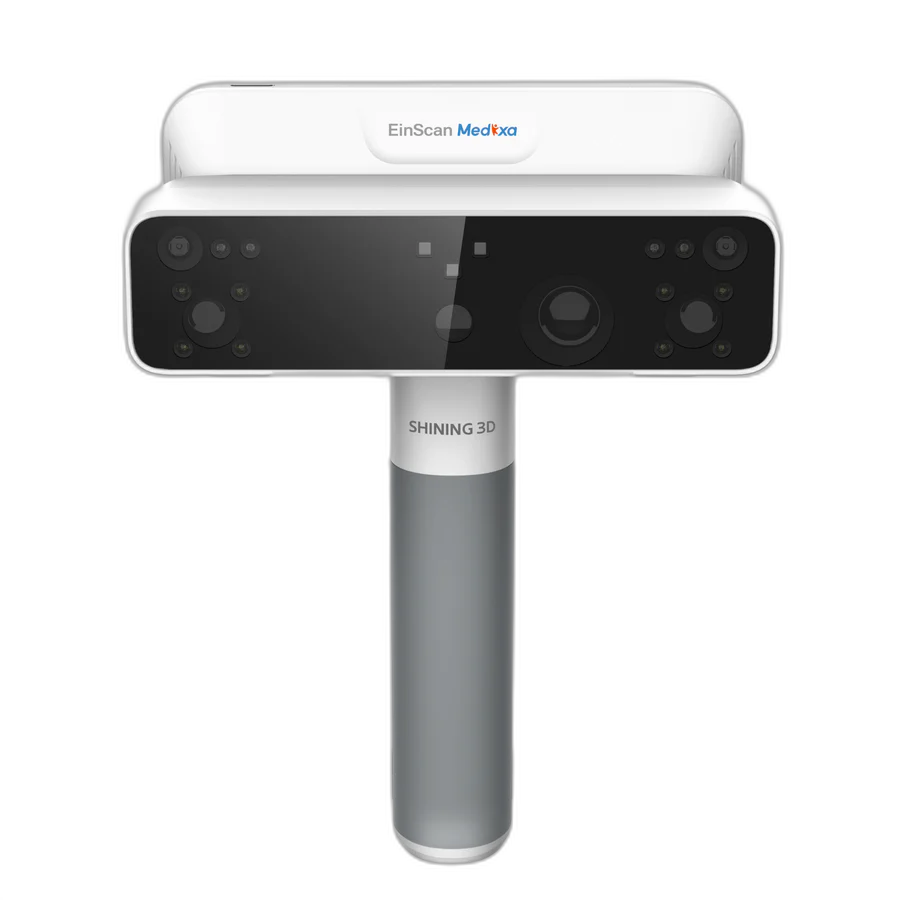
9 Presets
Clinical scan presets
5 MP
Texture camera
EinScan Medixa front view — dual-camera optical engine with onboard display

Vendor-published: 80% case-time reduction, 400% patient-throughput increase

Replacing the plaster-casting workflow end-to-end changes clinic capacity, not just digital deliverable quality. Vendor claims 5 hour → 1 hour per case (80% time reduction) and 1.6 → 8 patients/day (400% throughput increase). That math is the actual O&P business case: more patients served, faster turn-around to the fabricator, and a cleaner clinic environment without the casting room. Rev1 helps validate these claims against your patient mix and downstream CAD/CAM platform before quote.
80%
Case-time reduction
400%
Patient throughput
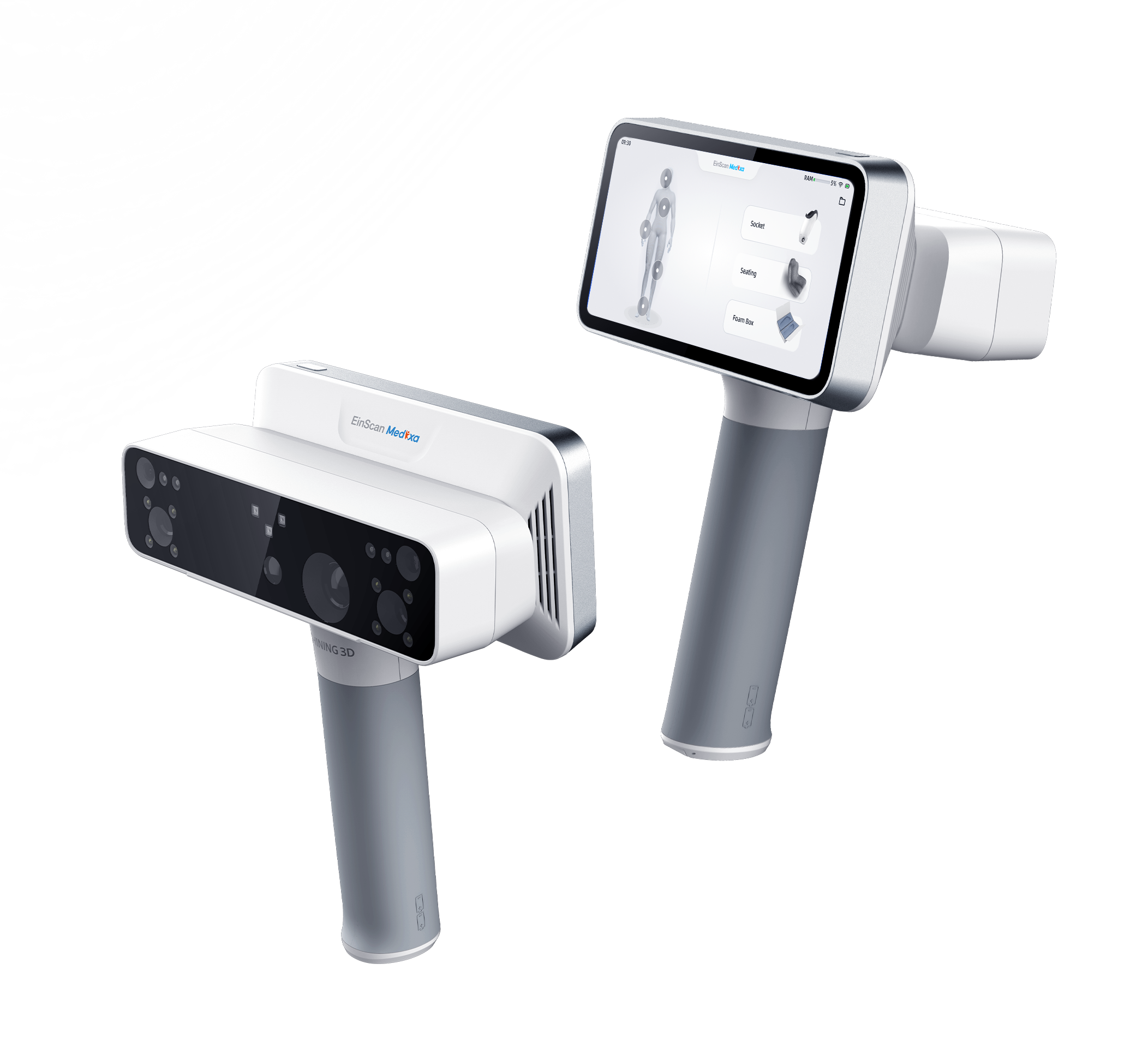
Two EinScan Medixa units — dual-camera sensor and onboard touchscreen showing clinical body presets

A clinician picking up the Medixa is picking up a scanner designed by O&P workflow, not adapted from a reverse-engineering tool. The patient-region presets, the eye-safe light source, the movement compensation, the 5 MP texture pass for pen marks, the standalone wireless workflow — every design choice was made for the exam room. The Medixa is the EinScan line's answer to the question: “why are O&P clinics still using industrial scanners or plaster?”

Clinical Hardware

953 g wireless handheld. 5 MP texture. Dual hot-swap battery. Onboard touchscreen. No laptop in the exam room.

The hardware is sized for clinical hands, not industrial grips

A 953 g wireless handheld balanced for clinical use — light enough to hold over a pediatric patient, stiff enough to hold optical alignment across a multi-pose socket scan. The onboard touchscreen is the entire control surface; no laptop, no tablet, no cart in the exam room. Two 5500 mAh hot-swap battery packs (~3 hr continuous each) plus USB-C charge-while-use keep the scanner running through a full clinic day with zero downtime. A 5 MP texture camera captures the clinician's pen marks — trim lines, pressure zones, anatomical references — alongside the geometry, rare on a clinical-class scanner at this price.
953 g
Wireless Handheld
2× 5500 mAh
Hot-Swap Battery
5 MP
Texture Camera
EinScan Medixa onboard scan preview — live scan stages shown on the device touchscreen
Clinical-grip chassis
953 g wireless handheld balanced for clinician use over patients of all ages; ergonomic single-piece grip.
953 g / WIRELESS
Movement compensation
Algorithmic correction for involuntary patient motion — infants, pediatrics, elderly tremor, breathing. The scanner adapts to the patient, not the other way around.
MOTION-OK
5 MP texture camera
Pen marks (trim lines, pressure zones, anatomical references) carry into the digital model alongside geometry — one pass, no second photo session.
5 MP / TEXTURE
Right scanner for your clinic?
Not sure the Medixa fits your O&P workflow?
Send us your clinic's case mix and downstream CAD/CAM platform — Rev1 validates accuracy class, preset coverage, software pipeline, and training scope before you commit. Free, no purchase required.
Medixa in Action

Live on-device preview, all-day power, and eye-safe contact-free capture — proof from the clinic.

Watch the workflow in the demo above, then look at what makes it repeatable in a real clinic day. The clinician never leaves the patient to check coverage on a workstation, never plugs in mid-session, and never points an unsafe light source at a patient. These three behaviors — live on-device preview, hot-swap power, and eye-safe contact-free capture — are what turn a fast demo into a production O&P workflow.

Live
Onboard Scan Preview
Clinicians see the mesh growing in real time on the onboard touchscreen during the patient encounter — no walking back to a workstation to check coverage before the patient leaves the chair.
All-Day
Dual Hot-Swap Battery + USB-C
Two 5500 mAh packs at ~3 hours each, plus USB-C charge-while-use. Swap mid-clinic without losing a scan; never wait for a charge between patients.
Eye-Safe
Contact-Free Capture
Dual white-structured + eye-safe IR VCSEL light source. Class 1 safe at clinical working distance — the patient can blink, breathe, and look around while the clinician scans through the workflow.
Clinical Connectivity

Wireless data transfer, USB-C, standalone capture, and on-device control via the built-in touchscreen.

The Medixa is designed to operate without a tether in the exam room. The primary control surface is the built-in touchscreen on the unit itself — not a remote app on the clinician's phone or a connected laptop. Wireless data transfer moves finished STL/OBJ/PLY meshes off the scanner to the clinic workstation or fabricator portal when the patient encounter is done; USB-C handles charge-while-use and high-bandwidth transfer when wired access is convenient. There is no “must-connect” capture mode — standalone is the default.

Wireless Data Transfer
Built-in WiFi-class radio for moving finished meshes off the scanner to the clinic workstation, fabricator portal, or ordering system after the patient encounter. Not required for capture.
USB-C Charge-While-Use
USB-C handles battery top-up between patients and high-bandwidth wired transfer. Useful when an outlet is convenient; never required for the capture workflow.
Standalone (No PC) Capture
The default mode. Onboard touchscreen and onboard processing run the full capture-to-export path on the scanner itself — no laptop, no tablet, no remote app between the clinician and the patient.
Output Formats & Integration
STL, OBJ, and PLY exports drop into O&P CAD/CAM design platforms (Vorum, Rodin4D, Standard Cyborg, Mecuris, and others). An SDK is available for hospital ordering systems and branded patient portals.
Clinical Applications

Prosthetic sockets. Cranial helmets. AFO/KAFO orthoses. Foot orthotics. Seating. The full O&P workflow on one scanner.

The Medixa is built for the full range of O&P clinical capture work — from infant cranial remolding helmets to adult prosthetic sockets, AFO/KAFO orthotic bracing, custom seating impressions, and weight-bearing foot orthotic scanning. The nine clinical scan presets and movement-compensation algorithm cover pediatric, geriatric, and motion-sensitive patient populations that generic industrial scanners cannot. For O&P labs and clinic groups serving multiple specialties, the Medixa replaces a stack of single-purpose tools and the entire plaster casting workflow with one wireless handheld.

Pediatric Cranial Remolding Helmets
Infant cranial capture for helmet fabrication — eye-safe, contact-free, with movement compensation for an unsedated, moving baby.
Prosthetic Socket Capture
Transtibial and transfemoral residual-limb capture with the Lower Limb and Socket presets — clean meshes ready for socket design.
AFO / KAFO Orthoses
Lower-limb orthotic bracing capture with trim-line texture from the clinician's pen marks carried into the digital model.
Foot Orthotics & Insoles
Weight-bearing and foam-box impression digitization with the Feet and Foam Box presets for custom insole fabrication.
Custom Seating & Mobility
Custom wheelchair seating and cushion impressions with the Seating preset — faster, cleaner, and more comfortable than casting.
Torso / Spinal Bracing
Torso and spinal bracing capture with the Torso preset for scoliosis braces and body jackets across patient ages.
O&P Software Ecosystem

Capture on the device. Design in your existing O&P CAD/CAM platform. Fabricate.

The Medixa captures and meshes on-device with EXScan, then exports clean STL, OBJ, and PLY files into the O&P CAD/CAM design platforms that clinics already use. Vorum, Rodin4D, Standard Cyborg, Mecuris, Comfia, Hephy, and other O&P-specific design suites all consume the Medixa's output formats directly. For clinics building branded patient portals or integrating with hospital ordering systems, an SDK is available. Rev1 confirms software-fit and integration path during application review before purchase — including which O&P CAD/CAM seat license matches the clinic's patient mix.

EXScan (Onboard) Vorum CanFit / Spectra Rodin4D Romeo / Neo Standard Cyborg Mecuris OS Comfia Hephy Geomagic Freeform (Touch / Plus) Meshmixer (via STL) Rhino (via OBJ) Blender (via OBJ/PLY) SDK for ordering / portal integration
Competitive Comparison

Medixa vs. the O&P alternatives clinics actually shortlist.

We benchmark the Medixa against the O&P-relevant alternatives clinics actually shortlist: Structure Sensor Pro (the iPad-based scanner common in lower-cost O&P workflows), Artec Leo (the most-recognized standalone handheld used in clinical capture), Vorum Yeti / Spectra (proprietary O&P hardware + software bundles), and the plaster-casting status quo. The goal is buyer clarity: where the Medixa leads on clinical workflow, eye-safe contact-free capture, and value — and where a different option genuinely fits better.

Scanner Accuracy Class Workflow Light Source Where It Fits
EinScan MedixaRev1 supported · O&P purpose-built RMS < 0.3 mm Wireless, standalone, onboard touchscreen · 9 clinical presets · movement compensation Dual: white structured light + eye-safe IR VCSEL · contact-free The full O&P range — cranial helmets, sockets, AFO/KAFO orthoses, foot orthotics, seating, torso bracing. Replaces plaster end-to-end with a 5 MP texture pass for pen marks. Rev1 US application support included.
Structure Sensor ProiPad-based, low-cost entry ~1–2 mm (depth-sensor class) Tethered to iPad · app-based capture Structured IR depth sensor The entry-level O&P workhorse for clinics testing digital workflows on a small budget; capture happens in third-party iPad apps. The Medixa lands with a tighter accuracy class, purpose-built clinical presets, a 5 MP texture camera, movement compensation, and standalone wireless operation. Pick Structure when budget is the binding constraint.
Artec Leostandalone handheld · general-purpose 0.10 mm + 0.30 mm/m (vendor) Standalone, onboard touchscreen, swappable battery Structured blue light · markerless The most-recognized standalone handheld, well-loved for freeform capture in art, anatomy, and clinical work in the Artec Studio ecosystem. The Medixa lands with O&P-specific design (clinical presets, movement compensation), an eye-safe IR VCSEL vs. blue light at a patient, and a clinic-priced US tag. Pick Leo if Artec Studio is already entrenched for art / freeform work.
Vorum Yeti / SpectraO&P-specific hardware + software bundle Vendor-specific, varies by model Proprietary capture + design ecosystem Varies (Yeti structured light; Spectra touch-probe) Ships as part of an O&P CAD/CAM ecosystem (CanFit and Spectra design suites). Strong for clinics deeply integrated with Vorum's software and willing to commit to the vertical stack. The Medixa is an open scanner that exports to Vorum's software (and every other O&P CAD/CAM platform) without the proprietary bundle lock-in.
Plaster Castingtraditional analog status quo Operator-dependent Manual: cast, fill, ship to fabricator, await physical negative N/A — no scanner Still the dominant O&P capture workflow at many clinics. Familiar and low up-front cost, but high in clinic time, patient-comfort impact, mess, shipping cost, and turn-around time. The Medixa replaces the entire plaster path with a contact-free, digital, 1-hour workflow — the vendor case is 80% case-time reduction and 400% patient throughput.

Rev1 takeaway: the Medixa is the right scanner for O&P clinics building or replacing a digital workflow. It lands with materially better accuracy than depth-sensor entry options, purpose-built clinical presets that general-purpose handhelds lack, and freedom from proprietary CAD/CAM bundling. Sideways-shop Structure Sensor Pro when budget is the only constraint; Artec Leo if Artec Studio is already entrenched for art / freeform work; Vorum if you are committing to the full vertical stack. Application review with Rev1 is the fastest way to confirm fit before quote. Street prices are approximate and stated honestly during your quote.

Application Review
Comparing the Medixa to an Artec, a Structure Sensor, or another EinScan scanner?
Send Rev1 your target patient mix, accuracy budget, and software stack and we'll tell you which scanner actually fits the application — including when a different scanner is the better answer.
Specifications

EinScan Medixa Technical Data

Optical Engine
Technology
Wireless O&P handheld 3D scanner — dual contact-free light source
Light Source
White structured light + eye-safe IR VCSEL (dual)
Texture Camera
5 MP onboard color camera
Movement Compensation
Yes — algorithmic correction for involuntary patient motion
Contact-Free
Yes — no skin contact, no plaster, no markers required
Accuracy & Capture
RMS Accuracy
< 0.3 mm
Point Distance / Resolution
0.2–3 mm (selectable)
Field of View (White Light)
475 × 360 mm
Field of View (IR VCSEL)
1090 × 1260 mm
Full Body Region Capture
< 2 minutes
Alignment Modes
Feature · Texture · Hybrid · Markers · Global Markers
Clinical Scan Presets (9)
Face / Cranial / Torso
Facial work · pediatric cranial remolding · torso/spinal bracing
Upper / Lower Limb
Upper-extremity sockets & orthoses · transtibial / transfemoral sockets
Feet / Socket
Foot orthotic insoles · existing-socket replication / refinement
Seating / Foam Box
Custom seating & cushion · foam-box impression digitization
Onboard Hardware
Weight
953 g
Chassis
Ergonomic single-piece clinical-grip design
Onboard Display
Built-in touchscreen with live scan preview and on-device editing
Onboard Compute
Standalone capture-to-export — no PC required
Power & Workflow
Battery
2× replaceable 5500 mAh hot-swap packs
Battery Runtime
~3 hours continuous per pack
USB-C
Charge-while-use and high-bandwidth file transfer
Wireless Data Transfer
Yes — built-in WiFi-class radio for finished-mesh export
Software & Output
Native Software
EXScan (onboard)
O&P CAD/CAM Compatibility
Vorum CanFit / Spectra · Rodin4D Romeo / Neo · Standard Cyborg · Mecuris OS · Comfia · Hephy
Output Formats
STL · OBJ · PLY
SDK
Available for hospital ordering systems and branded patient portals
Compliance
Eye Safety
Class 1 eye-safe IR VCSEL at clinical working distance
Certifications
Confirm CE / FDA / MDR per market and intended clinical use during quote
Price
$5,599 · ~$98/mo est (72 mo, OAC) · financing available
Warranty & Support
Rev1 US warranty service routing, training, and factory-trained support

RESOURCES

Downloads & Technical Support

Everything you need to evaluate and deploy your EinScan Medixa with confidence.

Medixa Product Page (SHINING 3D)
Vendor canonical page for the EinScan Medixa — full feature breakdown, clinical scan presets, and downloadable datasheet. Rev1 can provide an annotated brochure copy with US support and pricing terms on request.
Visit Vendor Page →
O&P-Designed Overview
SHINING 3D's O&P-focused landing page covering the nine clinical scan presets, movement compensation, and the prosthetics/orthotics workflow case. Useful background for clinic owners and software integrators evaluating the platform.
Open Overview →
Rev1 Clinical Support
Pre-sale clinical workflow review, scan-preset validation against your patient mix, O&P CAD/CAM integration planning, operator training, and warranty service routing — delivered from Auburn Hills, Michigan by a factory-trained EinScan support team.

BEFORE YOU BUY

Authorized EinScan Reseller. O&P Workflow Specialists.

Most scanner returns happen because the buyer matched a price to a spec sheet instead of a workflow to a patient mix. Rev1's pre-sale process closes that gap — before your Medixa ships.

YOUR REV1 PARTNER
AUTHORIZED EINSCAN RESELLER

Before your Medixa ships, Rev1 maps your actual patient mix, accuracy budget, software stack, and operator-training plan against what the scanner delivers. If the Medixa isn't the best fit, you'll hear that before the order — not after.

01
Clinic Patient-Mix Audit
What does your clinic actually scan — cranial helmets, prosthetic sockets, AFOs/KAFOs, foot orthotics, custom seating? Pediatric, adult, geriatric? Rev1 maps the Medixa's nine presets and movement-compensation behavior against your real patient mix before the order, and tells you when a different scanner fits better.
02
O&P CAD/CAM Integration Plan
Which O&P design platform are you on — Vorum CanFit / Spectra, Rodin4D Romeo / Neo, Standard Cyborg, Mecuris OS, Comfia, Hephy? Planned before the scanner ships. SDK integration with hospital ordering systems and branded patient portals is scoped here too.
03
Install & First-Patient Walkthrough
Rev1 verifies the scanner on arrival, sets up clinical scan profiles for your patient mix, walks operators through the onboard touchscreen workflow, and runs a first-scan session on a representative patient region — usable clinical output on day one.
04
US Support & Service
Phone and video support, authorized service routing, firmware updates, and clinical guidance from Auburn Hills, Michigan — so warranty service never routes through grey-market channels and your clinic stays productive.
05
Operator Training
Remote or on-site operator + workflow training so clinicians are confident with preset selection, capture technique, and on-device editing — not learning by trial-and-error on live patients.
06
Financing
$5,599, or ~$98/mo est over 72 months OAC. Rev1 works with multiple lending partners; volume, education, and clinic-bundle pricing are available on quote.
Buyer FAQ

EinScan Medixa questions buyers ask before quoting.

Is the Medixa a dental scanner?
No. The Medixa is purpose-built for Orthotics & Prosthetics (O&P) — prosthetic sockets, cranial helmets, AFO/KAFO orthoses, foot orthotics, custom seating, and torso/spinal bracing. The SHINING 3D dental scanner is the Aoralscan 3, a separate SKU. If you are evaluating an intraoral or chairside dental capture device, the Medixa is the wrong product — talk to Rev1 about the Aoralscan or an alternative dental-specific solution.
What accuracy can the Medixa hold in clinical conditions?
The Medixa publishes RMS accuracy below 0.3 mm at clinical working distance. Crucially, the movement-compensation algorithm corrects for involuntary patient motion (breathing, infant micro-movements, geriatric tremor), so the published accuracy holds in real exam-room conditions — not only when the patient holds perfectly still. This accuracy class is appropriate for socket fit, cranial remolding tolerance, AFO/KAFO trim-line precision, and seating impressions. The Medixa is not pitched as a metrology tool — for VDI/VDE 2634 / ISO 10360 lab-certified accuracy in industrial workflows, a FreeScan-class metrology scanner is the right sibling.
Is the Medixa safe for use on patients, including infants?
Yes. The Medixa uses dual contact-free light sources: white structured light and an eye-safe IR VCSEL. The IR VCSEL is Class 1 eye-safe at clinical working distance, so the patient does not need to close their eyes or hold still. Movement compensation in the capture algorithm handles involuntary motion (breathing, micro-movements common in pediatric and geriatric patients), which is what makes the Medixa appropriate for cranial-helmet capture on infants without requiring sedation or fixation. Confirm any market-specific medical-device certifications (CE / FDA / MDR) during your Rev1 quote process — clinical intended-use documentation is provided per your jurisdiction.
What are the nine clinical scan presets and when do I use each?
The nine presets are: Face (facial prosthetic/orthotic), Cranial (pediatric cranial-remolding helmet), Torso (spinal / torso bracing), Upper Limb (upper-extremity sockets and orthoses), Lower Limb (transtibial / transfemoral socket), Feet (foot orthotic insole), Socket (existing socket replication / refinement), Seating (custom wheelchair seating and cushion), and Foam Box (foam-box impression digitization). Each preset tunes the scanner's optics, alignment, and reconstruction settings for the patient region and clinical use case. The clinician picks the region from the onboard touchscreen — not algorithm parameters from an engineering menu.
Does the Medixa really replace plaster casting end-to-end?
Yes. The dual contact-free light source captures the patient region directly — no plaster, no slurry, no setup time, no shipped negatives. The clinician scans the patient, reviews the mesh on the onboard touchscreen, edits if needed, and exports STL/OBJ/PLY to the O&P CAD/CAM design platform. Vendor claim: 80% case-time reduction (5 hr → 1 hr per case) and 400% throughput increase (1.6 → 8 patients/day) vs. plaster workflows. The patient encounter is faster, cleaner, and more comfortable — especially for pediatric, geriatric, and sensitive populations where plaster is genuinely difficult.
Can the Medixa run without a PC, tablet, or external device?
Yes — standalone wireless is the default mode. Onboard touchscreen and onboard processing handle the entire capture-to-export workflow on the device itself. No laptop in the exam room, no tablet pairing, no remote-app handshake. Two replaceable 5500 mAh battery packs (~3 hours continuous each) plus USB-C charge-while-use keep the scanner running through a full clinic day. When you are done with the patient encounter, wireless data transfer or USB-C moves the finished STL/OBJ/PLY mesh files to your workstation, fabricator portal, or ordering system — not required for capture, just for handoff.
What O&P CAD/CAM software does the Medixa integrate with?
The Medixa exports clean STL, OBJ, and PLY files — the formats every major O&P CAD/CAM platform consumes. Confirmed compatible: Vorum CanFit / Spectra, Rodin4D Romeo / Neo, Standard Cyborg, Mecuris OS, Comfia, Hephy, and Geomagic Freeform (Touch / Plus). For clinics building branded patient portals or integrating with hospital ordering systems, an SDK is available. Rev1 confirms the integration path against your existing design-software seat licenses during application review — including whether your current workflow needs adjustment to take advantage of digital capture.
How does the Medixa compare to a Structure Sensor or iPad-based capture?
Structure Sensor Pro and similar iPad-based depth sensors are the entry-level O&P digital workflow option — useful when budget is the binding constraint and accuracy expectations are modest (~1–2 mm depth-sensor class). The Medixa lands with a materially tighter accuracy class (RMS < 0.3 mm), purpose-built clinical scan presets, movement compensation, a 5 MP texture camera that captures pen marks alongside geometry, and standalone wireless operation (no iPad tethering or app dependency). Pick Structure when the goal is “test digital capture cheaply”; pick the Medixa when you are building a production O&P workflow that needs to scale across a full clinic patient mix.
Is Rev1 Technologies an authorized EinScan / SHINING 3D dealer in the United States?
Yes. Rev1 Technologies is an Authorized EinScan Reseller and a factory-trained SHINING 3D support partner, based in Auburn Hills, Michigan. Clinical application review, O&P CAD/CAM integration planning, on-site or remote operator training, calibration assistance, and engineering consultation are delivered from the US — not from grey-market importers or unauthorized resellers. Volume, education, and clinic-bundle pricing are available on quote.
What does Rev1's installation, training, and post-sale support include for the Medixa?
Rev1 supports Medixa buyers from quote through production. Pre-sale: clinical patient-mix audit, scan-preset validation against your case types, O&P CAD/CAM integration planning, and freight planning. At install: scanner verification on arrival, scan-profile setup, walkthrough on the onboard touchscreen workflow, and a first-patient session on a representative clinical region. Post-sale: phone and video support, authorized service routing, firmware updates, and clinical guidance from Auburn Hills, Michigan — so warranty service does not route through grey-market channels and your clinic stays productive.
Ready for answers?
Talk through the application before the quote.
Use the FAQ as the starting point. Rev1 can confirm accuracy class, software stack, accessory needs, and delivery considerations before the Medixa is ordered.

READY TO ORDER

Get the EinScan Medixa From an Authorized Reseller

Add to cart at $5,599, or talk to Rev1 first. We validate clinical patient-mix fit, scan-preset coverage, O&P CAD/CAM integration, and operator-training scope before you commit. Authorized EinScan reseller and factory-trained SHINING 3D support partner in the USA.

Reply within 1 business day We validate fit — not just take orders Authorized EinScan reseller in the USA US stock, training & support

Auburn Hills, Michigan's premier source for industrial 3D printers, 3D scanners, materials, and software. Serving engineers and manufacturers across North America.

Products
Company
Contact
Payment methods
AMEXApple PayGoogle PayPayPalShop PayUnionPayVISA
Pay over time

© 2026 Rev1 Technologies. All rights reserved.