Industrial X-Ray CT Scanner / Slide-Format / NDT Inspection

RF System Lab NAOMi-CT 3D-Slide L

Slide-Format X-Ray CT Scanner for Long Samples

The RF System Lab NAOMi-CT 3D-Slide L is the slide-format CT scanner in the Naomi line, engineered for long samples that don't fit a rotation-stage envelope. The sample translates through the X-ray beam path on a precision linear slide rather than rotating in place — supporting parts up to 1000 mm in length, 360 mm in width, 300 mm in height, and 10 kg in weight. A 100 kV / 10 mA micro-focus X-ray source pairs with an 11.4 MP amorphous-Si flat-panel detector at 100 µm pixel pitch to deliver 87 µm reconstructed voxels along the slide length. Each slice completes in ~60 seconds. The cabinet is FDA-classified self-shielded under 21 CFR 1020.40 — same no-X-ray-room deployment story as the rotation-stage Naomi units. Sold and supported in the United States by Rev1 Technologies of Auburn Hills, Michigan. Full specifications →

W360 mm
Scan Diameter
87µm
Min Voxel
100kV
X-Ray Source
11.4MP
FPD Detector
X-Ray Source
100kV / 10mA Tube 0.5mm Focal Spot Sealed micro-focus tube
Detector
Amorphous-Si FPD 11.4MP Resolution 100µm Pixel Pitch 14-bit
Sample
W360 mm × H300mm Envelope 10kg Max Weight Linear slide track (W360 × D1000 mm) Self-Shielded — No X-Ray Room
Financing
$78,499 $1376 /mo est · 72 mo · 8% APR · OAC

Rev1 validates application fit, sample requirements, facility power, and shielding before purchase. Industrial X-ray CT is an application decision — we help you confirm fit before quote.
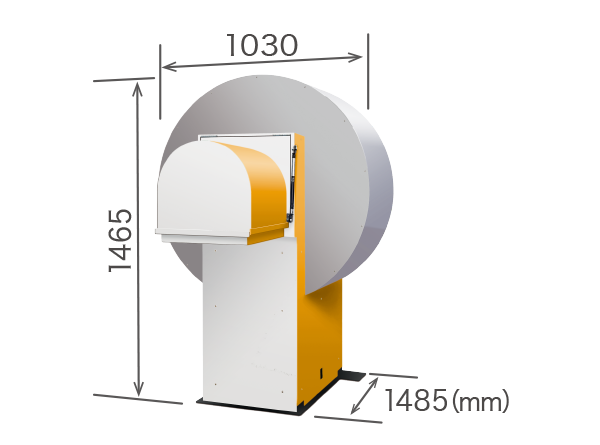
RF System Lab NAOMi-CT 3D-Slide L industrial X-ray CT scanner — front view
01
CT Scanner Overview

Slide-format CT scanner for long samples that won't fit a rotation envelope.

The NAOMi-CT 3D-Slide L is the long-format scanner in the RF System Lab industrial CT line, engineered for samples whose length exceeds the Φ300 mm envelope of the rotation-stage 3D-L. Instead of rotating the sample in place, the slide-format scanner translates the sample on a linear track through the X-ray beam path — supporting parts up to 1000 mm long, 360 mm wide, and 300 mm tall. The 100 kV / 10 mA source and 11.4 MP detector deliver 87 µm voxels along the scan length. Self-shielded to FDA 21 CFR 1020.40 for benchtop / factory-floor deployment.

87µm
Minimum Voxel
87 µm reconstructed voxel along the slide track. Resolves porosity, void chains, fiber orientation, and inclusion structure inside long samples without sectioning.
W360 mm × 300mm
Scan Envelope (Φ × H)
W360 × D1000 × H300 mm slide-format sample area. Holds large PCBs, full cable harnesses, long extrusions, vehicle subassembly sections, and complete composite test coupons.
100kV / 10mA
X-Ray Source
Same 100 kV / 10 mA micro-focus tube as 3D-M / 3D-L. Right kV class for aluminum, polymers, electronics, composites, and food / packaging samples.
11.4MP
Flat Panel Detector
11.4 MP amorphous-Si flat panel at 100 µm pixel pitch — calibrated to 87 µm voxel target across the slide travel range.
SELF-SHIELDED
No X-Ray Room Required
FDA-classified cabinet X-ray (21 CFR 1020.40). No X-ray room build-out, no licensed operator. Same self-shielded design as the rotation-stage Naomi units.
10kg
Max Sample Weight
10 kg maximum sample weight on the slide track. Machine itself is ~250 kg with a ~1300 mm long footprint — needs more bench depth than 3D-M / 3D-L.
02
X-Ray Source

100 kV / 10 mA micro-focus source with 0.5 mm focal spot.

Same source class as the rotation-stage Naomi units — the difference is sample handling.

The 3D-Slide L runs the same 100 kV / 10 mA micro-focus tube and 0.5 mm focal spot as the 3D-M and 3D-L. Penetration limits stay the same: aluminum to ~10 mm, polymers and composites at any sample-size-bound thickness, electronics, food / packaging, biological specimens. The structural difference is the slide track — the sample translates rather than rotates — which removes the Φ envelope constraint and replaces it with a long, narrow scan corridor.

100kV
Tube Voltage
10mA
Tube Current
0.5mm
Focal Spot
NAOMi-CT 3D-Slide L tall slide-format industrial X-ray CT scanner — 1030 mm wide chassis with vertical X-ray disk and front-facing sample slide stage
Application Review
Not sure if 100kV is enough penetration for your sample?

Send Rev1 your sample geometry, density, and target defect size. We will help validate whether the NAOMi-CT 3D-Slide L's 100kV / 10mA source has the penetrating power for your inspection workflow before you quote.

03
Flat Panel Detector

11.4 MP detector integrated across the 1000 mm slide travel.

The 3D-Slide L runs the same 11.4 MP amorphous-Si FPD class as the rotation-stage 3D-L, configured for the slide format. Per-slice acquisitions integrate along the 1000 mm linear travel to produce a continuous 3D volume of long samples at the 87 µm reconstructed voxel target.

100µm
Pixel Pitch
Matched to the 87 µm voxel target across the slide travel. Resolves solder joint voids, internal cable lay, terminal seating, and polymer flow defects without sectioning the part.
11.4 MP
Per-Slice Resolution
3792 × 3024 sensor on every slice. High pixel density across the W360 mm scan corridor, with reconstruction integrating slices along the 1000 mm slide axis into a continuous volume.
14-bit
Dynamic Range
Handles the long-sample materials mix: dense connectors, ribbon cables, polymer housings, composite plies, terminals — all readable in the same continuous scan along the slide.

Same detector class as the 3D-L, configured for length instead of diameter. The slide format earns its premium when sample length is the binding geometric constraint — the detector resolution is comparable to a rotation-stage metrology CT, but the geometry serves cable harnesses, vehicle subassembly sections, and long PCBs that won't fit a Φ envelope.

04
Scan Envelope & Sample Handling

Slide-format scan corridor: W360 × D1000 × H300 mm. Up to 10 kg.

A 360 mm wide by 1000 mm long by 300 mm tall scan corridor holds long samples in their native length: full cable harnesses, vehicle subassembly sections, extrusion samples, large PCBs, and complete composite test coupons. The slide track replaces the rotation stage — samples translate through the beam rather than spin in place. Sample weight is bounded at 10 kg by the slide drive; for parts at or near that limit, fixturing should distribute load along the slide length.

A precision linear slide with auto-positioning across the scan corridor.

The slide track carries the sample through the X-ray beam at controlled speed while the source-to-detector Z-lift sets the geometric magnification. Positioning repeatability holds at ~15 µm along the slide axis so that scan-to-scan comparisons across a production lot stay meaningful. Reconstruction integrates the per-slice projections along the slide length to produce a continuous 3D volume.
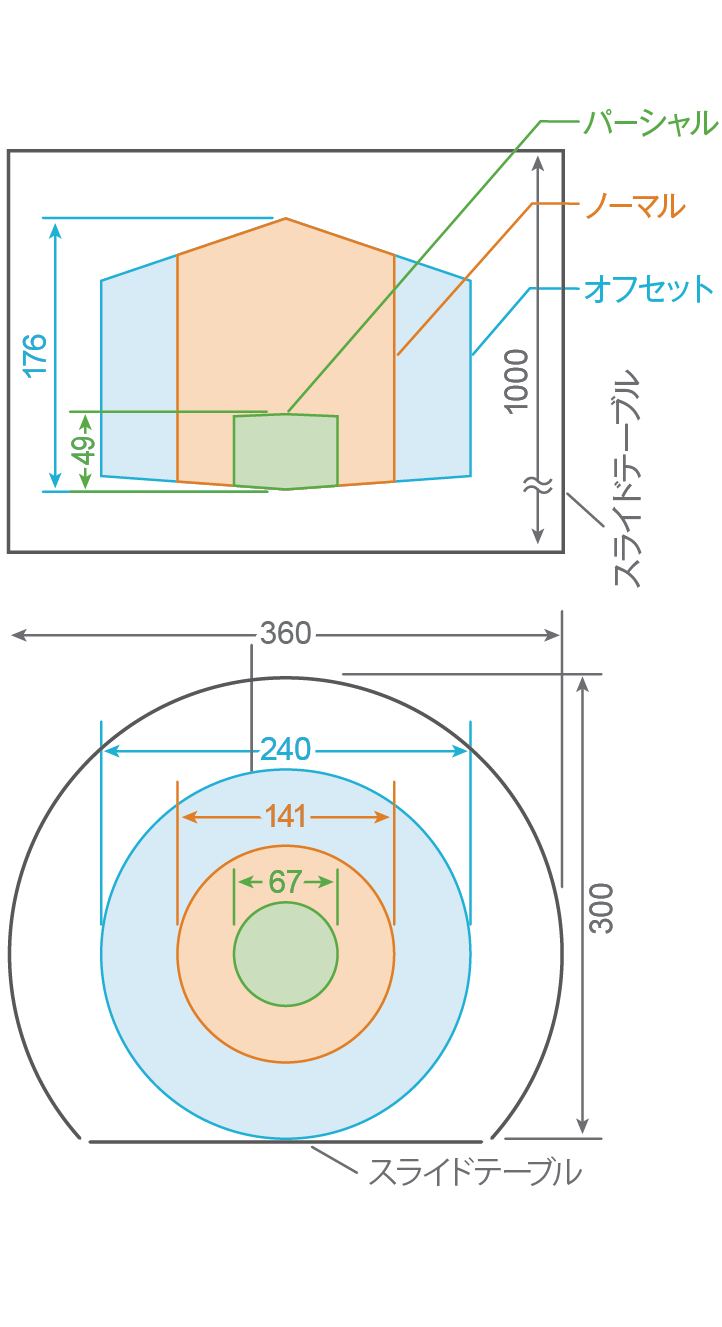
W360 mm
Max Diameter
300mm
Max Height
10kg
Max Weight
Linear slide + Z-lift + magnification
Stage Axes
NAOMi-CT 3D-Slide L slide-format scan corridor — W360 mm wide by 1000 mm long, H300 mm chamber
05
NDT in Production

Long PCBs. Cable harnesses. Vehicle subassembly sections. Extrusion samples.

Cable Harness & Long Electronics QA
Inspect full cable harnesses and long PCBs without sectioning.
Where the rotation-stage 3D-M and 3D-L are bounded by the diameter envelope, the slide-format 3D-Slide L scans full automotive cable harnesses, long PCBs, complete wire-routing assemblies, and rack-mount electronics in their native length. The 87 µm voxel resolves solder joint voids, internal cable lay, terminal seating, and assembly-tolerance failures without cutting the part open.
1000 mm
Maximum sample length
Composite Lay-Up & Long-Form Plastics
Long composite test coupons and large-format injection moldings.
Composite lay-up audit on long test coupons, ply-orientation verification across full panel sections, and internal-structure inspection of large-format plastic moldings — the slide track lets you scan the full part rather than a 250 mm subsection. The 11.4 MP detector at 100 µm pitch delivers high slice density across the scan corridor.
11.4 MP
FPD detector resolution

These are the application classes the 3D-Slide L was engineered around. For samples that fit a rotation envelope, the 3D-M (Φ250 mm, $38,999) or 3D-L (Φ300 mm, $51,499) is the more cost-effective choice. The slide format earns its premium when sample length is the binding geometric constraint.

06
Reconstruction & Analysis

Filtered back projection, iterative reconstruction, defect quantification, CAD bridge.

The bundled NAOMi-CT software handles end-to-end acquisition, FBP and iterative reconstruction, multi-planar reformat (MPR), volume rendering, automated porosity and void quantification with CSV / report export, and surface extraction to STL or STEP for downstream CAD compare and dimensional metrology in VGSTUDIO MAX, Volume Graphics, or any standard CAD platform. Reconstructed volumes export as DICOM stack, TIFF stack, or VGL.

Filtered Back Projection
Standard FBP reconstruction plus iterative algorithms for low-dose / high-noise samples. 2-5 min for a typical scan.
2-5 min
Defect & Porosity Analysis
Automated porosity quantification, void detection, and defect sizing. Outputs to CSV / report templates for QA records.
AUTOMATED
Dimensional Metrology
CAD comparison, GD&T, wall thickness analysis. Bridge to VGSTUDIO MAX, Volume Graphics, and standard CAD platforms via STL / STEP export.
CAD COMPARE
07
NAOMi-CT 3D-Slide L in Action

See the Naomi CT line image internal structure across material classes.

The hero video shows a NAOMi-CT detecting voids inside an aluminum casting. The six-tile gallery samples the breadth of materials the Naomi line images in production: aluminum HPDC porosity, plastic injection void analysis, electronics and PCB assembly verification, battery cell internal structure, and consumer-product range. All from RF System Lab reference scans — click any tile to play.

08
Workflow & Connectivity

Workstation control. DICOM / TIFF / STL / STEP export. Air-gapped operation.

The 3D-Slide L is operated from a dedicated workstation with the vendor reconstruction software pre-installed. Data lives locally — no cloud dependency for sensitive inspection records, no third-party uplink for ITAR / EAR / classified-facility deployments. LAN export to network storage and air-gapped operation are both supported.

Workstation Control
Dedicated PC workstation with vendor reconstruction software. Local data, no cloud dependency for sensitive inspection records.
DICOM / TIFF Export
Export reconstructed volumes as DICOM, TIFF stack, or VGL format for downstream analysis in VGSTUDIO MAX, Volume Graphics, or in-house QA tooling.
CAD Bridge (STL / STEP)
Direct surface extraction to STL / STEP for CAD comparison, reverse engineering, and dimensional metrology workflows.
Network & Archive
LAN export to network storage. Air-gapped operation supported for ITAR / EAR / classified facility environments.
09
Industries Served

Long-sample QA — cable harnesses, PCBs, composites, vehicle subassemblies.

The 3D-Slide L targets in-house production-QA and R&D applications where sample length is the binding constraint: full automotive cable harnesses, complete wire-routing assemblies, long-format PCBs, vehicle subassembly sections, large composite test coupons, and long-form plastic moldings. Same self-shielded deployment story as the rotation-stage Naomi units, with a long-sample geometry.

🔌
Electronics & PCB Inspection
Additive Manufacturing QC
🚗
Automotive & EV Components
Aerospace & Defense NDT
🧪
Plastics, Composites & Ceramics
🏛
Research & University Labs
10
Sample Compatibility

What the 3D-Slide L is built to scan — and what it is not.

The 100 kV / 10 mA source qualifies the 3D-Slide L for light alloys (aluminum to ~10 mm thick), polymers and composites at any sample-size-bound thickness, electronics including long PCBs and cable harnesses, food packaging, and biological specimens — with the slide-format envelope optimized for parts where length is the binding constraint. For thicker steel components or dense ceramics, step up to a 225+ kV vendor.

PCB & Electronics Assemblies Additive Manufactured Parts Plastic Injection Moldings Composite Lay-Ups Castings (Al / Mg / Zn) Ceramic Components Battery Cells (cylindrical / pouch) Polymer Foams EV Modules Welds & Brazed Joints Geological / Core Samples Biological Specimens (preserved)
11
Competitive Comparison

NAOMi-CT 3D-Slide L vs. industry benchmarks & intra-brand peers.

We benchmark the 3D-Slide L against the standard metrology-CT punch-up tier (Nikon Metrology XT H 225 ST 2x and ZEISS METROTOM 1500) plus an open-vendor mid-market peer (North Star Imaging X5000), and against the natural intra-brand cross-shop (NAOMi-CT 3D-L, the rotation-stage sibling). The goal is buyer clarity: where the 3D-Slide L leads on long-sample geometry — and where a different system genuinely fits better.

Scanner
Scan Envelope
Source / Detector
Min Voxel
Where It Fits
Nikon Metrology XT H 225 ST 2xindustry-standard punch-up · ~4× the price
Φ500 × H800 mm
225 kV / 1 mA · 4MP+ FPD
1 µm
Metrology-grade rotation-stage CT with sub-10-µm voxel for cert-pipeline aerospace and dense alloys. Roughly 4× the 3D-Slide L price plus a shielded-room facility build-out and a licensed operator. Choose Nikon Metrology when sub-10-µm voxel on dense materials is the binding constraint AND samples fit the rotation envelope.
ZEISS METROTOM 1500premium peer · ~5× the price
Φ300 × H350 mm
225 kV · high-MP FPD
8 µm
Premium rotation-stage metrology CT integrated with the ZEISS CAD compare and GD&T workflow. ~5× the 3D-Slide L price. Best when the production line already runs ZEISS metrology software AND samples fit a rotation envelope — not the binding choice for long-sample inspection.
North Star Imaging X5000open-vendor peer
Variable; large-envelope configurations
Up to 450 kV
5–50 µm
Open-vendor mid-market CT at significantly higher cost than the 3D-Slide L. Choose North Star Imaging when sample size or kV requirement exceeds the 3D-Slide L envelope and budget allows.
NAOMi-CT 3D-Lintra-brand peer
Φ300 × H320 mm rotation envelope
100 kV · 11.4MP FPD
95 µm
Step DOWN to the rotation-stage 3D-L when the sample fits inside Φ300 × H320 mm. Same source class, same detector, $51,499 — $27,000 less than the slide-format unit. Use the 3D-Slide L only when sample length is the binding geometric constraint.
Rev1 takeaway: the 3D-Slide L earns its premium when sample length exceeds a rotation envelope. For samples that fit a rotation stage, the 3D-L is roughly $27K less for the same source and detector class. Punch up to 225 kV metrology systems only when dense materials or sub-10-µm voxel is the binding constraint. Application review with Rev1 confirms which Naomi configuration fits before quote.
Application Review
Cross-shopping a Nikon Metrology or ZEISS METROTOM?

Send Rev1 your sample geometry, target voxel, and inspection workflow and we will tell you which CT platform actually fits the application — including when a different vendor is the better answer.

12
Technical Specifications

RF System Lab NAOMi-CT 3D-Slide L — full specifications.

X-Ray Source
Tube Type
Sealed micro-focus tube
Max Tube Voltage
100kV
Max Tube Current
10mA
Focal Spot
0.5mm
Cooling
Oil & air-cooled
Detector
Detector Type
Amorphous-Si Flat Panel
Active Area
430 x 430 mm
Resolution
11.4MP
Pixel Pitch
100µm
Dynamic Range
14-bit
Scan Envelope
Max Sample Diameter
W360 mm
Max Sample Height
300mm
Max Sample Weight
10kg
Min Voxel Size
87µm
Sample Stage
Stage Type
Linear slide track (W360 × D1000 mm)
Stage Axes
Linear slide + Z-lift + magnification
Positioning Repeatability
±15µm
Reconstruction & Software
Reconstruction Method
FBP / Iterative
Typical Scan Time
~60 sec per slice
Reconstruction Time
2-5 min
Output Formats
DICOM · TIFF stack · STL · STEP · VGL
Workstation OS
Windows 11 Pro
Shielding & Safety
Shielding
Self-shielded — no X-ray room required
Compliance
FDA cabinet X-ray (21 CFR 1020.40), self-shielded
Door Interlocks
Dual-redundant safety interlocks
Radiation Leakage
< 1 µSv/h at 5cm from cabinet
Electrical & Facility
Power Input
AC 100-240V, 50/60 Hz, single phase
Rated Power
1.0 kVA peak
Operating Temperature
15-30°C
Connectivity
LAN (network export) · USB · air-gapped operation supported
Physical
Machine Dimensions
1485 x 1030 x 1465 mm (D x W x H)
Machine Weight
~250 kg
Floor Footprint
~1.5 m²
13
Downloads & Support

Documentation, software, and Rev1 support resources.

14
Authorized Partner

RF System Lab hardware with Rev1 application support.

An industrial X-ray CT scanner is a multi-year application investment, not just a hardware purchase. Rev1 helps validate the target sample, voxel requirement, source kV class, facility shielding plan, software workflow, and total cost of ownership before the NAOMi-CT 3D-Slide L is deployed in your QA lab or production line.

01
Application Review

Confirm whether the NAOMi-CT 3D-Slide L is the right CT platform for the specific sample geometry, defect-size target, throughput requirement, and downstream analysis workflow — or whether a larger / smaller / higher-kV vendor is the better fit.

02
Facility & Compliance Planning

Plan electrical, footprint, environmental, and shielding compliance for the 100kV source class. Self-shielded means no X-ray room build-out, but facility power and HVAC still need to be sized correctly.

03
US-Based Support

Work with Rev1 for quoting, freight, install support, software training, and practical troubleshooting from Auburn Hills, Michigan — not from a grey-market reseller or unauthorized importer.

04
Software & Workflow Bridge

Integrate the NAOMi-CT 3D-Slide L output with VGSTUDIO MAX, Volume Graphics, downstream CAD comparison, and your existing QA reporting workflow. Rev1 helps make the data useful, not just acquired.

15
Buyer FAQ

RF System Lab NAOMi-CT 3D-Slide L questions buyers ask before quoting.

What is the NAOMi-CT 3D-Slide L designed for?
The NAOMi-CT 3D-Slide L is the slide-format scanner in the RF System Lab CT line, designed for samples whose length exceeds a rotation-stage envelope. Instead of rotating the sample in place, the slide-format scanner translates the sample on a linear track through the X-ray beam path. Typical use cases are full automotive cable harnesses, long PCBs, vehicle subassembly sections, composite test coupons, and long-form plastic moldings.
How is the slide format different from the rotation-stage 3D-M / 3D-L?
The 3D-M and 3D-L use a rotation stage — the sample spins in place inside a Φ250 / Φ300 mm envelope. The 3D-Slide L uses a linear slide track — the sample translates through the beam path along a 1000 mm corridor. Same 100 kV source, same 11.4 MP detector class, but the geometry is optimized for long samples instead of round ones.
What materials and sample types can the 3D-Slide L scan?
The 100 kV / 10 mA source qualifies the 3D-Slide L for light alloys including aluminum up to roughly 10 mm thick, polymers and composites at any sample-size-bound thickness, electronics including long PCBs and full cable harnesses, food packaging, and biological specimens — across a slide-format scan corridor of W360 × D1000 × H300 mm.
How small a defect can the 3D-Slide L resolve?
The 3D-Slide L reconstructs voxels down to 87 µm. Small enough to image porosity, hairline cracks, void chains, fiber orientation, fine inclusions, solder joint voids, terminal seating defects, and polymer flow defects on the long-sample classes the system targets. The 11.4 MP detector at 100 µm pixel pitch is matched to that 87 µm voxel target across the slide travel range.
How long does a scan take on the 3D-Slide L?
A single slice completes in approximately 60 seconds. Total scan time depends on sample length and chosen voxel size — longer samples integrate more slices along the slide travel. Reconstruction adds 2-5 minutes per scan depending on chosen voxel and reconstruction algorithm.
Does the 3D-Slide L require an X-ray room or licensed operator?
No. Same self-shielded design as the rotation-stage Naomi units, scaled to the slide-format chassis. The cabinet is FDA-classified under 21 CFR 1020.40 with radiation leakage below 1 µSv/h at 5 cm from the cabinet exterior. No X-ray room build-out, no facility shielding plan, no licensed-operator credential is required.
What software does the 3D-Slide L use, and can I export to my existing CAD or metrology workflow?
The 3D-Slide L ships with the bundled NAOMi-CT software for acquisition, FBP and iterative reconstruction, multi-planar reformat, volume rendering, and automated porosity / void quantification with CSV and report export. Reconstructed volumes export as DICOM stack, TIFF stack, or VGL for downstream analysis in VGSTUDIO MAX or Volume Graphics. Surface extraction to STL or STEP supports CAD-compare and dimensional-metrology workflows in any standard CAD platform.
What does Rev1 installation, training, and post-sale support include?
Rev1 supports 3D-Slide L buyers from quote through production. Pre-sale: application review, sample-fit validation, facility power and footprint check (the slide-format chassis needs more bench depth than rotation-stage units). At install: setup guidance, calibration verification, operator orientation. Post-sale: phone and video support, software-workflow guidance, parts coordination, and engineering troubleshooting from Auburn Hills, Michigan.
How does the 3D-Slide L compare to a Nikon Metrology XT H 225 ST 2x?
The Nikon Metrology XT H 225 ST 2x is a rotation-stage metrology CT with a 225 kV source and sub-10 µm voxel resolution — for cert-pipeline aerospace inspection, dense alloys, and parts requiring serious penetration. It runs roughly 4× the 3D-Slide L price and requires a shielded X-ray room plus a licensed operator. The 3D-Slide L is the right answer when sample length (up to 1000 mm) is the binding geometric constraint and the application is light alloys, polymers, electronics, or composites in the 87 µm voxel band.
How does the 3D-Slide L compare to a ZEISS METROTOM 1500?
The ZEISS METROTOM 1500 is a rotation-stage premium metrology CT — Φ300 × H350 mm envelope at 225 kV with ~8 µm voxel resolution. It runs ~5× the 3D-Slide L price. ZEISS is the right answer when the production line already runs ZEISS metrology software AND samples fit a rotation envelope. The 3D-Slide L wins on long-sample geometry: full cable harnesses, long PCBs, vehicle subassembly sections that exceed a 300 mm rotation envelope.
Ready for answers?
Talk through the application before the quote.

Use the FAQ as the starting point. Rev1 can confirm sample fit, voxel target, source class, facility power, shielding compliance, and delivery considerations before the NAOMi-CT 3D-Slide L is ordered.

Final Step

Get a quote or schedule a NAOMi-CT 3D-Slide L application review.

Rev1 validates sample fit, voxel target, source kV class, facility power, shielding compliance, software workflow, and total cost of ownership before you commit. US-based application support and post-sale guidance from Auburn Hills, Michigan.