HeyGears UltraCraft Reflex Turbo 385 nm True-UV, Set-and-Forget Resin Printing
385 nm True-UV, Set-and-Forget Resin Printing
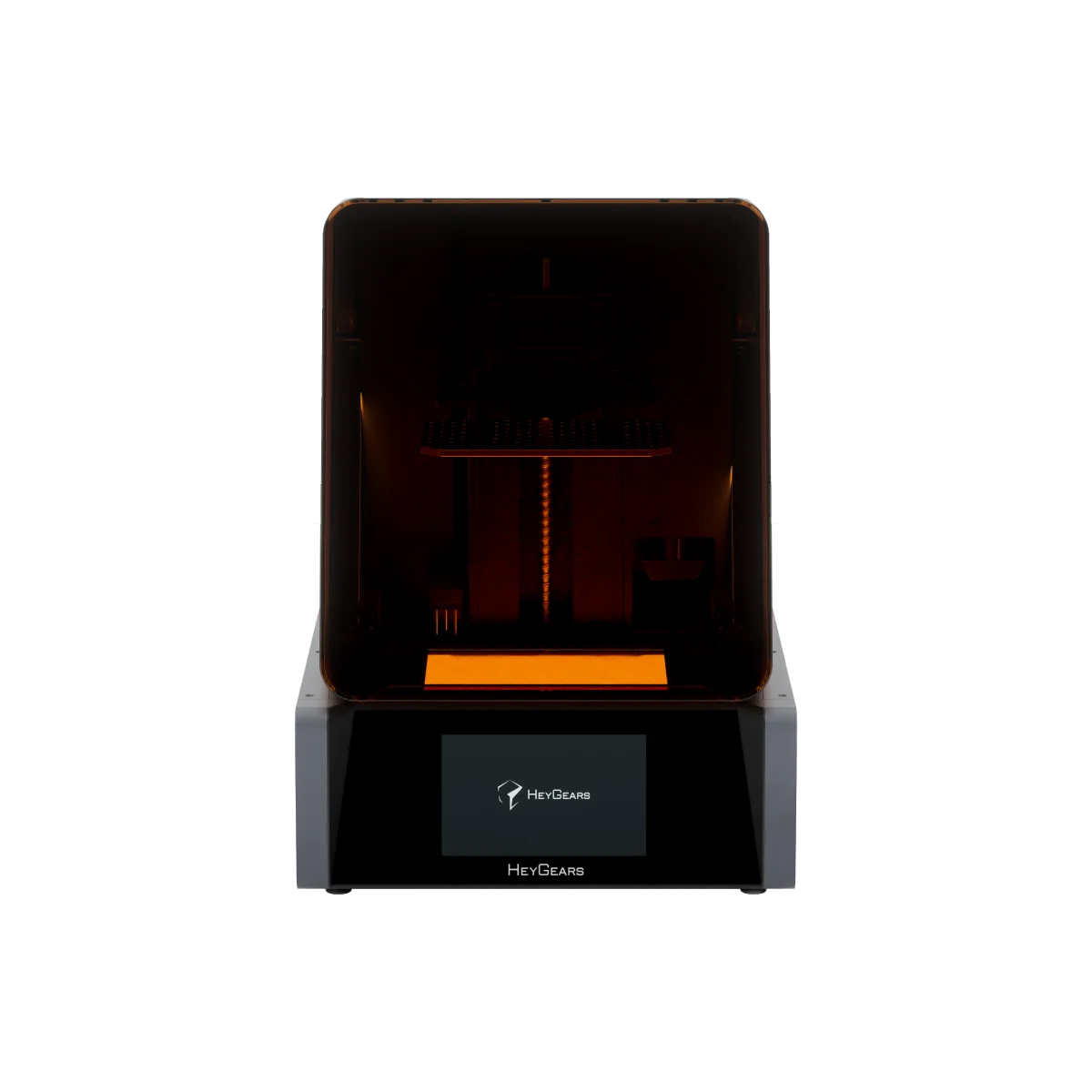
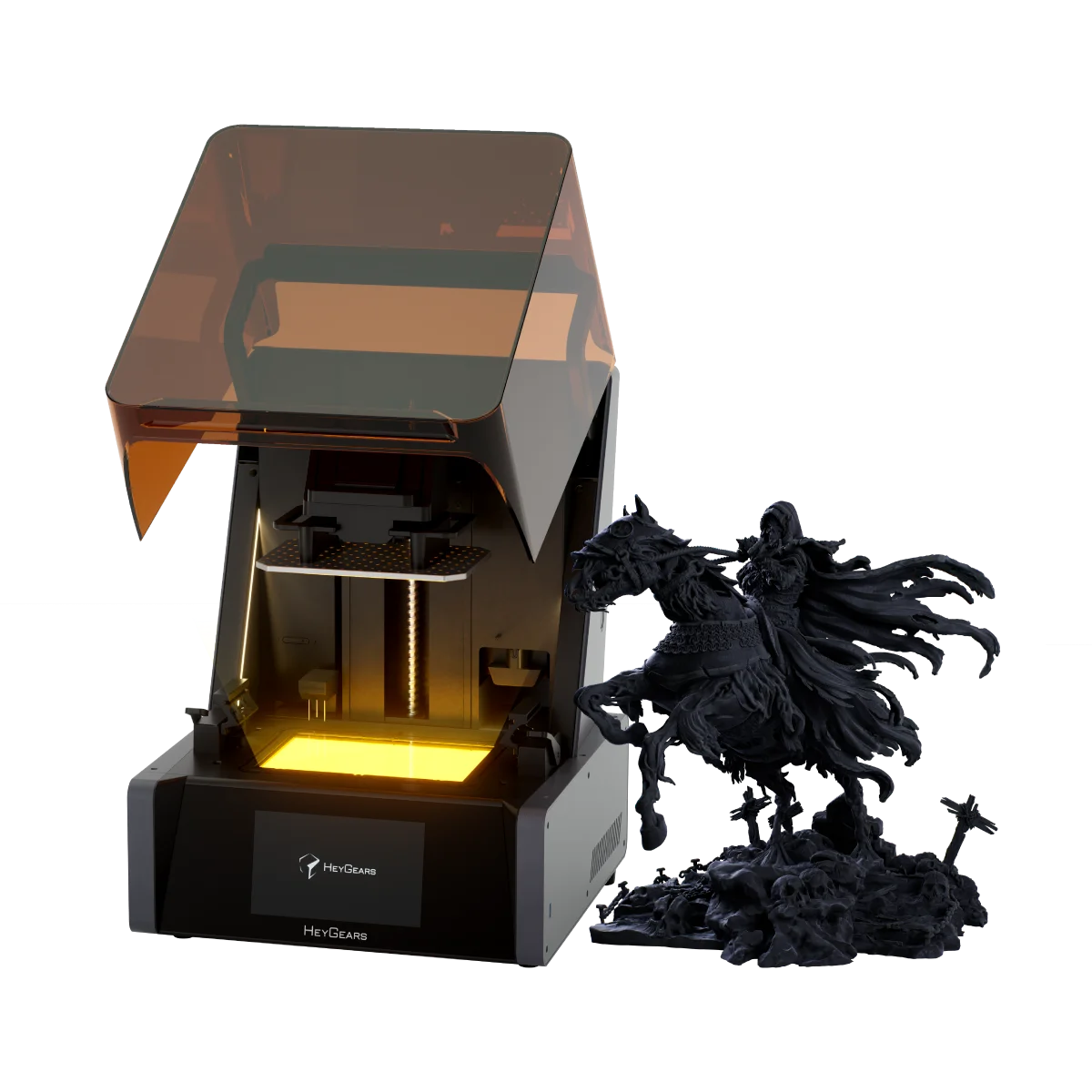
Commercial-grade resin printing with the workflow doing the work for you. The Reflex Turbo pairs a 385+ nm true-UV light engine with full closed-loop automation — auto-leveling, automatic resin refill, residue detection and a heated tank — so prints start right and finish unattended. A longer-life 9.25-inch amber screen and HeyGears’ AI motion and exposure algorithms hold detail to 0.136 mm, run after run. Full specifications →
Authorized HeyGears reseller in the USA — Rev1 confirms the right resin set and configuration for your application. Questions? Call (248) 707-2950.
An Authorized HeyGears Reseller in the USA.
Rev1 Technologies is an authorized HeyGears reseller serving manufacturers and studios across the United States. Application consultation, genuine OEM hardware and resin, Klarna EasyPay financing, and US-based phone and video support are delivered from Auburn Hills, Michigan.


A resin printer that runs itself, and prints harder.
Most desktop resin printers ask you to babysit them: level the plate, top up the tank, watch for a failed layer, and hope the cure was even. The Reflex Turbo is built to remove that labor. A 385+ nm true-UV light engine cures resin roughly 1.5× faster and more completely than a typical 405 nm machine, while a closed loop of automation — auto-leveling, automatic resin refill, residue detection and a heated tank — keeps a job running start to finish without an operator standing over it. The result is a machine that behaves less like a hobby printer and more like a small production cell: load a validated profile, send the job, and come back to finished parts.
A true-UV source cures resin about 1.5× faster and more thoroughly than 405 nm, for stronger parts and shorter cycles.
An amber masking LCD with +22% contrast and roughly 2.5× the lifespan of the previous generation — sharper edges, fewer screen swaps.
Auto-leveling, automatic resin refill, residue detection and a heated tank work together so prints start right and finish unattended.
A 33µm native pixel with 90.6% detail restoration resolves fine features cleanly across the full plate.
A C5 ground ball-screw Z-module holds ±2µm repeatability, so layers stack consistently print after print.
Authorized HeyGears reseller with US warehouse stock, genuine OEM resin, application review and ongoing support.
385 nm true-UV cures faster, harder, deeper.
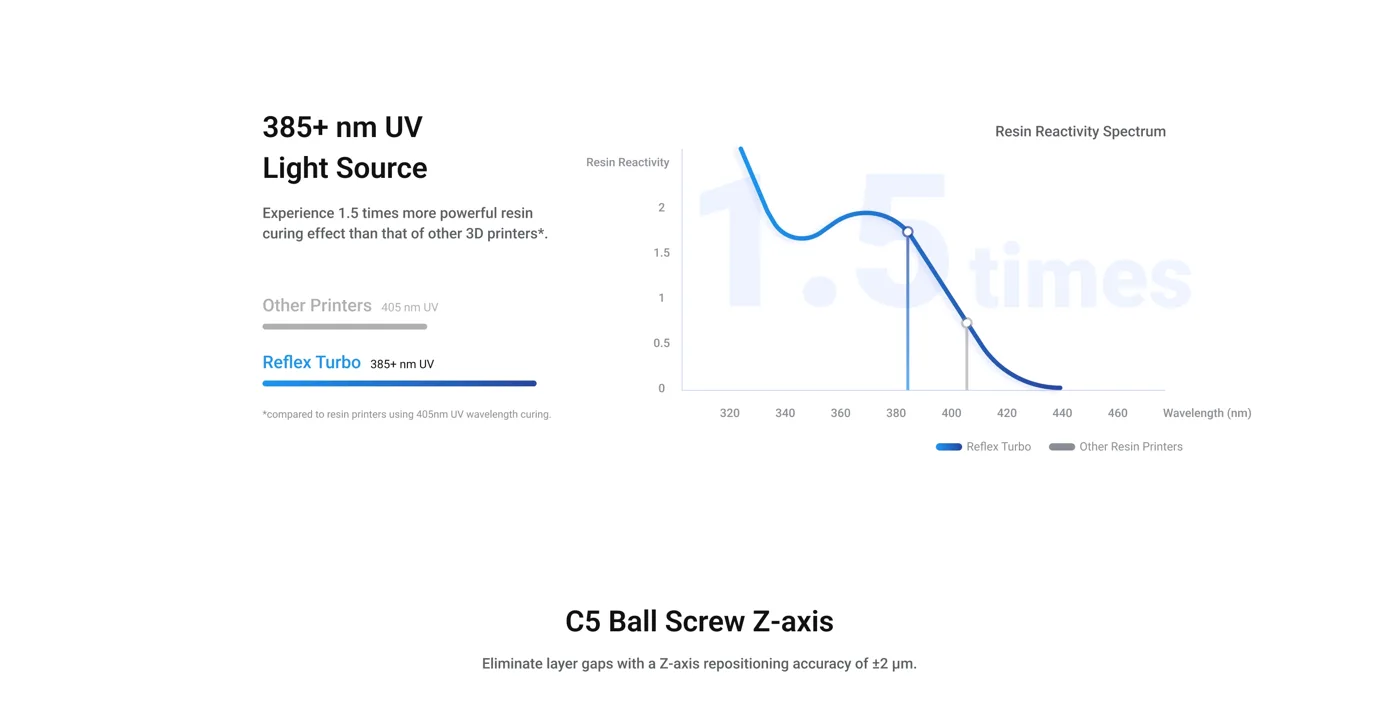
The wavelength most resins actually want.
Photoinitiators in most engineering resins react more efficiently to 385 nm than to the 405 nm light common on consumer printers — the Reflex Turbo delivers roughly 1.5× the effective curing power.
Curing energy is where resin parts earn their strength. A 405 nm source leaves many high-performance resins partially cross-linked unless you slow the print down; the Reflex Turbo’s 385+ nm true-UV engine drives the reaction harder, so parts reach full mechanical properties with shorter exposures and cleaner deep-cure. For tough, elastic and engineering resins, that means stronger, more dimensionally stable parts — and faster cycles, because you are not padding exposure times to compensate for a weaker wavelength. It also improves consistency batch to batch: when a layer reaches full cure within its intended exposure window, small variations in resin temperature or age have far less effect on the finished part, so the hundredth print behaves like the first. For a shop quoting repeatable parts, that predictability is worth as much as raw speed.
A 9.25-inch amber screen that lasts and resolves.
Sharper edges, far fewer screen swaps.
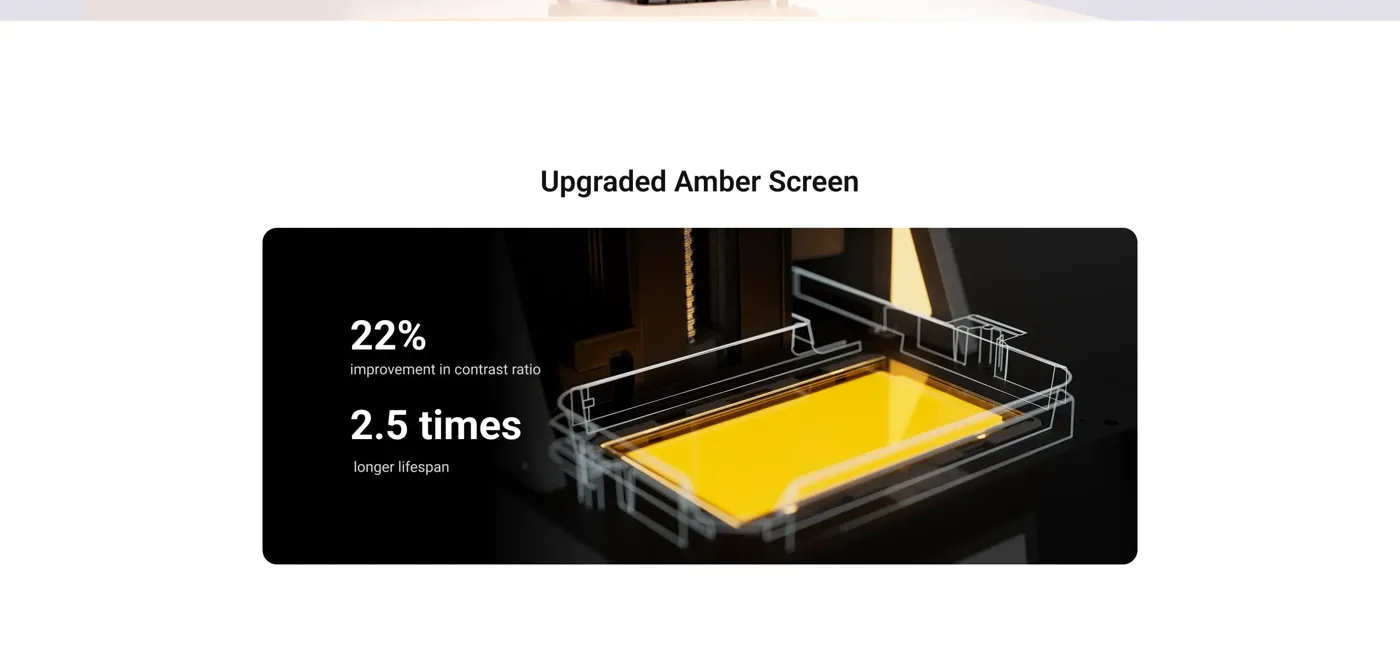
The 9.25-inch amber masking LCD raises contrast about 22% for crisper feature edges, and is rated to roughly 2.5× the lifespan of the previous generation.
On LCD resin printers the masking screen is a consumable — UV exposure slowly degrades it, softening detail and eventually forcing a replacement. The Reflex Turbo’s amber screen is engineered for both sharpness and endurance: higher contrast means the boundary between cured and uncured pixels is cleaner, so edges and fine text resolve better, while the extended lifespan lowers running cost and keeps quality consistent far longer between swaps. Light intensity is held within roughly ±3% across the build area, so a part at the corner matches one printed dead center.
Industrial Z-motion for repeatable layers.
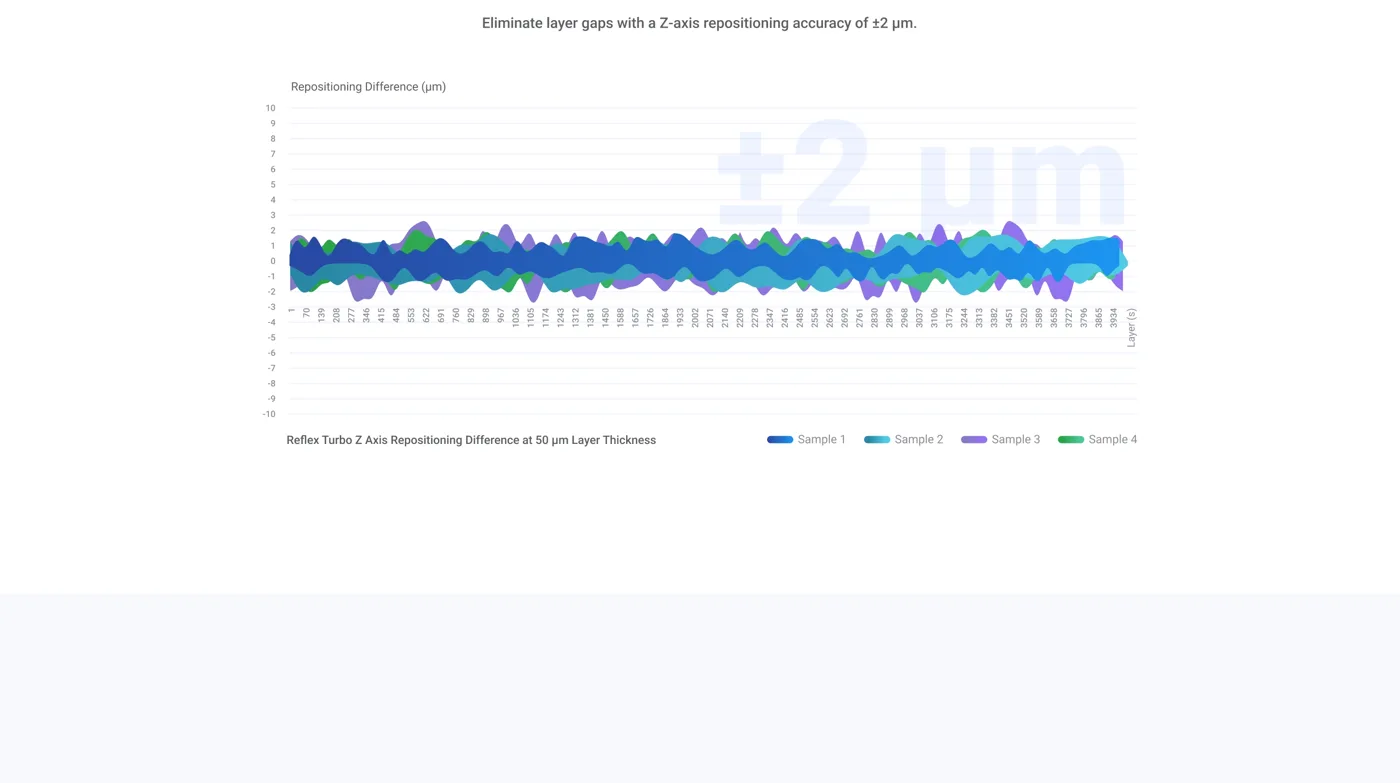
±2µm repeatability, layer after layer.
A C5-grade ground ball-screw drives the Z-axis to ±2µm repeatability, while adaptive Z-compensation smooths the stepping that shows on flat top surfaces.
Resin accuracy is decided as much by how the platform moves as by the screen. The Reflex Turbo pairs a precision-ground C5 ball-screw module with HeyGears’ AI motion control, tuning lift-and-settle motion per layer to cut peel forces and keep tall, slender features intact. Adaptive Z-compensation corrects the micro-stepping that leaves visible bands on flat tops, so surfaces come off smooth and parts hold their published tolerances run after run — the consistency a production workflow depends on.
Cures supports and shells to their own needs.
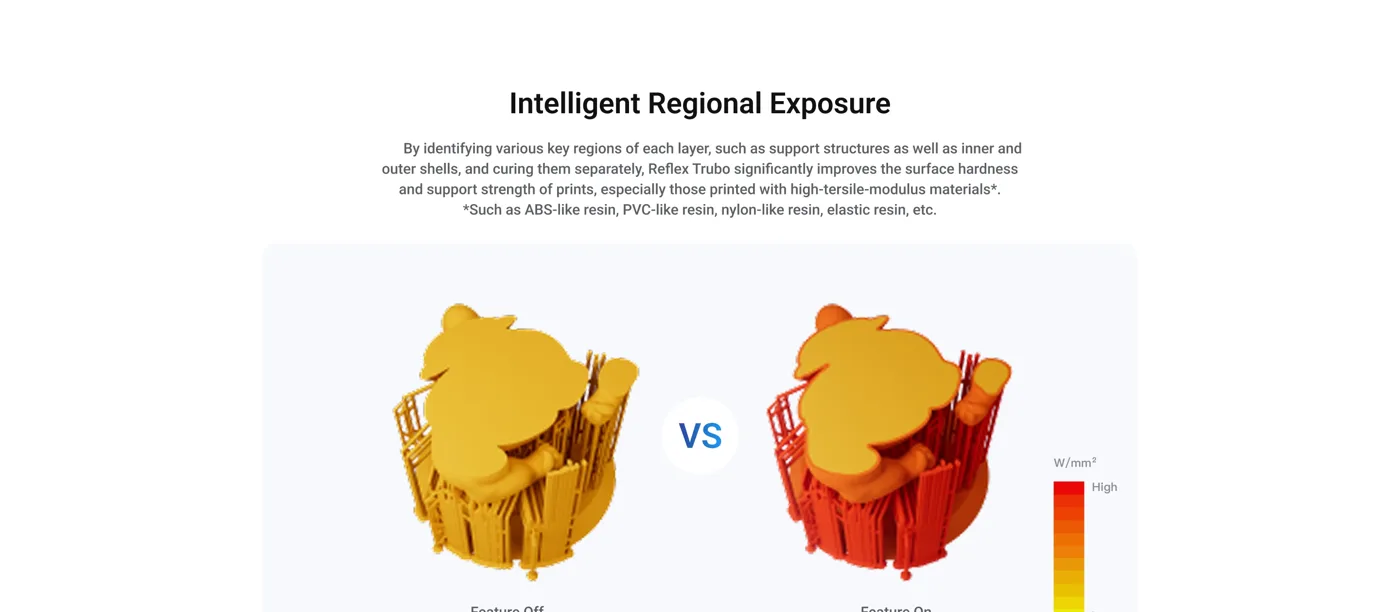
Different regions, different exposure.
The Turbo identifies key regions of each layer — support structures, inner cores and outer shells — and cures them separately for higher surface hardness and stronger supports.
A single flat exposure per layer is a compromise: enough energy to anchor supports often over-cures fine surface detail, and enough to keep detail crisp can leave supports weak. Intelligent regional exposure breaks that trade-off by varying cure energy across the layer, which especially helps high-tensile-modulus materials like ABS-like, PVC-like, nylon-like and elastic resins. The payoff is parts that hold sharp surfaces while their supports stay strong enough to survive the print and detach cleanly.
Set it, send it, walk away.

The four jobs you used to do by hand.
Floating-screen auto-leveling, automatic resin refill, force-sensor residue detection and a heated tank turn a hands-on machine into a set-and-forget one.
Each automation removes a common failure point. Floating-screen auto-leveling corrects to 0.15° with up to 240µm of gap compensation, so the first layer plants every time. Automatic resin refill tops the tank to within 5 g, so long jobs never starve. A 0.1 N force sensor detects cured residue from 0.2 mm and stops the print before a stuck fragment cracks the screen. And the heated tank brings resin from 10°C to 22°C so viscosity and cure stay consistent regardless of room temperature. Together they let the Reflex Turbo run unattended overnight with confidence. The practical effect is that the machine stops demanding an experienced operator’s constant attention: a new team member can load a validated profile and trust the printer to catch the problems that normally ruin an unsupervised job, which is exactly what turns a single printer into a dependable production resource rather than a device someone has to nurse.
From miniatures to functional engineering parts.
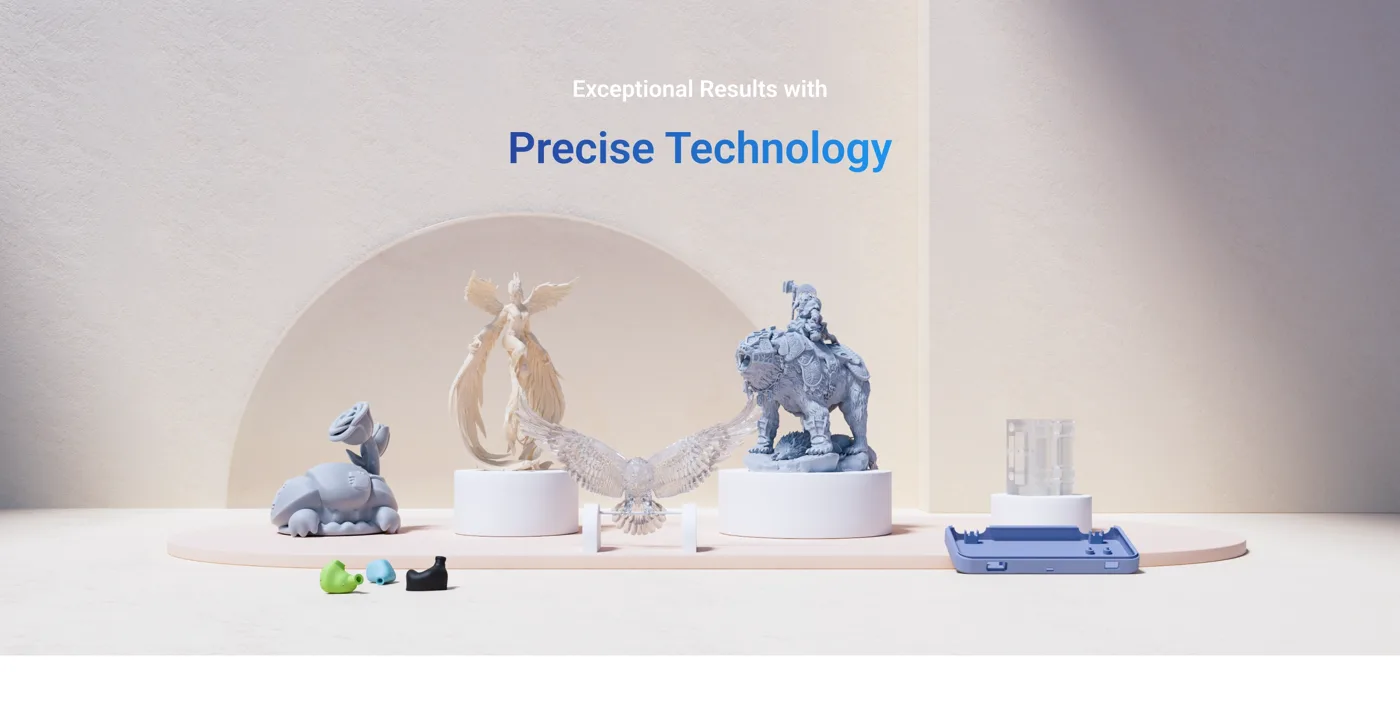
Detail and durability from the same printer.
Because the Turbo pairs a high-detail 33µm screen with a hard-curing 385 nm engine and a deep resin range, the same machine produces crisp miniatures and display models, dental and jewelry work, and functional engineering components in tough, elastic and detail resins. Studios use it to take a concept from file to finished, repeatable part without switching printers — and the automation means the tenth part matches the first. That versatility is what lets a small studio consolidate onto a single dependable machine instead of juggling a detail printer and a separate workhorse. Rev1 helps qualify the right resin set for your application before you commit.
One-click prep, cloud queue, remote monitoring.
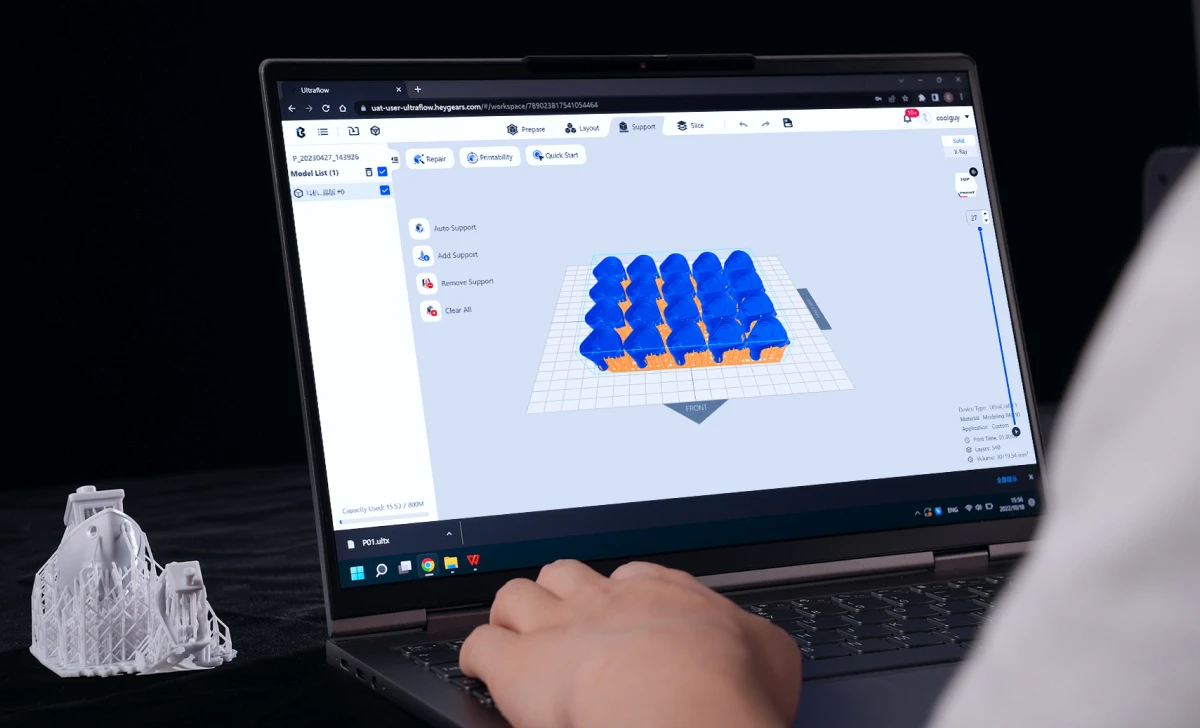
The workflow that makes it set-and-forget.
HeyGears’ slicer prepares models with one-click auto-supports and validated resin profiles, then sends jobs over USB, Wi-Fi or Ethernet — with cloud management and remote monitoring for fleets.
Automation in the machine only pays off if the software feeds it good jobs. The HeyGears suite handles model repair, printability checks and auto-support generation, and ships matched profiles so a resin’s print, exposure and motion settings are already dialed in. Jobs queue to the printer over the network, and cloud management lets a studio monitor progress and manage multiple machines remotely — so the Turbo fits a single bench or a growing production cell with the same workflow.
A deep resin range, validated end to end.
Tough, elastic, clear and detail — or bring your own.
The Turbo ships with validated profiles for HeyGears UltraPrint resins — PAT10 Clear, PAU20 Tough, PAE20 Elastic and PAP10 Detail — and stays open for third-party materials.
Because the 385 nm engine cures a wider range of chemistries effectively, the Turbo covers everything from high-clarity transparent parts and flexible elastomer-like prints to stiff engineering components and ultra-fine detail models. Matched profiles mean each resin’s exposure and motion are already tuned, so switching materials is a profile change rather than a tuning session — and open-material support keeps the door open when a job demands a specific certification or property. Rev1 helps you qualify and dial in any resin before production. In day-to-day use most studios settle on a small core set — one tough engineering resin, one high-detail model resin, and a specialty such as clear or elastic — and lean on the validated profiles so swapping between them is routine rather than a re-tuning exercise. Because the 385 nm engine and matched profiles do the heavy lifting, the finish you sign off on in testing is the finish you keep getting in production.
How the Reflex Turbo compares.
| Capability | Reflex Turbo | Formlabs Form 4 | Phrozen Sonic Mighty Revo | Anycubic Photon M7 Pro |
|---|---|---|---|---|
| Light engine | 385+ nm true UV | 405 nm LFS (SLA) | 405 nm LED-LCD | 405 nm LED-LCD |
| Closed-loop automation | Auto-level + refill + residue + heat | Partial | Minimal | Minimal |
| Heated resin tank | Yes | Yes | No | No |
| Z-axis | C5 · ±2µm | Industrial | Dual linear | Dual linear |
| Approx. street price | $1,499 | ~$3,800+ | ~$1,900+ | ~$1,700+ |
Comparison sourced from published manufacturer data at build time. Street prices are approximate; validate specifications against your part geometry, resin and finish requirements before purchase. The Reflex Turbo’s distinction is a 385 nm true-UV engine paired with full closed-loop automation at a price well below comparable automated resin systems from the established premium brands.
UltraCraft Reflex Turbo Technical Data
RESOURCES
Downloads & Technical Support
Everything you need to qualify and run your Reflex Turbo with confidence.
WHY REV1 TECH
Authorized HeyGears Reseller. Resin Workflow Specialists.
Rev1 Technologies is an authorized HeyGears reseller, headquartered in Auburn Hills, MI, with hands-on expertise in resin production workflows.
Rev1 Technologies is an authorized HeyGears reseller serving manufacturers and studios across the USA. We don’t just ship boxes — we help you choose resins, set up the workflow, and support your team so the Reflex Turbo produces in-spec parts from day one.
Reflex Turbo questions.
What does the 385 nm true-UV light engine actually do for me?
Most resin photoinitiators react more efficiently to 385 nm than to the 405 nm light used by consumer printers, so the Reflex Turbo cures roughly 1.5× faster and more completely. In practice that means stronger, more dimensionally stable parts — especially in tough and engineering resins — and shorter print cycles because you don’t need to pad exposure to compensate.
What makes it “set-and-forget”?
Four automations work together: floating-screen auto-leveling (0.15°, up to 240µm compensation), automatic resin refill (tops the tank to within 5 g), force-sensor residue detection (catches cured fragments from 0.2 mm and stops before screen damage), and a heated tank (10→22°C for consistent viscosity). Together they let the printer start a job correctly and run unattended overnight.
What is the build volume and resolution?
The build volume is 191 × 121 × 220 mm, with a 33µm native XY pixel on a 9.25-inch amber LCD, ±16µm accuracy and 0.136 mm smallest detail (90.6% detail restoration). The Z-axis is a C5 ground ball screw with ±2µm repeatability.
How long does the amber screen last?
The 9.25-inch amber masking LCD is rated to roughly 2.5× the lifespan of the previous generation and raises contrast about 22% for crisper edges. That lowers running cost and keeps print quality consistent far longer between screen replacements.
Which resins can I run?
It ships with validated profiles for HeyGears UltraPrint resins — PAT10 Clear, PAU20 Tough, PAE20 Elastic and PAP10 Detail — and supports open third-party materials. The 385 nm engine cures a wide range of chemistries effectively, from high-clarity and flexible resins to stiff engineering materials.
What software and connectivity does it use?
The HeyGears slicer handles model repair, printability checks and one-click auto-supports, and ships matched resin profiles. Jobs send over USB, Wi-Fi or Ethernet, with cloud management and remote monitoring for running multiple machines.
What are the facility requirements?
The printer measures 400 × 420 × 572 mm and weighs 25 kg, running on 100–240 V at 350 W — a standard bench and outlet. Rev1 reviews placement, ventilation and resin handling with you before delivery.
How is the Turbo different from the other UltraCraft Reflex models?
The Reflex family spans several tiers. The Turbo’s signature is its 385 nm true-UV light engine paired with the long-life 9.25-inch amber screen and full closed-loop automation, positioned as the set-and-forget production option. The Reflex RS emphasizes an 8K screen and DMA motion, while the standard Reflex uses a COB TrueUV engine; Rev1 can walk you through which model fits your detail, throughput and budget targets.
How does Rev1 support the purchase?
As an authorized HeyGears reseller, Rev1 reviews your application, recommends resins, validates the workflow, ships genuine OEM hardware from a US warehouse, and provides ongoing US-based phone and video support for the life of the printer. Klarna EasyPay (Pay-in-4) is available.