CreatBot F430 NX IDEX High-Speed Industrial 3D Printer
IDEX High-Speed Industrial 3D Printer
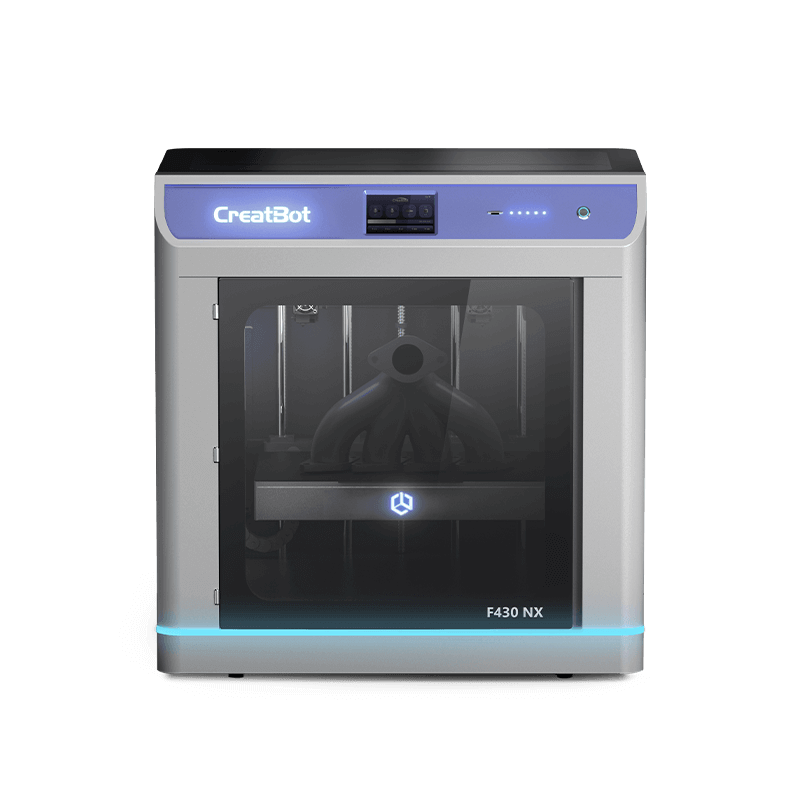
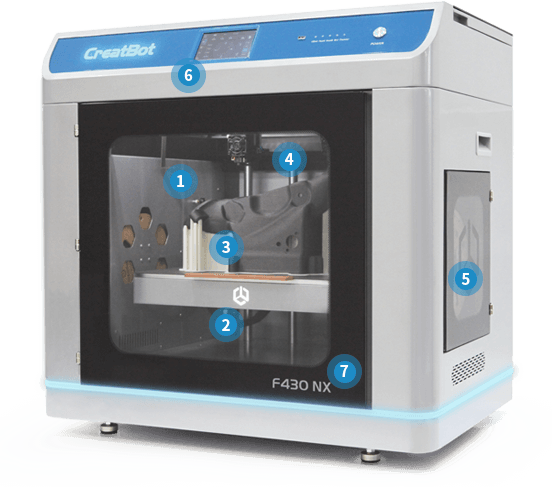
The CreatBot F430 NX is an industrial IDEX FFF / FDM 3D printer — the new generation of the 5,000-unit F430 series, with a 400 × 300 × 300 mm build volume pairing independent dual silicon-carbide nozzles to 420°C, a 70°C active chamber and a 140°C bed, driven at up to 300 mm/s on a high-precision machined frame for round-the-clock production of carbon- and glass-fiber engineering composites. Full specifications →
Rev1 validates application fit, material requirements, and facility readiness before purchase. Only authorized CreatBot service provider in the USA — questions? Call (248) 707-2950.
The Only Approved CreatBot Service Provider in the USA.
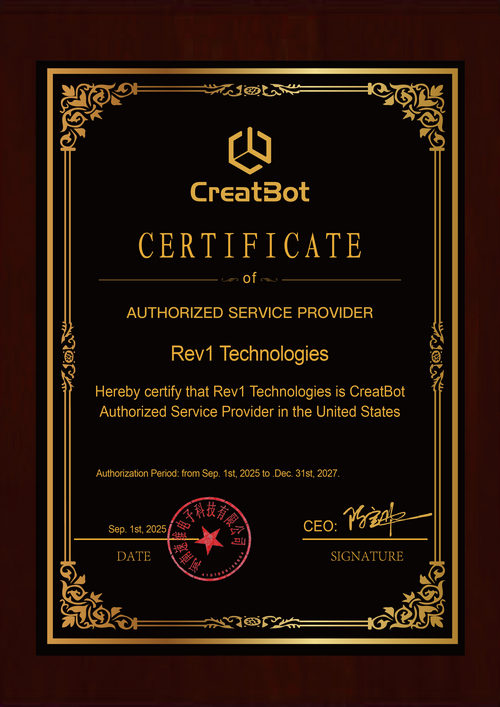
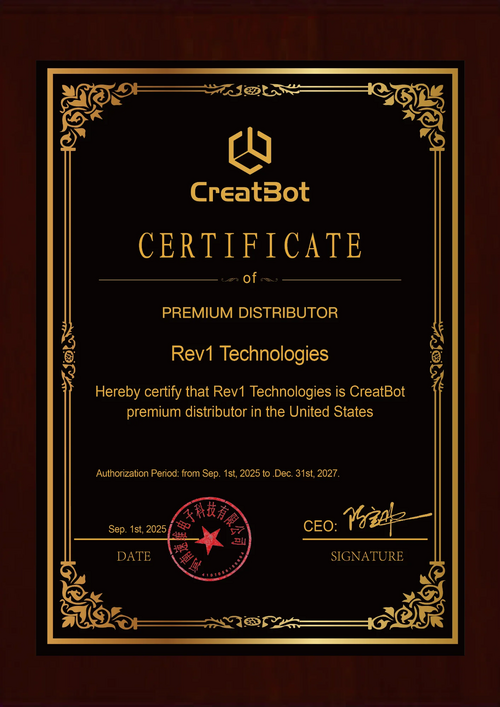
Rev1 Technologies is the sole CreatBot Authorized Service Provider in the United States and a certified CreatBot Premium Distributor. Phone and video support, application consultation, parts, and engineering guidance are delivered from Auburn Hills, Michigan.
A production printer, not a desktop machine that prints big.
The F430 NX is the latest generation of CreatBot’s best-selling professional series — more than 5,000 units of the F430 family are running in production around the world. It is built around the things that decide whether an industrial 3D printer earns its place on a shop floor: a genuinely large 400 × 300 × 300 mm build envelope, independent dual extruders that hit 420°C, an actively heated chamber, and a high-precision machined frame engineered for 7-day, 24-hour operation. The result is a machine that takes an engineering part from concept to qualified production without the warping, contamination and downtime that limit lighter equipment. Where a desktop printer is a fast way to make a prototype, the F430 NX is a repeatable way to make the same functional part, in the same engineering composite, week after week.
Two independent heads. Four ways to print.
IDEX, not a fixed dual head.
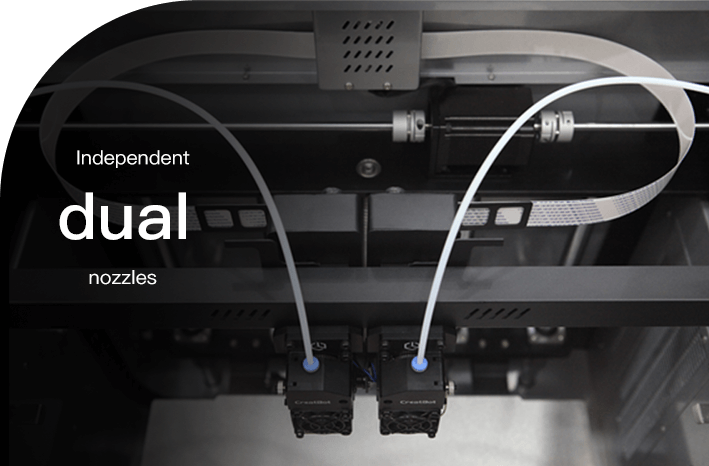
The F430 NX carries two fully independent extruders that move on separate carriages. The idle head parks completely clear of the part, so there is no ooze dragging and no cross-contamination between the model material and a soluble or second-color support.
Independent motion is what turns dual extrusion from a liability into a productivity multiplier. In single mode you run one head and keep the other in reserve. In dual mode the second head lays soluble support — CreatBot’s S-270 and S-350 supports dissolve away to leave clean overhangs and internal channels no single-nozzle machine can produce. The two modes that competitors rarely match are copy and mirror: copy prints the same part with both heads simultaneously to double throughput, and mirror prints a part and its mirror image at once — ideal for left/right pairs. A dual-nozzle auto-resume feature automatically switches to the backup nozzle if one runs out of filament, so a long unattended build does not fail at hour twenty over an empty spool.
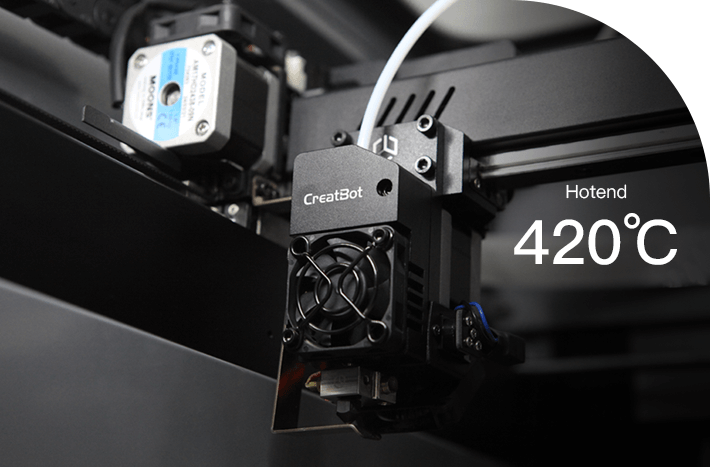
420°C silicon-carbide nozzles built to survive carbon fiber.
Wear that stays under 10% after 2,000 hours of carbon fiber.
The F430 NX uses a one-piece die-cast memory-alloy hotend with a super-wear-resistant silicon-carbide nozzle rated to 420°C. That temperature ceiling and that nozzle material are what let it print abrasive, high-temperature engineering composites reliably instead of as a one-time experiment.
Carbon- and glass-fiber filaments are punishing: the fibers that make a printed part stiff also grind a standard brass nozzle out of tolerance within hours, after which dimensional accuracy quietly drifts. CreatBot rates the F430 NX nozzle to no more than 10% aperture wear after 2,000 hours of printing carbon-fiber material — a full production duty cycle, not a demo. The 420°C ceiling clears the processing windows for PC, Nylon, PA-CF, PET-CF, PET-GF and UltraPA-CF, and the quick-swap hotend design means an operator can change nozzle diameter — 0.4 mm standard, 0.6 mm optional — or service a head in minutes rather than tearing down the carriage.
70°C chamber and a 140°C bed kill warp before it starts.
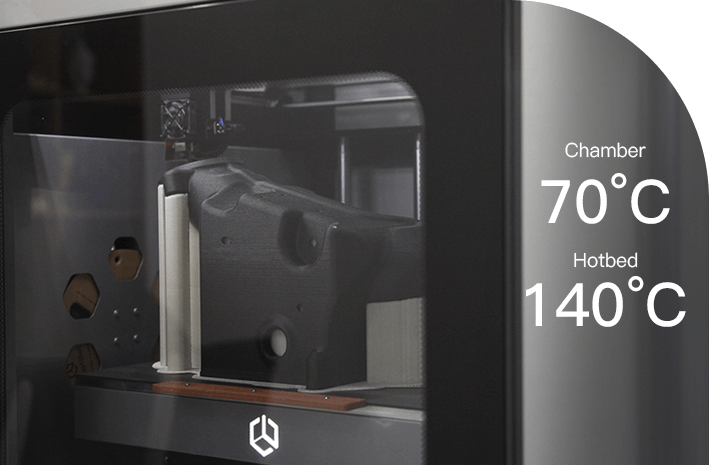
Warp-free large parts in engineering polymers.
The F430 NX runs a sealed chamber actively heated to 70°C over a high-temperature bed that reaches 140°C. Holding the whole cavity warm keeps a tall ABS, ASA, PC or carbon-fiber part from cooling unevenly — the cause of the curling, cracking and layer separation that ruins large prints on open machines.
On a 300 mm-tall part, the difference between a warm chamber and an open one is the difference between a usable part and scrap. As an open print cools, the bottom layers contract while the top is still molten, and the part lifts off the bed or splits internally. The F430 NX prevents that by keeping ambient temperature high and stable across the entire build, while the 140°C bed plants the first layers firmly on a removable magnetic PEI platform. That thermal envelope is what unlocks the engineering materials the machine is built for: ABS and ASA for UV-stable enclosures, PC and Nylon for load-bearing parts, and fiber-reinforced grades for structural tooling — all printed at full size without a heated room or a post-print babysitting routine.
400 × 300 × 300 mm — and four ways to fill it.
Large functional parts — or twice the throughput.
A 400 × 300 × 300 mm single-nozzle envelope (360 × 300 × 300 mm in dual mode) lets a shop print large brackets, jigs, ducting, housings and end-use tooling in one continuous piece — no bonding, no joints to fail under load. When the part is small enough, the F430 NX’s IDEX heads switch to copy mode for a 225 × 300 × 300 mm pair printed simultaneously, doubling output, or mirror mode for a 190 × 300 × 300 mm left/right pair in a single build. Few machines in this price class give a production planner both the format to print big and the parallelism to print fast.
Dry filament in, unattended runs out.
Engineering materials only print as well as they are dried.
Nylon, PA-CF and other hygroscopic engineering filaments absorb moisture from the air and then print with stringing, bubbling and weak layers. The F430 NX integrates a 70°C filament drying room so the spool stays dry on the machine, plus auto filament switching to keep a long job running across spools.
For a production shop, material handling is where uptime is won or lost. A wet spool of carbon-fiber nylon does not announce itself — it just produces parts that fail QC, and by then the run is wasted. The on-board 70°C drying room keeps filament conditioned right up to the extruder, and the F430 NX’s auto filament switching plus dual-nozzle auto-resume mean a job can run through a spool change or a runout without an operator standing by. Add filament-runout detection, power-loss recovery that saves data when the power drops, and automatic shutdown when a print completes, and the machine is genuinely built for the lights-out, 24/7 duty cycle CreatBot designed it for.
A machined frame and auto-leveling that holds 0.04 mm.
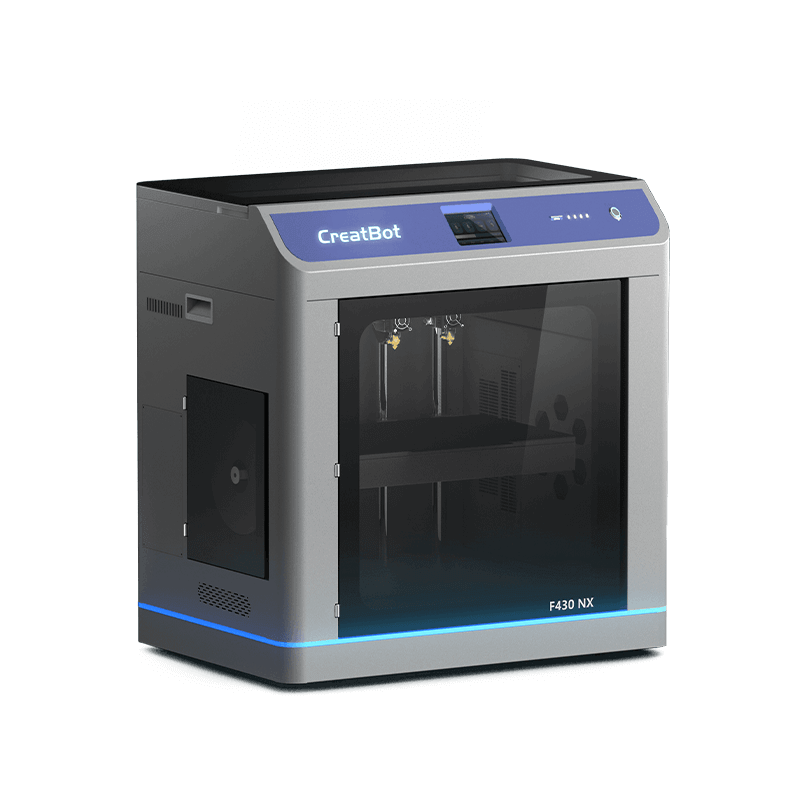
Speed is only useful if the part is still accurate.
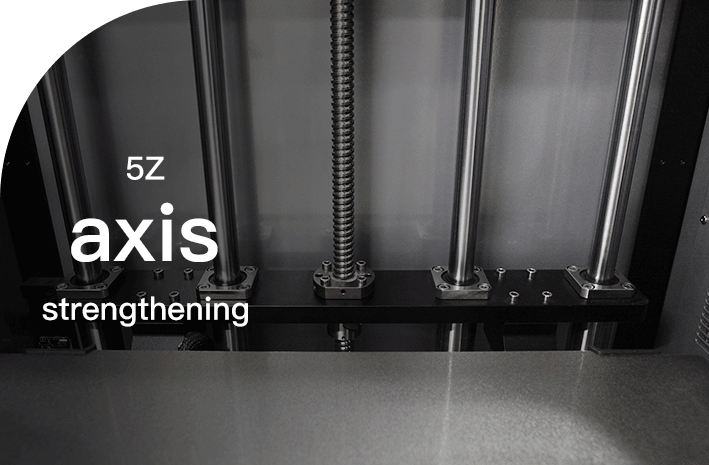
The F430 NX is built on high-precision machined structural parts with Z-axis strengthening, so the frame stays rigid as the machine prints at up to 300 mm/s. Automatic bed leveling and photoelectric X/Y limit switches keep the first layer and the part datum repeatable run after run.
Print speed headlines are meaningless if dimensional accuracy collapses at the top of a tall part. CreatBot pairs the F430 NX’s 100–300 mm/s speed range with a stiffened Z axis and a machined — not bent-sheet — frame, so resonance and flex stay low and a 0.04 mm minimum positioning resolution is held across the full build height. Automatic bed leveling removes the manual tramming that drifts between jobs, and because the platform is a removable magnetic PEI plate, an operator pops a finished build off and drops a fresh plate in without re-leveling. The net effect is a machine an engineer can qualify a process on and trust to reproduce it.
HEPA + carbon filtration and a ~50 dB work envelope.
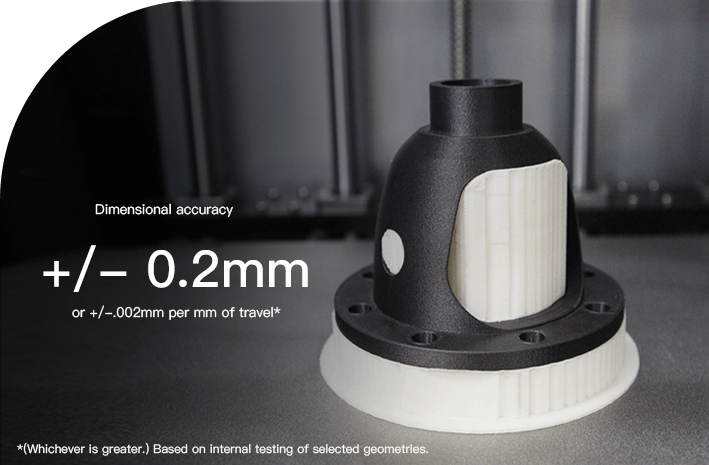
Safe to run next to people.
A combined HEPA and activated-carbon filter captures the ultrafine particles and VOCs that high-temperature engineering polymers emit, and the machine runs at roughly 50 dB — quiet enough to sit in a shared lab or office-adjacent workspace rather than an isolated room.
Printing ABS, ASA and fiber-reinforced composites at 420°C releases fumes and fine particulate that you do not want recirculating through a workspace. The F430 NX’s sealed chamber draws exhaust through a HEPA stage that traps ultrafine particles and an activated-carbon stage that adsorbs the VOCs, so the air leaving the machine is clean — the before-and-after filter media tells the story. On the safety side, the machine adds thermal-runaway protection, a fault signal light, and a high-temperature hotend interlock, so an unattended overnight run is protected against the failure modes that matter. For a buyer placing a printer in a populated facility, that filtration and that noise floor are often the difference between an approved installation and a denied one.
Where the F430 NX earns its keep.
Because it pairs a large heated build volume with 420°C IDEX heads and fiber-ready hardware, the F430 NX spans the gap between rapid prototyping and low-volume production across engineering verticals — running the same composite parts a shop would otherwise outsource or machine.
Aerospace & Defense
Large brackets, housings, ducting and jigs in PA-CF, PET-CF and PC — printed whole, with repeatable dimensional accuracy across long runs.
Automotive
Under-hood fixtures, end-of-arm tooling and functional prototypes in high-temperature composites that survive the heat of a real test cell.
Industrial Manufacturing
Production tooling, fixtures and replacement parts in carbon- and glass-fiber grades — dimensionally stable under mechanical load.
R&D / Engineering
Rapid iteration on structural concepts, with soluble dual-extrusion support for complex internal geometry no single nozzle can build.
Medical Devices
Jigs, fixtures and device housings in validated engineering polymers; HEPA + carbon filtration supports clean-adjacent workflows.
Education & Research
Material-science and additive labs running high-temperature polymers with professional-grade process control and air handling.
Touchscreen, camera and network — built to run unattended.
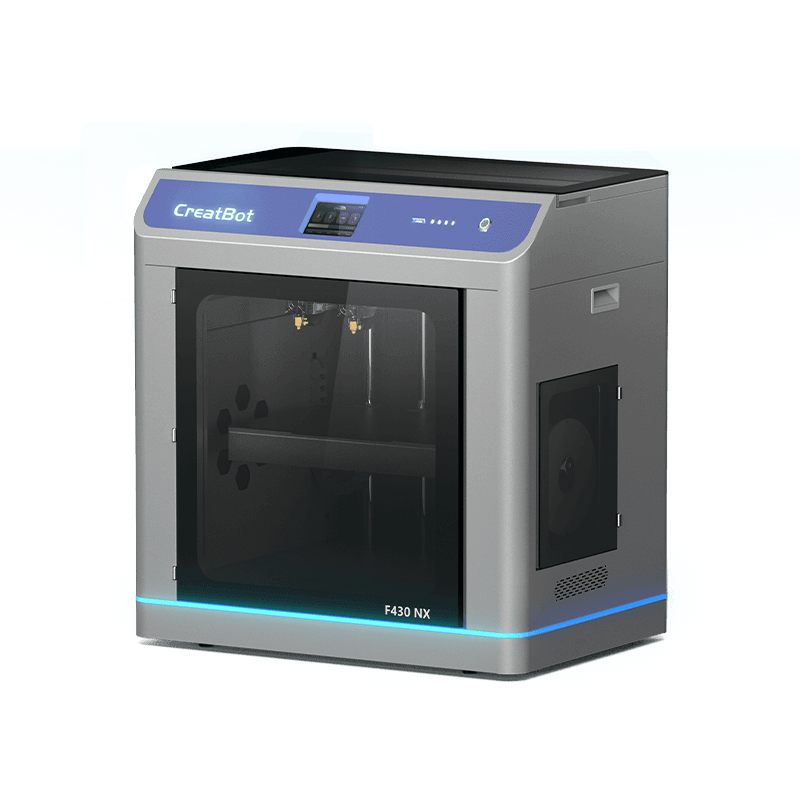
Start it, walk away, watch it from anywhere.
A 5″ capacitive touchscreen drives the machine locally, while WiFi and Ethernet plus a built-in camera let an operator queue jobs and monitor a print remotely. A status-breathing atmosphere light shows machine state across the shop at a glance.
The F430 NX is designed so one operator can keep several machines productive. Network connectivity over WiFi or wired Ethernet means files go to the printer without a USB walk, and the on-board camera streams the build so a problem is caught early rather than discovered at unload. Model backup keeps the last job recoverable, and the breathing atmosphere light communicates running, paused or fault status from across the room. CreatWare is the bundled slicer, and the F430 NX also accepts profiles from Cura, Simplify3D and Slic3r — so a shop that already has a qualified workflow does not have to rebuild it. Rev1 supplies validated print profiles for the common engineering materials on request.
How the F430 NX compares among industrial IDEX printers.
| Capability | CreatBot F430 NX | Raise3D Pro3 Plus | INTAMSYS FUNMAT HT |
|---|---|---|---|
| Build volume | 400×300×300 mm | 300×300×605 mm | 260×260×260 mm |
| Dual extrusion | IDEX (copy / mirror) | IDEX | Single |
| Max nozzle temperature | 420°C | 300°C | 450°C |
| Active chamber | 70°C heated | 60°C passive | 90°C heated |
| Max print speed | 300 mm/s | 150 mm/s | ~150 mm/s |
| US service & support | Rev1 (authorized) | Raise3D direct | Reseller network |
| Approx. street price | $7,999 | ~$8,000 | ~$10,000+ |
Comparison sourced from published manufacturer data at build time. Street prices are approximate; validate specifications against your part geometry, material and facility before purchase. The F430 NX pairs IDEX copy/mirror printing and a 420°C heated platform with a large build volume at the entry of its class — and is the only one of these systems backed by a US-based authorized CreatBot service provider.
CreatBot F430 NX Technical Data
RESOURCES
Downloads & Technical Support
Everything you need to qualify and run your CreatBot F430 NX with confidence. Explore related CreatBot printers: the standard F430, the high-temperature PEEK-300 and PEEK-250, or the larger D600 Pro 3 HS and D1000 HS.
WHY REV1 TECH
Authorized CreatBot Reseller. Industrial AM Specialists.
Rev1 Technologies is the sole Authorized CreatBot Service Provider in the United States, headquartered in Auburn Hills, MI, with direct technical expertise in industrial 3D printing.

Rev1 Technologies is an authorized CreatBot reseller serving manufacturers across the USA. We don’t just ship boxes — we deploy, calibrate, train, and support your team so your F430 NX produces at full capability from day one.
CreatBot F430 NX — Frequently Asked Questions
What does the NX generation add over the original F430?
The F430 NX is the latest generation of the 5,000-unit F430 series. It introduces a brand-new high-precision machined structural frame, an independent dual-extruder (IDEX) print head with one-piece die-cast silicon-carbide nozzles to 420°C, quick-swap hotends, a 70°C on-board filament drying room, auto filament switching with dual-nozzle auto-resume, and print speeds up to 300 mm/s.
What is IDEX, and what are copy and mirror modes?
IDEX means Independent Dual Extruders — two print heads on separate carriages. In single mode you print with one head; in dual mode the second head lays soluble support (CreatBot S-270 / S-350); in copy mode both heads print the same part simultaneously to double throughput (225 × 300 × 300 mm); and in mirror mode the machine prints a part and its mirror image at once (190 × 300 × 300 mm), ideal for left/right pairs.
What materials can the F430 NX print?
The F430 NX prints PLA, PETG and PLA-CF on the consumer side and ASA, ABS, PC, Nylon, PA, UltraPA-CF, PET-CF and PET-GF on the industrial side, plus carbon- and glass-fiber composites and CreatBot S-270 / S-350 soluble supports. The 420°C silicon-carbide nozzle and 70°C active chamber are what make reliable, repeatable printing of these high-temperature engineering grades possible.
How durable is the nozzle when printing carbon fiber?
The F430 NX uses a one-piece die-cast memory-alloy hotend with a super-wear-resistant silicon-carbide nozzle. CreatBot rates aperture wear at no more than 10% after 2,000 hours of printing carbon-fiber material, so dimensional accuracy holds across a full production duty cycle rather than degrading after a few jobs.
Does the F430 NX require a dedicated electrical circuit?
The F430 NX runs on 220V or 110V at 50–60 Hz, drawing up to 2700 W on 220V (2200 W on 110V). Rev1 Technologies will confirm the right electrical configuration and facility requirements for your space during the pre-purchase consultation — contact us before ordering so your installation is ready.
Is the F430 NX safe to run in a shared workspace?
Yes. The sealed chamber exhausts through a combined HEPA and activated-carbon filter that captures ultrafine particles and VOCs, the machine runs at roughly 50 dB, and it includes thermal-runaway protection and a fault signal light. That combination is what allows installation in an office-adjacent lab rather than an isolated room.
Can it run unattended overnight?
The F430 NX is built for 24/7 operation. Filament-runout detection auto-pauses or switches to the backup nozzle, power-loss recovery saves the job state if power drops, automatic shutdown powers down the machine when a print finishes, and the built-in camera plus WiFi/Ethernet let you monitor a long build remotely.
What slicing software does it use?
CreatWare is the bundled slicer, and the F430 NX is also compatible with Cura, Simplify3D and Slic3r. It accepts STL, OBJ, AMF, STEP and G-code files on Windows and macOS. Rev1 Technologies provides validated print profiles for common engineering materials on request.
Does Rev1 provide service and support for the F430 NX?
Yes. Rev1 Technologies is the sole Authorized CreatBot Service Provider in the United States. We provide phone and video support, application consultation, installation and training, warranty parts, and engineering guidance from Auburn Hills, Michigan.