Bambu Lab P1P High-Speed CoreXY Printing, Right Out of the Box
High-Speed CoreXY Printing, Right Out of the Box
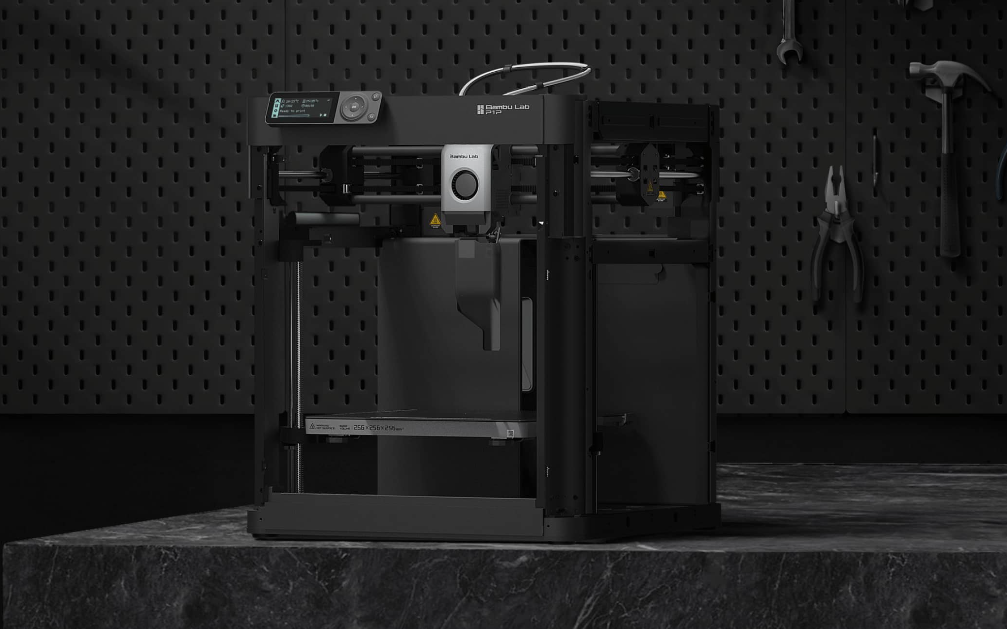
The Bambu Lab P1P is a high-speed CoreXY FDM 3D printer built on the same core platform as the flagship X1. It pairs a 256 × 256 × 256 mm build volume with 500 mm/s print speeds, a 300°C all-metal hotend and full auto-calibration — then opens up to 16-color printing with the AMS. Fully assembled, network-connected and driven by Bambu Studio, it delivers fast, accurate, hands-off prints at an accessible price. Full specifications →
The P1P has been discontinued by Bambu Lab — contact Rev1 to confirm remaining availability and pricing, or ask about the enclosed P1S that replaces it. Call (248) 707-2950.
Genuine Bambu Lab Hardware, Supplied & Supported in the USA.
Rev1 Technologies supplies genuine Bambu Lab printers and filament to makers, schools and engineering teams across the United States. Setup guidance, material selection, Klarna financing, and US-based phone and video support are delivered from Auburn Hills, Michigan.


Flagship speed and accuracy, stripped to the essentials.
The P1P is Bambu Lab’s value-engineered CoreXY printer — the same high-speed motion system, 300°C all-metal hotend and auto-calibration that made the X1 a benchmark, in an open-frame body that keeps the price accessible. It prints fast and clean straight out of the box, runs the full Bambu software stack with cloud and app control, and expands into 16-color printing whenever you add the AMS. For makers, classrooms and engineering teams that want X1-class output without the X1 price — and the option to grow into multi-material later — the P1P hits a rare balance of speed, quality and cost. Here is what it brings.
A lightweight CoreXY motion system with 20,000 mm/s² acceleration prints several times faster than a typical bed-slinger — a Benchy in roughly 18 minutes.
A 256 × 256 × 256 mm envelope — generous cube room for functional parts, batches and large single prints.
A 300°C all-metal hotend with a direct-drive dual-gear extruder handles PLA, PETG, TPU, ASA and more — with hardened options for abrasives.
Add the AMS for automatic multi-color and multi-material printing — up to four units for 16 colors, with RFID filament recognition.
Automatic bed leveling, vibration compensation and pressure advance dial the printer in for you — fast prints that actually land in tolerance.
Genuine Bambu Lab hardware with US warehouse stock, fully-assembled delivery, and setup and materials help from Rev1.
CoreXY speed that changes how you work.
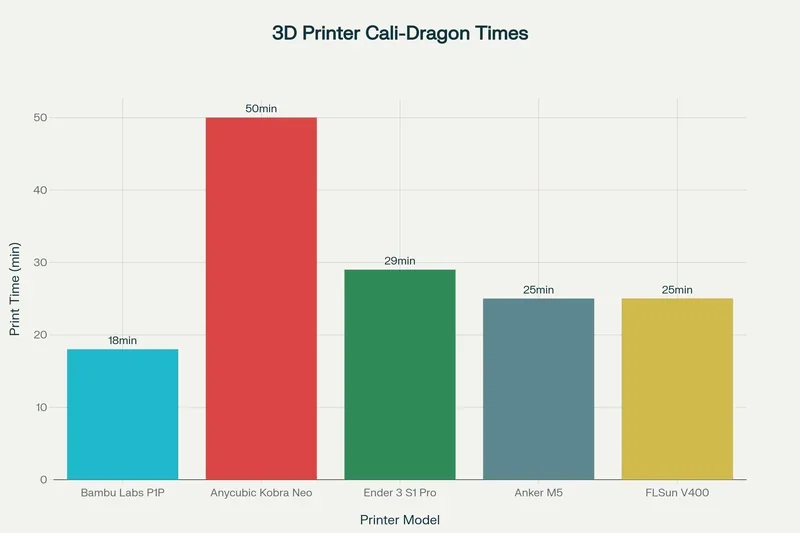
Prints in minutes, not hours.
The P1P’s CoreXY motion reaches 500 mm/s with 20,000 mm/s² acceleration — printing a calibration dragon in about 18 minutes and finishing jobs that take a bed-slinger many times longer.
Speed is the P1P’s headline advantage, and it is real. In a CoreXY system both motors stay fixed to the frame and only the lightweight toolhead moves in X and Y, so the printer can accelerate hard without the wobble that limits a moving-bed machine. That lets the P1P hold high speeds without sacrificing quality, turning iterative design into a same-afternoon activity: print a revision, check the fit, adjust, and print again before lunch. Across a production tray the time savings compound — a job that ties up an entry-level printer overnight can finish on the P1P in a few hours. Bambu’s motion algorithms (vibration compensation and pressure advance) are what keep those fast moves accurate, so you get the speed without the ringing and artifacts that usually come with it.
A 300°C all-metal hotend with direct drive.
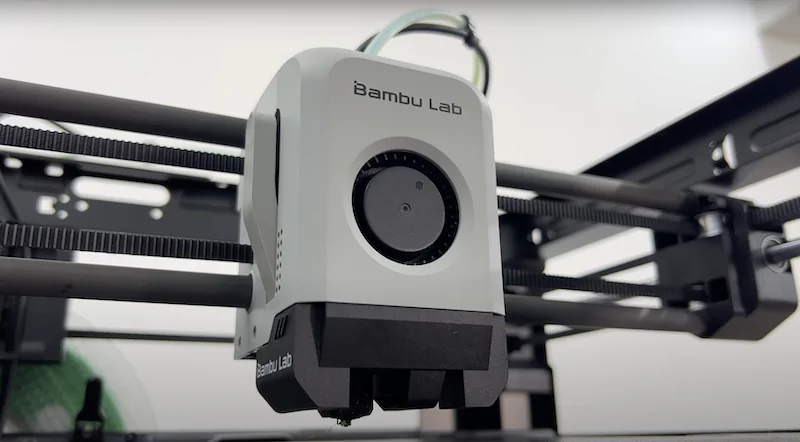
Hot enough and gripped tight enough for real materials.
The 300°C all-metal hotend clears the temperature range for PLA, PETG, TPU, ASA, PVA and PET, while a direct-drive dual-gear extruder grips filament close to the nozzle for reliable retraction and flexible-filament feeding.
A direct-drive extruder mounts the drive gears right above the hotend, so the distance filament travels under load is short — that is what makes flexible TPU printable and what keeps stringing and oozing under control across fast moves. The all-metal hot end removes the PTFE liner that limits cheaper printers to low temperatures, opening the door to engineering materials like ASA. The standard 0.4 mm stainless nozzle swaps for 0.2, 0.6 or 0.8 mm to trade detail for throughput, and hardened options handle abrasive carbon- and glass-filled filaments. A magnetic toolhead cover and tool-free design keep nozzle changes quick. The result is a hotend that is both fast and versatile — the part of the machine that most often limits an entry-level printer is, here, built to the same standard as Bambu’s flagship.
A rigid CoreXY gantry, tuned by software.
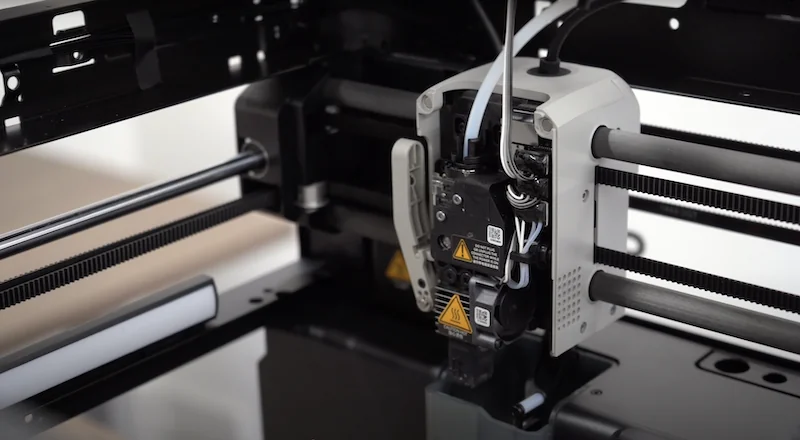
Fast moves, held accurate.
The P1P moves a light toolhead on a stiff CoreXY gantry — carbon rods on X, linear rods on Y and Z — while vibration compensation and pressure advance cancel the artifacts that high speed normally introduces.
Going fast is easy; going fast and accurate is the hard part. CoreXY gives the P1P a mechanically rigid, low-mass motion path, and Bambu’s onboard software does the rest: vibration compensation (input shaping) measures the printer’s resonant frequencies and adjusts motion to suppress ringing, while pressure advance manages how the extruder responds to acceleration so corners stay sharp and walls stay even. Together they let the P1P run near its limits without the ghosting and bulging corners that plague printers pushed past their comfort zone. Because the calibration is automatic, you get that accuracy without manually tuning resonance or flow — the machine characterizes itself and applies the corrections every print.
Detailed prints at production speed.
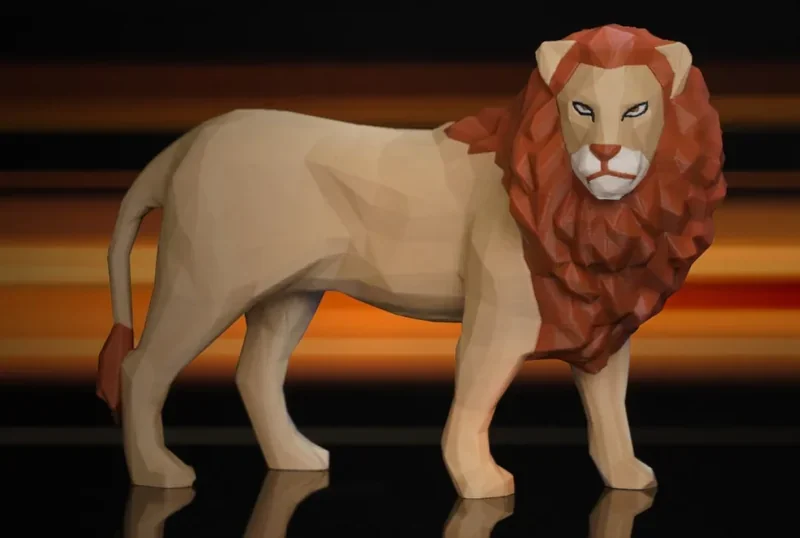
Models, miniatures and functional parts — clean, fast.
From crisp display models and miniatures to functional brackets, fixtures and household parts, the P1P turns out clean, dimensionally consistent prints at speeds that make iteration painless. The combination of CoreXY rigidity, motion compensation and a capable hotend means surface quality holds up even when the printer is moving fast — you are not trading finish for throughput. Add the AMS and the same machine produces multi-color models and multi-material parts in one job. Whether you are prototyping for engineering, printing for a classroom, or running a small print farm, the P1P delivers repeatable results print after print. Rev1 can help you match nozzle size, material and settings to the parts you make most.
Grow into 16-color printing when you’re ready.
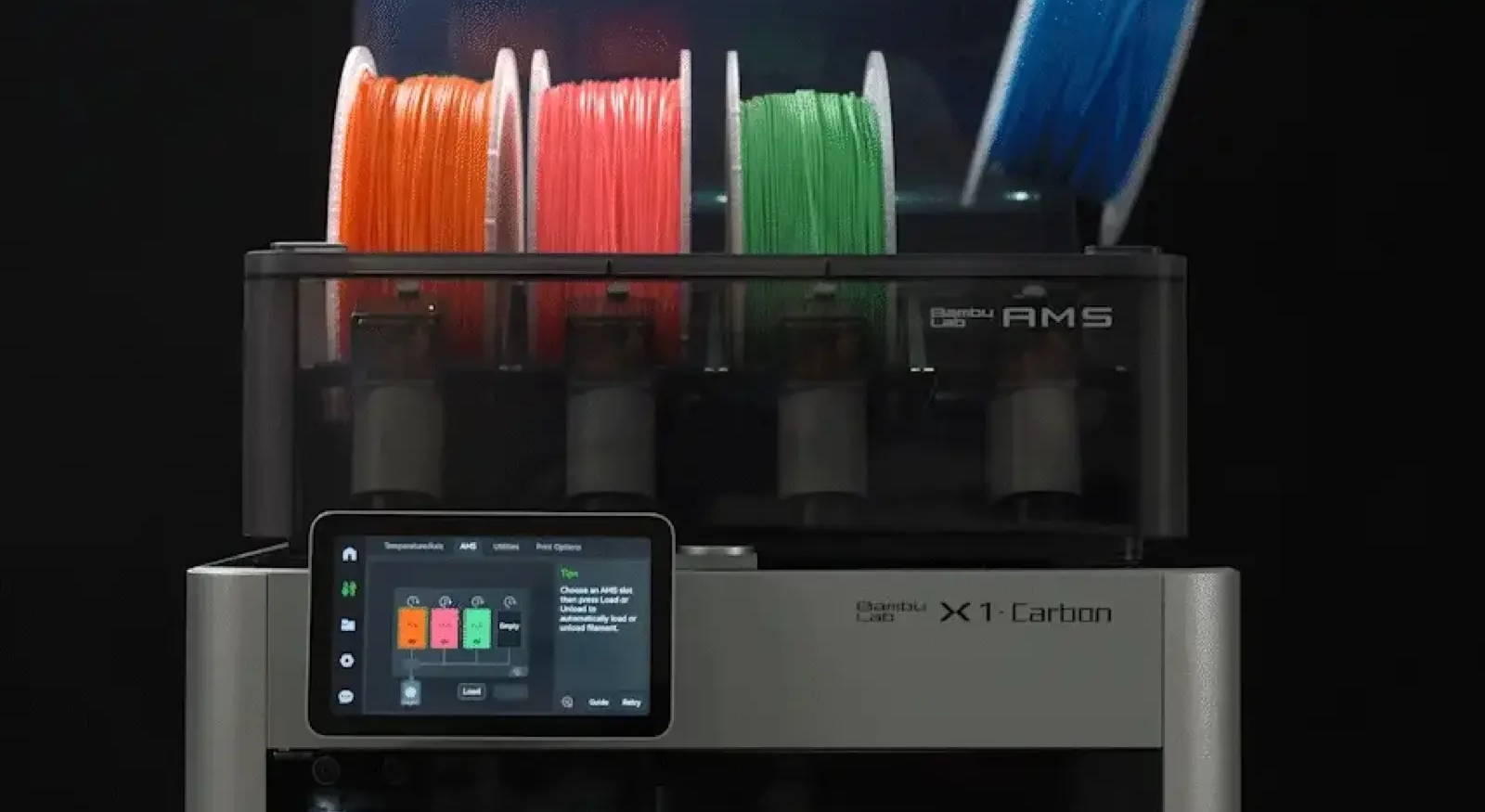
Automatic multi-color and multi-material.
The P1P is AMS-ready out of the box. Add the Automatic Material System for hands-off multi-color and multi-material printing — one AMS holds four spools, and up to four chain together for 16 colors.
The AMS is what makes the P1P a platform rather than a single-purpose printer. It automatically feeds and switches between spools mid-print, reads each filament’s type and color from an RFID tag so settings load themselves, and keeps spools sealed and dry in an enclosed bay. That means full-color models, multi-material parts with soluble supports, and unattended jobs that never pause to swap filament. Because it is an add-on, you can start with single-color printing and expand into multi-material when a project calls for it — protecting the lower entry price while leaving the ceiling high. Rev1 can spec the right AMS configuration and starter filament set for the work you plan to do.
An open system for everyday and engineering filaments.
The P1P’s 300°C all-metal hotend and 100°C bed cover the materials most shops actually use, and it runs as an open system — genuine Bambu Lab filament with automatic RFID settings, or any standard 1.75 mm filament you prefer. One honest note: the P1P ships open-frame, which is ideal for PLA, PETG and TPU; high-temperature, warp-prone materials like ABS, ASA, PC and PA print best with an enclosure, which the P1S adds (or aftermarket panels). Rev1 can help you decide which body fits your material plan.
PLA, PETG, TPU, PVA and PET print beautifully on the open-frame P1P — the bulk of model, prototype and functional work.
ABS, ASA, PC and PA reach the P1P’s hotend range; add an enclosure for the stable chamber these warp-prone materials want.
Run genuine Bambu Lab filament for automatic AMS settings, or any standard 1.75 mm spool — the P1P is not locked to one brand.
Fully assembled, auto-calibrated, app-connected.
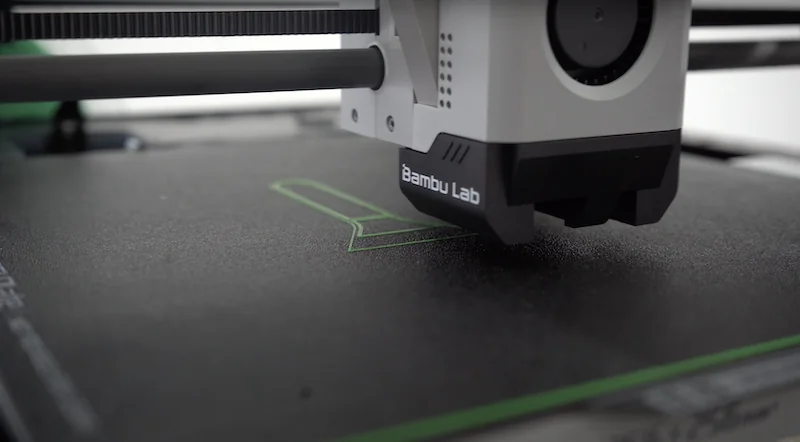
Out of the box to first print, fast.
The P1P arrives fully assembled and auto-levels itself, so first-layer setup is hands-off. Bambu Studio slices and sends jobs over Wi-Fi, and the Bambu Handy app plus cloud and LAN control let you start, monitor and manage prints remotely.
Getting started is deliberately simple: unbox, run the guided calibration, and the printer measures its bed, resonance and flow automatically. Bambu Studio gives you a capable slicer with tuned profiles, project files and per-object settings, while the Handy mobile app and cloud account let you send a print from your phone and check on it from anywhere — with LAN-only mode available when you want to keep everything local. A 2.7-inch monochrome screen with a control knob handles on-machine operation, filament runout detection pauses cleanly when a spool ends, and the flexible textured PEI plate releases finished prints with a flex. It is a workflow built so a newcomer can succeed on day one and a power user never feels boxed in. Rev1 can walk your team through setup and slicing so the first print is a good one.
How the P1P compares.
| Capability | Bambu Lab P1P | Creality Ender-3 V3 | Prusa MK4 |
|---|---|---|---|
| Motion system | CoreXY | CoreXZ | Bed-slinger (i3) |
| Max speed | 500 mm/s | ~600 mm/s | ~200–500 mm/s |
| Build volume | 256³ mm | 220³ mm | 250 × 210 × 220 mm |
| Hotend | 300°C all-metal | 300°C | 290°C |
| Multi-color path | AMS — up to 16 colors | CFS (limited) | MMU3 — 5 colors |
| Approx. price | $699 | ~$300 | ~$1,099 (kit) / $1,799 (assembled) |
Comparison sourced from published manufacturer data at build time; prices are approximate and vary with promotions and bundles. The P1P’s distinction is flagship-class CoreXY speed, auto-calibration and a clean 16-color AMS path at a mid-range price — more printer-for-the-money than a budget bed-slinger, and far less than a comparably-equipped premium machine. Match the choice to your speed, material and multi-color needs.
Bambu Lab P1P Technical Data
RESOURCES
Downloads & Technical Support
Everything you need to set up and run your Bambu Lab P1P with confidence.
WHY REV1 TECH
Genuine Bambu Lab Hardware. Additive Manufacturing Specialists.
Rev1 Technologies is an additive-manufacturing supplier headquartered in Auburn Hills, MI, with hands-on expertise across FDM printers, materials and production workflows.
Rev1 Technologies serves makers, schools and engineering teams across the USA. We don’t just ship boxes — we help you choose the right configuration, get the first print right, and keep the machine producing on genuine Bambu Lab hardware and filament.
Bambu Lab P1P questions.
How fast is the P1P, really?
Its CoreXY motion reaches 500 mm/s with 20,000 mm/s² acceleration — printing a calibration dragon in roughly 18 minutes and finishing typical jobs several times faster than an entry-level bed-slinger. Bambu’s vibration compensation and pressure advance keep those fast moves accurate.
What is the difference between the P1P and the P1S?
They share the same CoreXY motion, 300°C hotend and electronics. The P1P is open-frame; the P1S adds a fully enclosed chamber and filtration, which makes warp-prone, higher-temperature materials like ABS, ASA, PC and PA much easier to print. If you mostly run PLA, PETG and TPU, the open-frame P1P is the value pick; if engineering materials are central, consider the P1S or add an enclosure. Rev1 can help you decide.
What is the build volume?
256 × 256 × 256 mm — a generous cube that handles large single prints, tall models and full build-plate batches, larger than most printers near its price.
Can I print multiple colors?
Yes, with the AMS. The P1P is AMS-ready; one Automatic Material System holds four spools and up to four chain together for 16-color printing, with automatic filament switching and RFID recognition of genuine Bambu Lab filament. You can start single-color and add the AMS later.
What materials can it print?
The 300°C all-metal hotend and 100°C bed handle PLA, PETG, TPU, PVA and PET on the open frame. ABS, ASA, PC and PA are within the hotend’s range but print best in an enclosure. It is an open system, so you can run genuine Bambu Lab filament or any standard 1.75 mm spool.
Does it come assembled and easy to set up?
Yes. The P1P ships fully assembled and runs automatic bed leveling, resonance and flow calibration during setup, so the first layer is hands-off. Bambu Studio slices and sends jobs over Wi-Fi, and the Bambu Handy app adds remote start and monitoring.
Does it need an internet connection?
No. You can print over the cloud and the mobile app for convenience, or use LAN-only mode and a microSD card to keep everything local. The choice is yours.
How does it compare to a budget printer or a premium one?
It sits in the sweet spot: it brings flagship-class CoreXY speed, auto-calibration and a clean 16-color AMS path that budget bed-slingers can’t match, at a price well below a comparably-equipped premium machine. For most makers and teams it is more capability per dollar than either extreme.
Is the P1P a good choice for a print farm or classroom?
Yes — it is one of the most popular printers for exactly that. Fast CoreXY throughput, automatic calibration and cloud or LAN fleet control mean one operator can run several machines at once, and the fully-assembled, self-calibrating setup gets new units producing quickly. The open-frame design also keeps the per-unit cost low when you are buying in quantity. Rev1 quotes multi-unit and education orders with setup support so a lab or farm comes online smoothly.
Can I add an enclosure or upgrade later?
Yes. The P1P is designed to be expandable: add the AMS for multi-color and multi-material printing whenever you need it, fit aftermarket or official panels to create an enclosed chamber for higher-temperature materials, and swap nozzle sizes for detail or throughput. Because it shares its core with the enclosed P1S, much of the ecosystem is interchangeable. You can start with the essentials and grow the machine as your needs change rather than buying everything up front.
How does Rev1 support the purchase?
Rev1 ships genuine, fully-assembled Bambu Lab hardware from US stock, helps you choose the right configuration and starter materials, and supports setup, slicing and troubleshooting. Education and multi-unit pricing and Klarna are available.