Bambu Lab H2C Seven Hotends. Zero Purge.
An enclosed CoreXY multi-material printer built around the Vortek hotend-change system — six induction hotends plus a standard left nozzle for up to seven materials in a single print, purge-free.
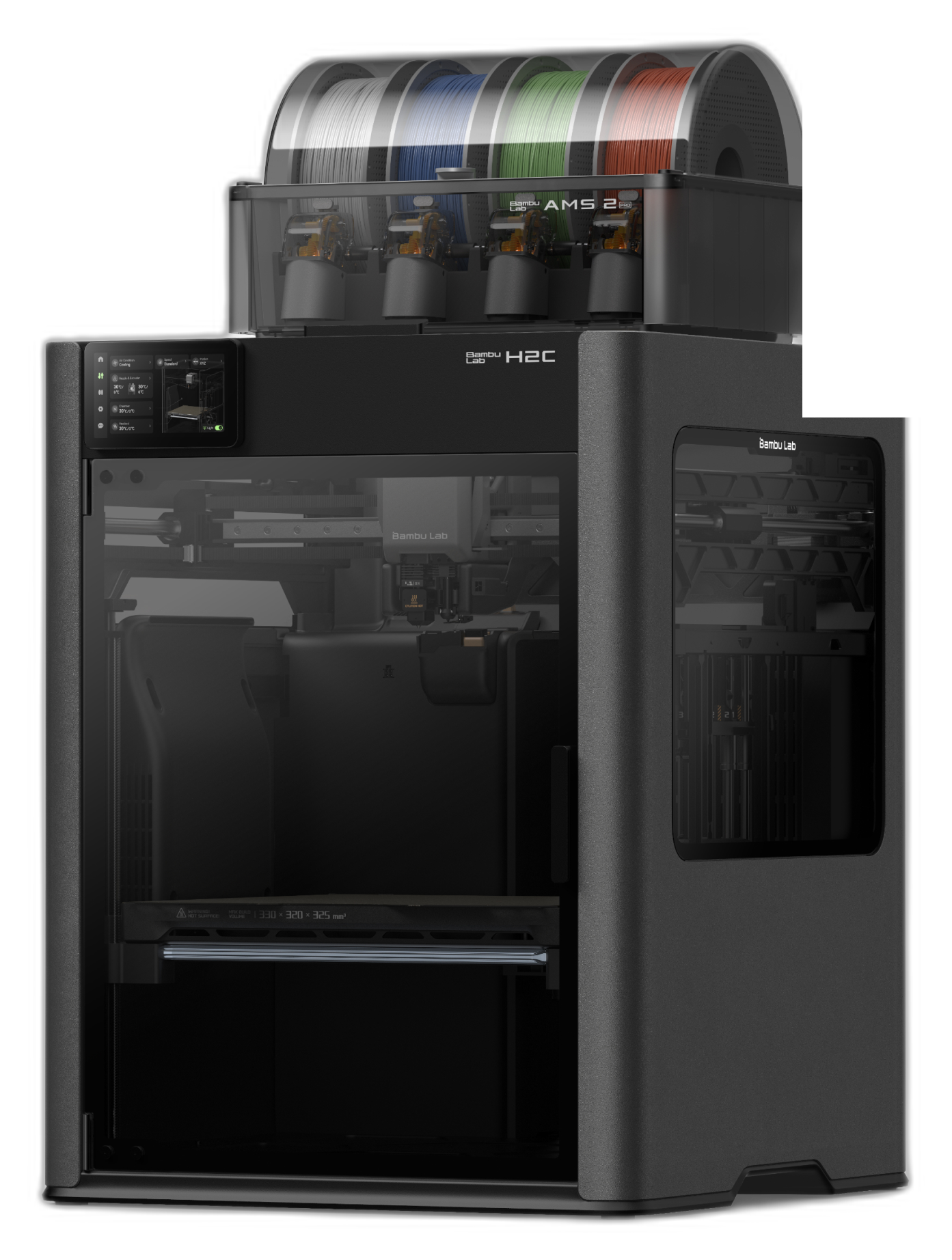
The H2C swaps the nozzle instead of purging the filament. Six induction hotends on a right-side Vortek rack plus a standard left hotend let each material keep its own clean nozzle — so Bambu’s reference multi-color print drops from 3,032 g of purge waste on the H2D to just 532 g on the H2C. 350 °C nozzles and a 65 °C actively heated chamber run engineering materials a desktop printer normally can’t. Full specifications →
Authorized Bambu Lab reseller in the USA — Rev1 confirms the right combo, Vortek configuration, and material profiles for your application. Questions? Call (248) 707-2950.
Factory-Built Precision. US-Supported by Rev1.
Every H2C ships from Bambu Lab’s US warehouse and is backed by Rev1’s application engineers — Vortek configuration, multi-material slicer setup, and material profiles before the machine runs its first production job. Phone and video support from Auburn Hills, Michigan.


Seven hotends, one toolhead, zero purge
Most multi-color FFF printers waste material every time they change filament — the slicer flushes the old color out of a shared nozzle and dumps it as a purge tower. The H2C eliminates that step. It carries a rack of six induction hotends on the right plus a standard left nozzle, and swaps the hotend instead of purging the filament. Each material keeps its own clean nozzle, so multi-material printing becomes an ordinary print job instead of a cleaning exercise. Here is what sets it apart.
Swap the nozzle, not the filament
Induction-heated, contactless, wireless
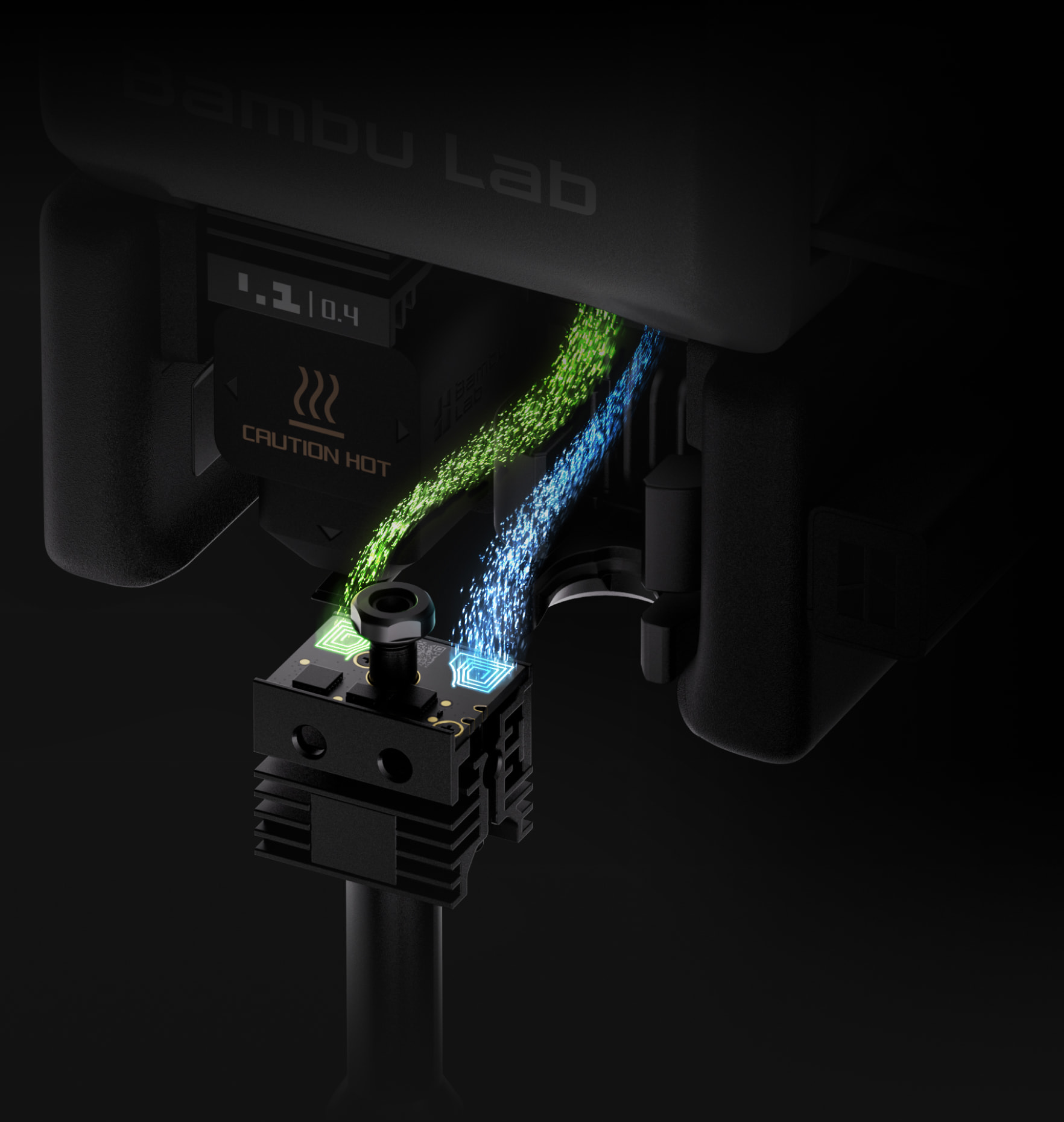
Conventional toolchangers move the whole toolhead — extruder motor, heater cartridge, thermistor, and cables — between positions. Vortek swaps only the hotend itself. Induction coils on the toolhead heat the cylindrical nozzle by electromagnetic field, so no heater-cartridge wiring is ever connected or disconnected. A wireless chip on each hotend reports its identity and temperature data back to the toolhead. Because nothing mechanical plugs and unplugs, the mechanism doesn’t wear out across the thousands of swaps a complex print can require.
Rigid bodies and flexible joints, printed in one piece
Dedicate hotends to materials that don’t mix
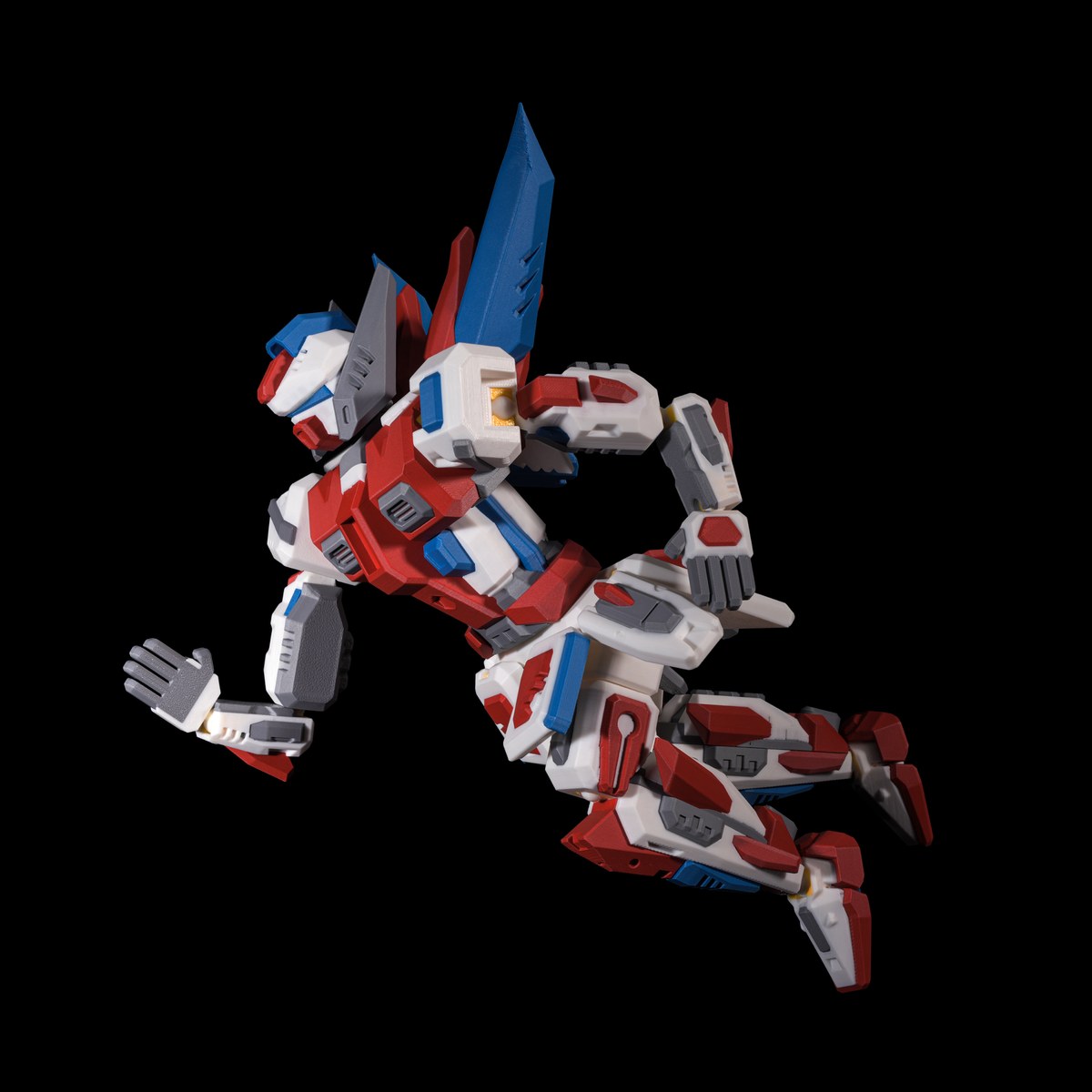
Reserve one Vortek hotend for TPU, another for PA6-GF, another for PC-FR — each filament gets a clean nozzle it never shares with another material. That turns multi-material design from a cleaning-and-purging exercise into an ordinary print job. Print TPU ball joints inside a PLA assembly so the finished part has its own flex hinges, or print structural PA6-GF frames with fire-retardant PC-FR exactly where it’s needed — functional articulation and material zoning without any post-assembly.
Functional parts straight off the plate
Bambu’s own reference parts fuse TPU AMS joints into PLA Matte bodies — an articulated figure that flexes at every joint with no fasteners, springs, or glue. Multi-material isn’t just multi-color on the H2C: it’s the ability to combine flexible, rigid, structural, and fire-retardant materials inside a single build so a finished mechanism comes off the bed ready to move.
Servo-driven extruder, real-time error detection
Closed-loop force, closed-loop motion
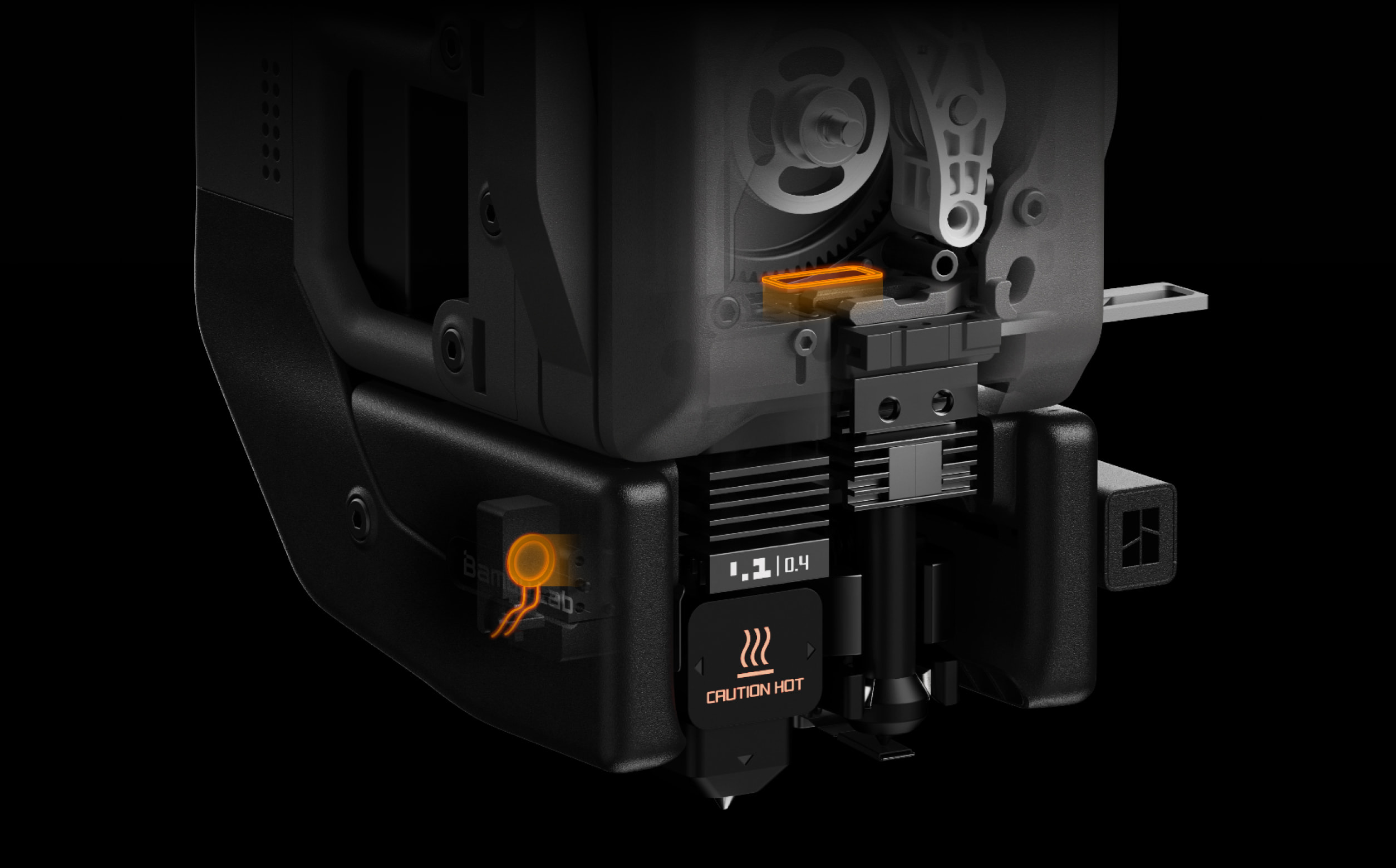
The H2C’s PMSM servo extruder delivers up to 10 kg of force — about 70% more than a stepper-driven extruder — and samples position and resistance at 20 kHz. That sampling rate is what makes real-time clog and filament-grinding detection possible: the system sees the problem in the torque curve before it shows up in a failed print. With the optional Vision Encoder plate, motion accuracy drops below 50 µm and holds across the whole bed by reading an optical grid that compensates for mechanical drift during calibration. Nozzle offset calibration is fully automatic to 25 µm.
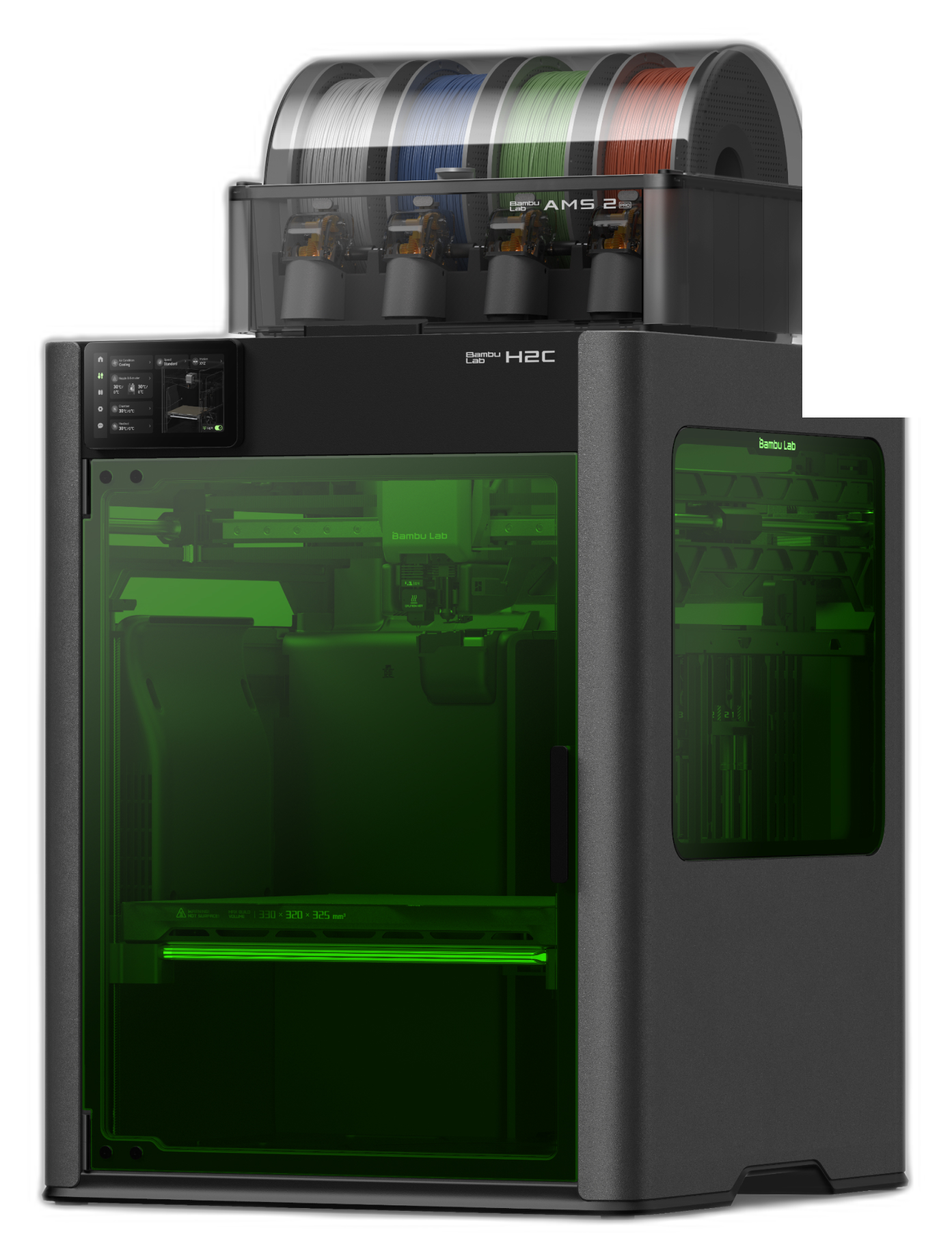
65 °C chamber, 350 °C nozzles, adaptive airflow
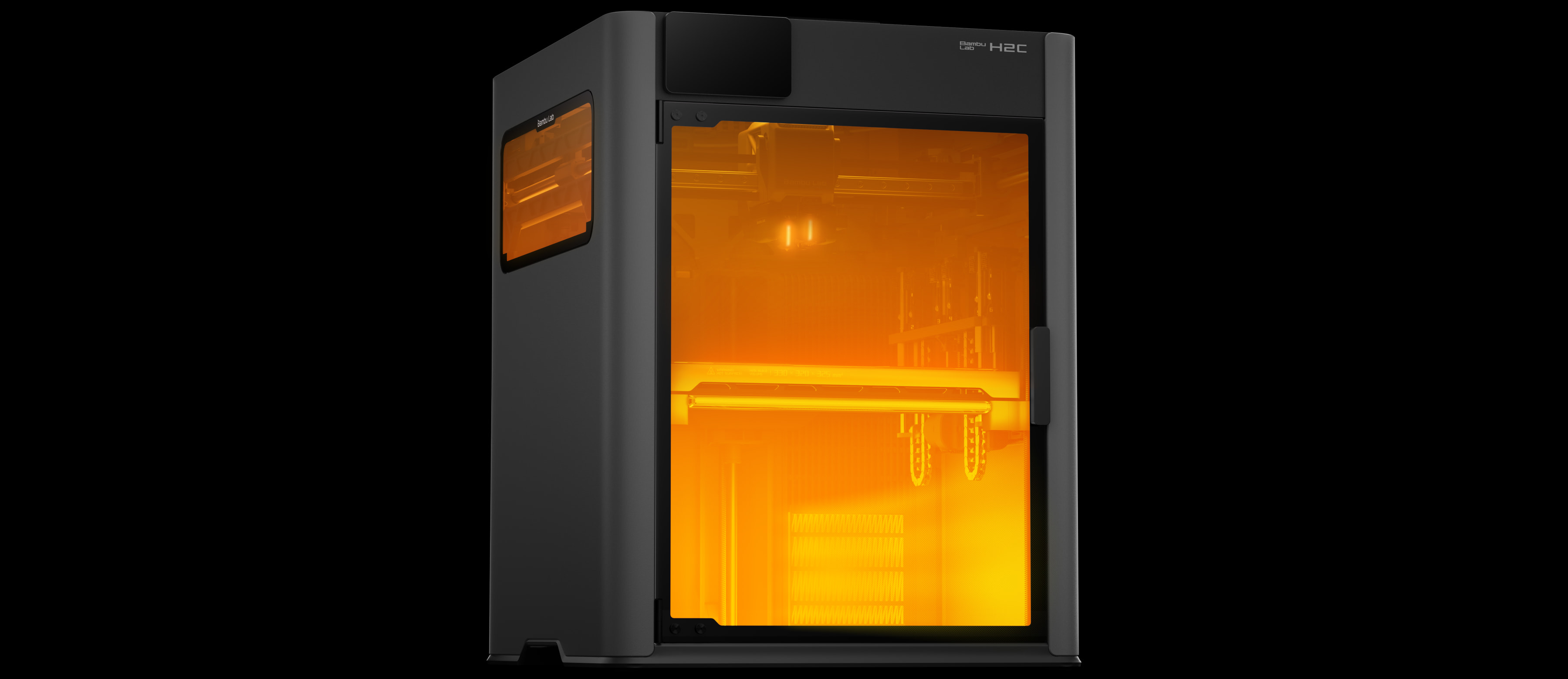
What the temperature envelope unlocks
An actively heated chamber at 65 °C and hardened-steel nozzles up to 350 °C run the materials desktop printers usually can’t — PA, PC, PPS, and their carbon-fiber and glass-fiber reinforced variants. Chamber temperature is actively controlled, not passive, which keeps the top of a tall print at the same temperature as the bottom so warping and layer splitting don’t creep in on long jobs. Adaptive airflow opens intake and rear vents for PLA and PETG to push heat out, and closes them for high-temp materials to retain chamber heat.
Engineering filament, filtered for the room it sits in
The enclosure is built from UL94 V-0 flame-retardant material and runs three-stage filtration — a G3 pre-filter, an H12 HEPA stage, and a coconut-shell activated-carbon stage — to handle the particulates and VOCs that come with engineering materials. That keeps the H2C deployable in an office or shared shop, not just a sealed equipment room, and lets you run carbon- and glass-filled filaments around people without venting the whole space. Pair that with the actively controlled 65 °C chamber and high-temp materials hold their dimensions from the first layer to the last.
Four cameras, 59 sensors, AI error detection
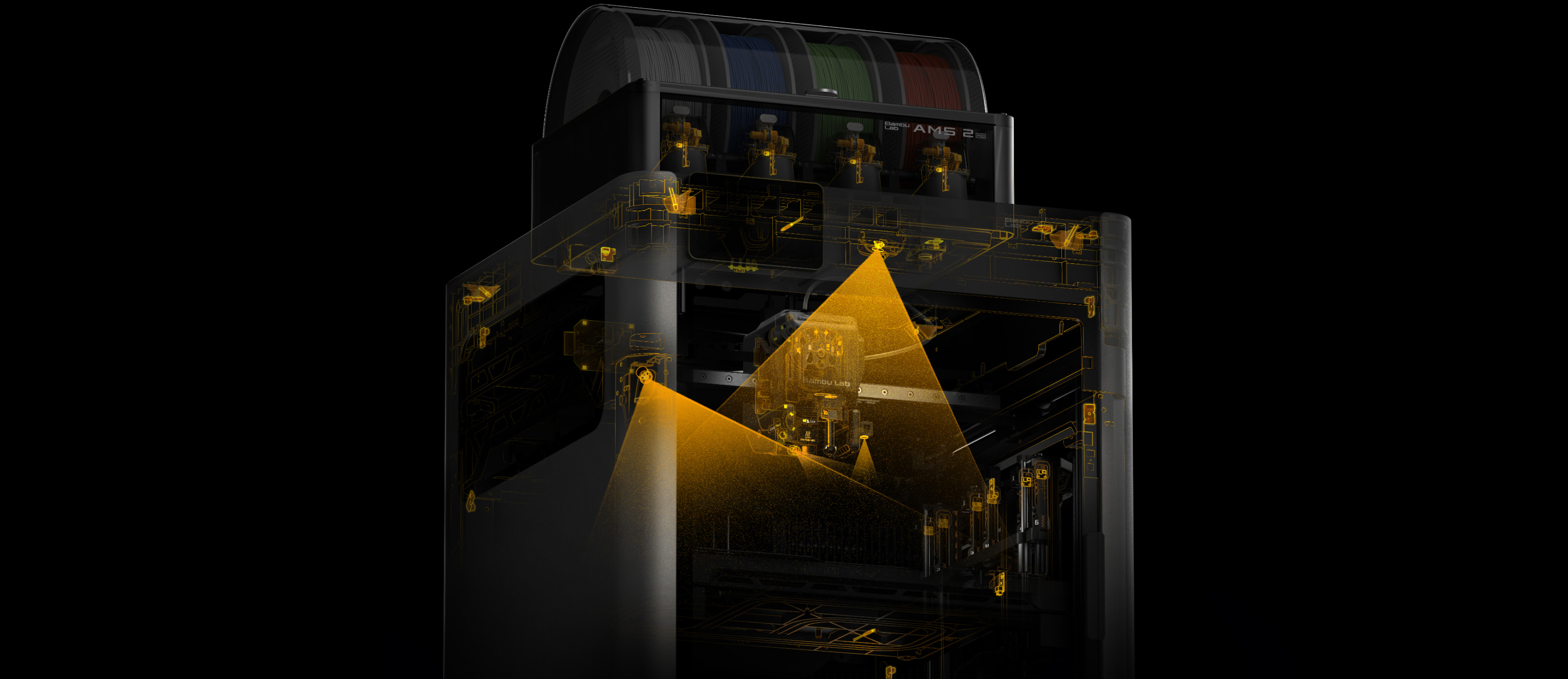
Catch the problem before it becomes a failed print
Three 1080p cameras — one for live monitoring, one on the nozzle for AI anomaly detection, one on the toolhead for calibration — plus an optional 8 MP Bird’s Eye camera on the Laser Edition. The nozzle camera watches for spaghetti, air printing, nozzle clumping, and clogged poop chutes, and runs a pre-flight scan before every job. A fully equipped H2C Laser Edition reports 59 sensors across the machine, feeding a neural algorithm that issues real-time diagnostics during a print. When a layer doesn’t adhere, a nozzle clogs, or a spool runs out, the machine knows immediately.
Cloud, LAN-only, or air-gapped — your call
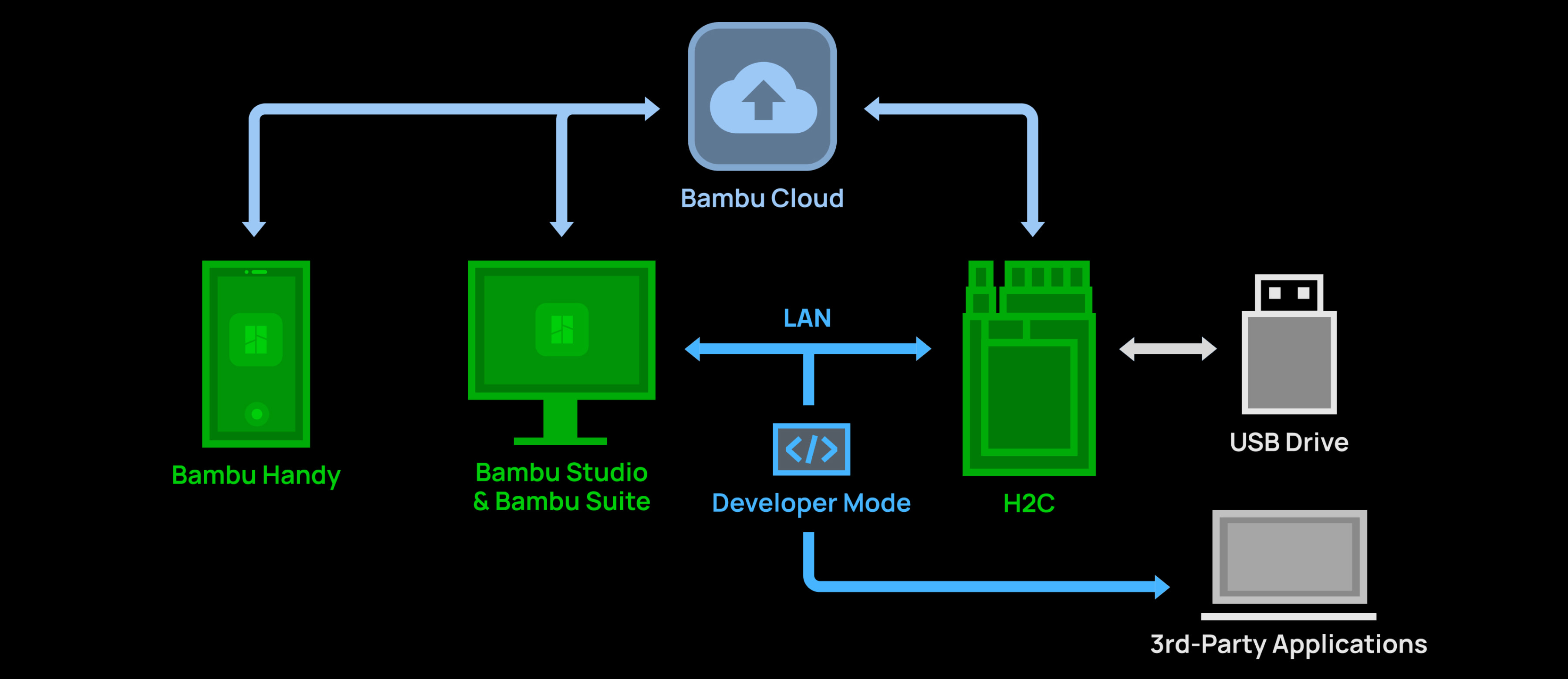
Security-sensitive workflows supported
The H2C runs in three network modes: cloud-connected for remote monitoring from Bambu Handy, LAN-only for shared-workspace deployments, or fully offline for air-gapped or security-sensitive environments where the printer can’t touch the internet at all. Files transfer by USB stick, firmware updates install locally, and the machine operates normally with no cloud connection. Developer Mode opens an MQTT port for third-party integrations — slicers, fleet-management platforms, or custom tooling. The printer is also cybersecurity-compliant with EU RED Article 3.3(d)(e) and ETSI EN 303 645 V2.1.1:2020 for regulated deployments.
Both combos, side by side
The H2C is offered as the AMS Combo and the Laser Full Combo (10W or 40W). Both ship from the Bambu Lab US warehouse — the AMS Combo in one package, the Laser Full Combo in two — with order processing typically 1–3 business days before transit. Use the configurator at the top of the page to pick a combo and see live pricing.
H2C vs. Prusa XL, Snapmaker U1, and Creality K2 Plus
The H2C solves the multi-color waste problem with the fewest compromises in its price band. Its Vortek rack delivers near-toolchanger purge behavior without carrying six full extruders — which keeps the machine smaller, faster, and substantially cheaper than a true toolchanger like the Prusa XL. Snapmaker’s U1 offers four-head tool changing at a lower price but with a smaller envelope and fewer sensors; Creality’s K2 Plus uses a conventional AMS that’s purge-hungry on multi-material jobs. Street prices shown honestly for the base machine.
| Bambu Lab H2C | Prusa XL (5-head) | Snapmaker U1 | Creality K2 Plus |
|---|---|---|---|
| Price & Build | |||
| From $2,649 | ~$3,500 (2-head) to ~$5,000+ (5-head) | ~$849 | ~$1,199 |
| 325 × 320 × 320 mm build | 360 × 360 × 360 mm | ~220 × 220 × 220 mm | 350 × 350 × 350 mm |
| Vortek hotend swap — 6+1 nozzles | True toolchanger — up to 5 full toolheads | True toolchanger — 4 full toolheads | AMS (purge-based filament change) |
| Up to 24 filaments (parallel AMS) | 5 (one per toolhead) | 4 (one per toolhead) | Up to 16 with stacked AMS |
| Thermal & Material | |||
| 350 °C max nozzle | 290 °C | 300 °C | 350 °C |
| 65 °C active chamber, adaptive airflow | Passive enclosure, optional heated | Enclosed, passive | 60 °C passive |
| PA, PC, PPS, CF/GF reinforced | PA, PC, CF/GF reinforced | PLA, PETG, ABS, TPU; limited high-temp | PLA, PETG, ABS, CF/GF reinforced |
| Automation & Support | |||
| 3× 1080p + 59 sensors; neural AI detect | Optional camera; no AI detection | AI camera | AI camera |
| Bambu Studio (open-source fork) | PrusaSlicer (open source) | Snapmaker Luban / OrcaSlicer | Creality Print / OrcaSlicer |
| Rev1 — US phone & video support, Auburn Hills MI | Prusa direct / regional reseller | Snapmaker direct / e-commerce | Creality direct / authorized reseller |
Bambu Lab H2C Technical Data
RESOURCES
Downloads & Technical Support
Everything you need to qualify and run your Bambu Lab H2C with confidence.
WHY REV1 TECH
Authorized Bambu Lab Reseller. Multi-Material Specialists.
Rev1 Technologies is headquartered in Auburn Hills, MI, with direct expertise in multi-material FFF workflows and industrial additive manufacturing.