Rev1 PC+-CF The Stiffest, Most Heat-Resistant Structural Filament
The Stiffest, Most Heat-Resistant Structural Filament
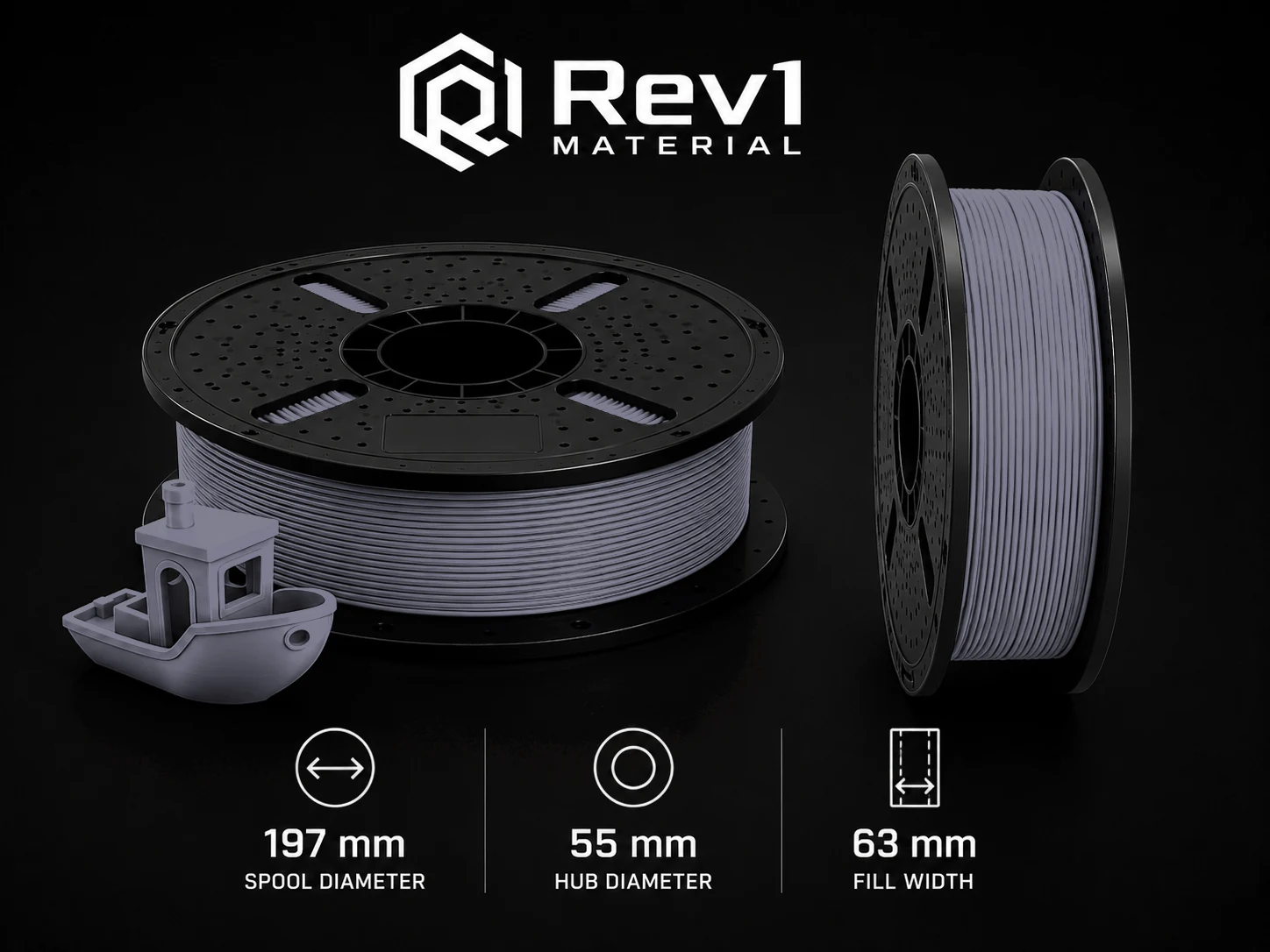
Carbon-fiber-reinforced polycarbonate is the top-tier structural engineering plastic — it keeps polycarbonate’s extreme strength and the highest heat tolerance of any common filament, then chopped carbon fiber adds serious stiffness, better strength-to-weight, and far lower warping than plain PC. It’s a demanding, advanced material: abrasive fiber means a hardened-steel nozzle is required, and it needs an enclosed, high-temp printer — in one premium Carbon Fiber matte-black finish, on 1 kg and 3 kg spools. Full specifications →
$64.99 per 1 kg. In-stock spools ship fast from Michigan; 3 kg spools are made to order and ship in 1–3 weeks. Need 3 kg spools or case pricing? Call (248) 707-2950.
Dimension-locked, vacuum-sealed, supported by humans.
Rev1 PC+-CF is precision-extruded 1.75 mm carbon-fiber polycarbonate filament, wound evenly and vacuum-sealed with desiccant to arrive dry, then stocked and supported from Auburn Hills, Michigan.

When the part has to survive extreme heat and load — and stay stiff.
PLA is easy but soft and heat-sensitive; PETG is tough but flexes; ABS handles moderate heat. Carbon-fiber polycarbonate sits above them all — it keeps polycarbonate’s extreme strength and the highest heat resistance of any common filament, then chopped carbon fiber adds real stiffness, better strength-to-weight, and far lower warping than plain PC. It holds its shape past 130 °C and takes brutal impact. The trade-off is that PC+-CF is demanding: the carbon fiber is abrasive, so it needs a hardened-steel nozzle, plus a high-temp, enclosed printer, and it must be kept bone-dry — give it that and Rev1 PC+-CF makes the stiffest, most heat-resistant structural parts you can print.
Tight diameter and a clean, dry wind for reliable high-temp runs.
Round, consistent 1.75 mm filament feeds smoothly so demanding enclosed prints don’t fail.
Every Rev1 PC+-CF spool is wound evenly and held to a tight diameter, so it feeds without under-extrusion across a full 1 kg or 3 kg run — run it through a hardened-steel nozzle, since the carbon fiber is abrasive. PC+-CF is strongly hygroscopic, so we vacuum-seal every spool with desiccant — keep it dry and it prints stiff and strong straight out of the bag.
Keeps polycarbonate’s heat tolerance — holds its shape past 130 °C (Tg ~145 °C), far beyond ABS, PETG, and PLA.
Chopped carbon fiber adds high stiffness and strength-to-weight on top of PC’s extreme impact strength — built for load-bearing parts.
Carbon fiber sharply reduces warping and shrinkage versus plain PC, so big structural parts stay flat and true.
One premium opaque finish — Carbon Fiber matte black, the structural look for engineering-grade end-use parts.
Print settings for strong, warp-free PC+-CF.
Carbon-fiber polycarbonate is an advanced material that demands a stable, high-temp setup. A hardened-steel nozzle, a high-temp hotend, a hot bed, an enclosure, and dry filament are what keep corners down and layers fused. This is not a beginner filament — it’s the hardest in the lineup to print — but the payoff is the stiffest, most heat-resistant part you can make.
The carbon fiber is abrasive and wears brass fast — a hardened-steel or ruby nozzle is required.
Needs a high-temp all-metal hotend well above ABS for strong layer bonding.
PC+-CF warps without a hot, draft-free chamber — an enclosure is effectively mandatory, though carbon fiber helps.
PC+-CF soaks up moisture fast; dry it before printing and store it sealed with desiccant.
Recommended slicer settings
A solid starting profile for Rev1 PC+-CF on a high-temp, enclosed FDM printer with a hardened nozzle. Tune cooling and chamber temperature for your machine.
| Setting | Recommended | Notes |
|---|---|---|
| Nozzle temperature | 260–300 °C | High-temp all-metal hotend required for strong layer bonding. |
| Nozzle type | Hardened steel / ruby | Required — the carbon fiber is abrasive and destroys brass nozzles. |
| Bed temperature | 100–120 °C | Strong adhesive on glass/PEI for a first layer that won’t lift. |
| Chamber / enclosure | Hot, draft-free | Essentially required — a big factor in warp-free PC+-CF. |
| Print speed | 30–60 mm/s | Moderate speeds help interlayer strength. |
| Part cooling fan | 0–10 % | Keep cooling very low — too much fan cracks and delaminates layers. |
| Retraction | 1–5 mm | Direct drive: ~1–2 mm. Tune to control stringing. |
| Nozzle size | 0.4 mm + | Larger hardened nozzles add strength on functional parts. |
| Drying | 80–100 °C · 6–8 h | Required before printing — PC+-CF is strongly hygroscopic. |
| Bed adhesion | Brim + adhesive | Use a brim and glue to fight warping on large parts. |
Stiff, structural parts that take extreme heat and load.
The top-tier material behind the stiffest, hottest-running structural parts.
PC+-CF trades easy printing for the highest real engineering performance: high stiffness, extreme strength, brutal impact resistance, the best heat tolerance of any common filament, and far lower warping than plain PC. Stocked in Carbon Fiber matte black, on 1 kg and 3 kg spools.
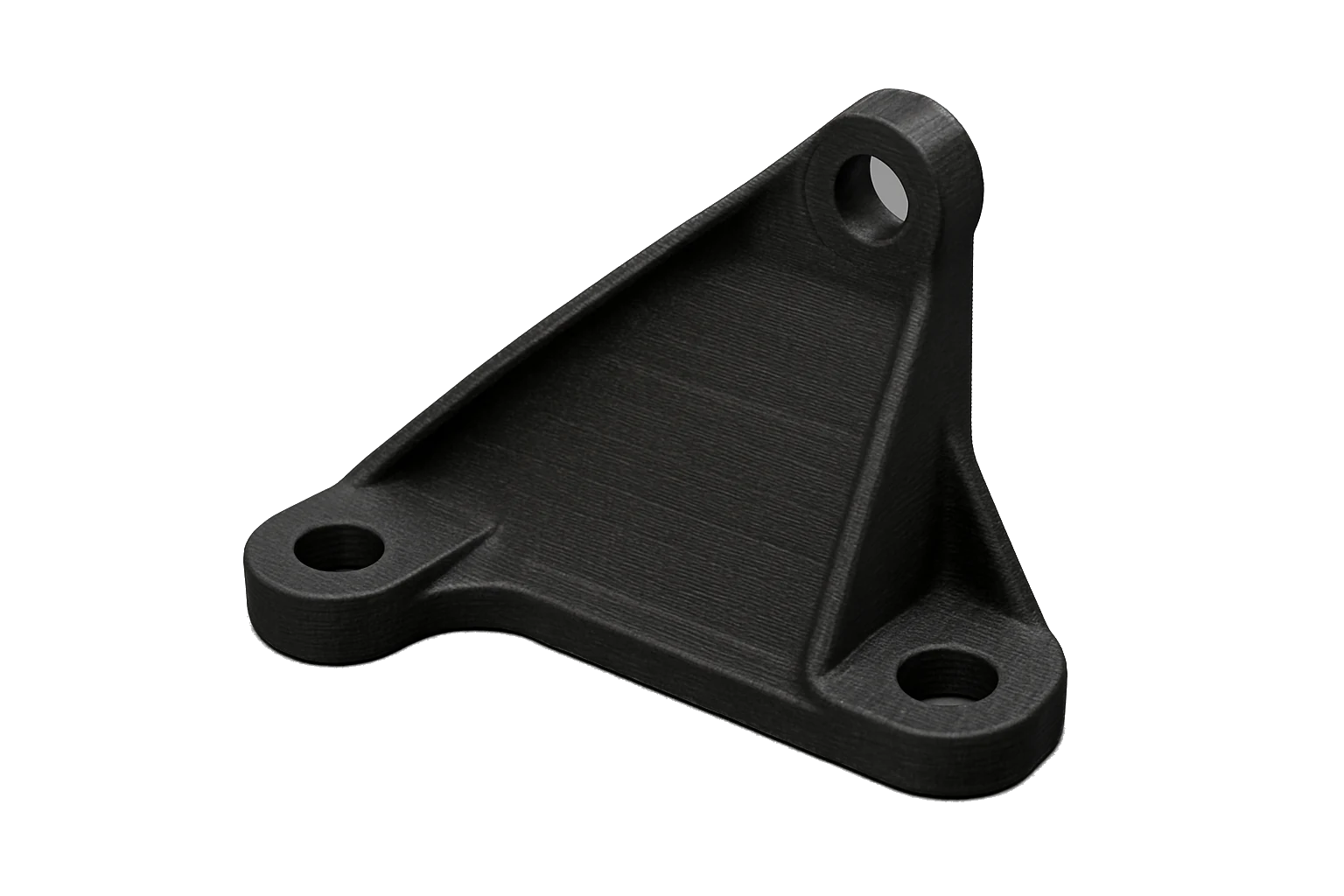
Under-hood heat and vibration? PC+-CF laughs it off.
The highest heat resistance of any common filament, plus carbon-fiber stiffness for structural mounts.
Structural brackets and mounts that live right next to the engine — PC+-CF holds its shape past 130 °C and stays rigid under vibration and impact where ABS and PETG would soften, crack, or flex.
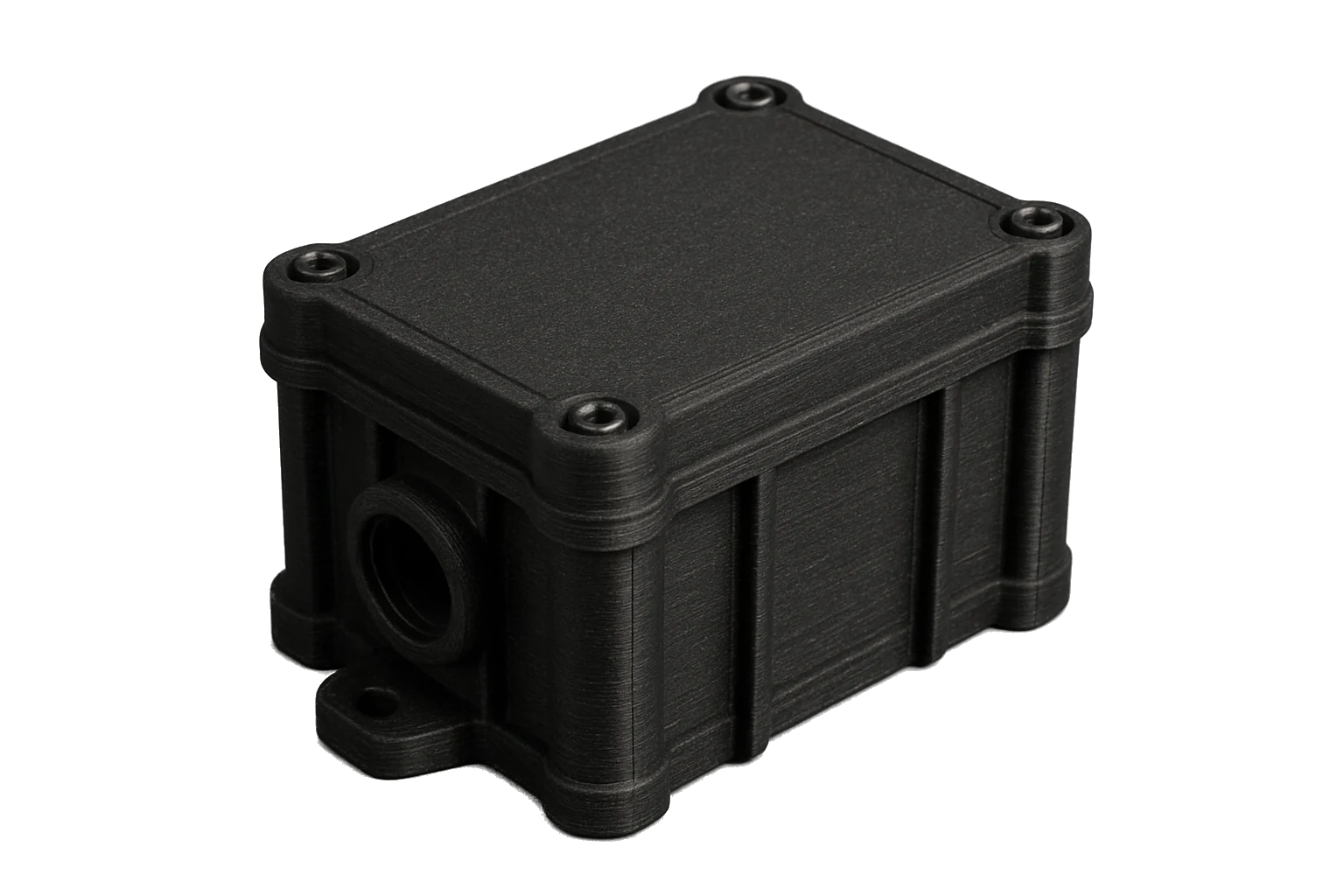
Sealed electronics enclosures that take a hit.
Rigid, high-stiffness housings for demanding industrial and field environments.
PC+-CF is the go-to for rugged equipment enclosures and electronics housings — stiff, dimensionally stable walls with extreme impact strength that survive knocks, heat, and daily plant use.
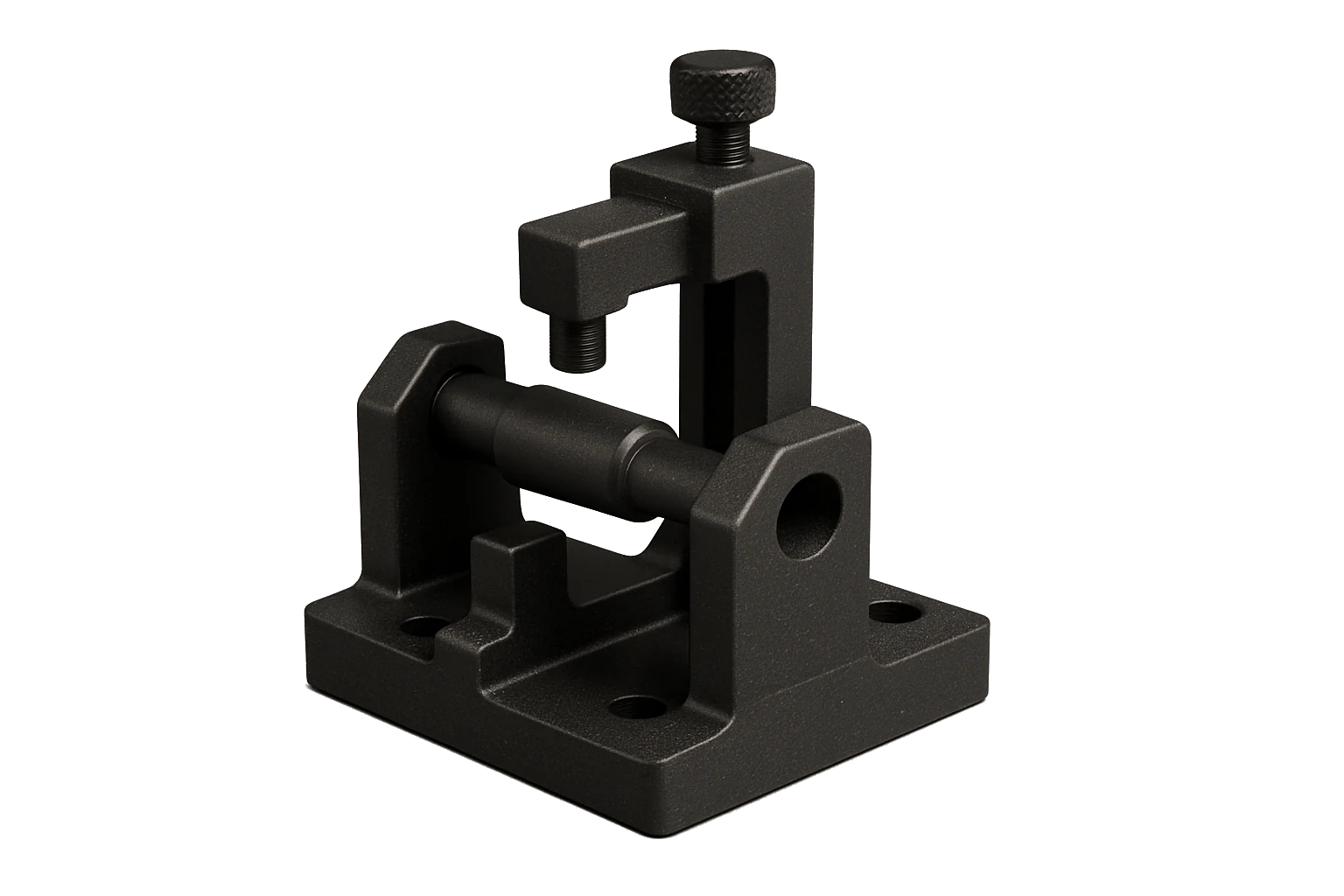
Precision jigs and fixtures that hold.
Carbon-fiber stability keeps tooling true under clamping and load.
Print the precision fixtures, jigs, and assembly aids your line needs — PC+-CF stays rigid and dimensionally stable through heat, clamping force, and repeated cycles, with far less warping than plain PC.
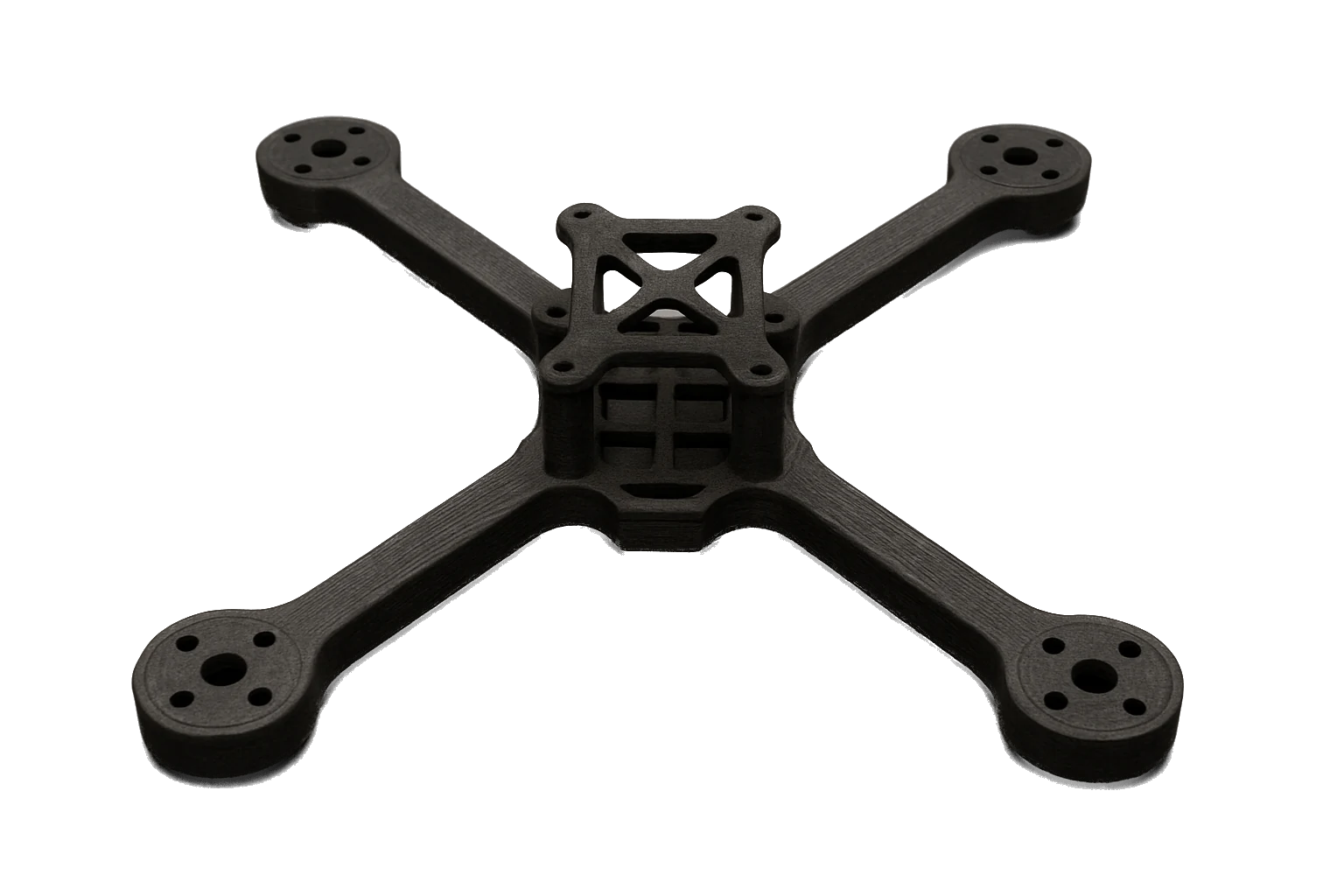
Drone and UAV frames with the stiffness-to-weight.
Carbon-fiber polycarbonate delivers the strength-to-weight airframes demand.
PC+-CF is ideal for structural quadcopter and UAV frames — the chopped carbon fiber adds stiffness and cuts weight, so frames resist flex and vibration while surviving hard landings and heat.
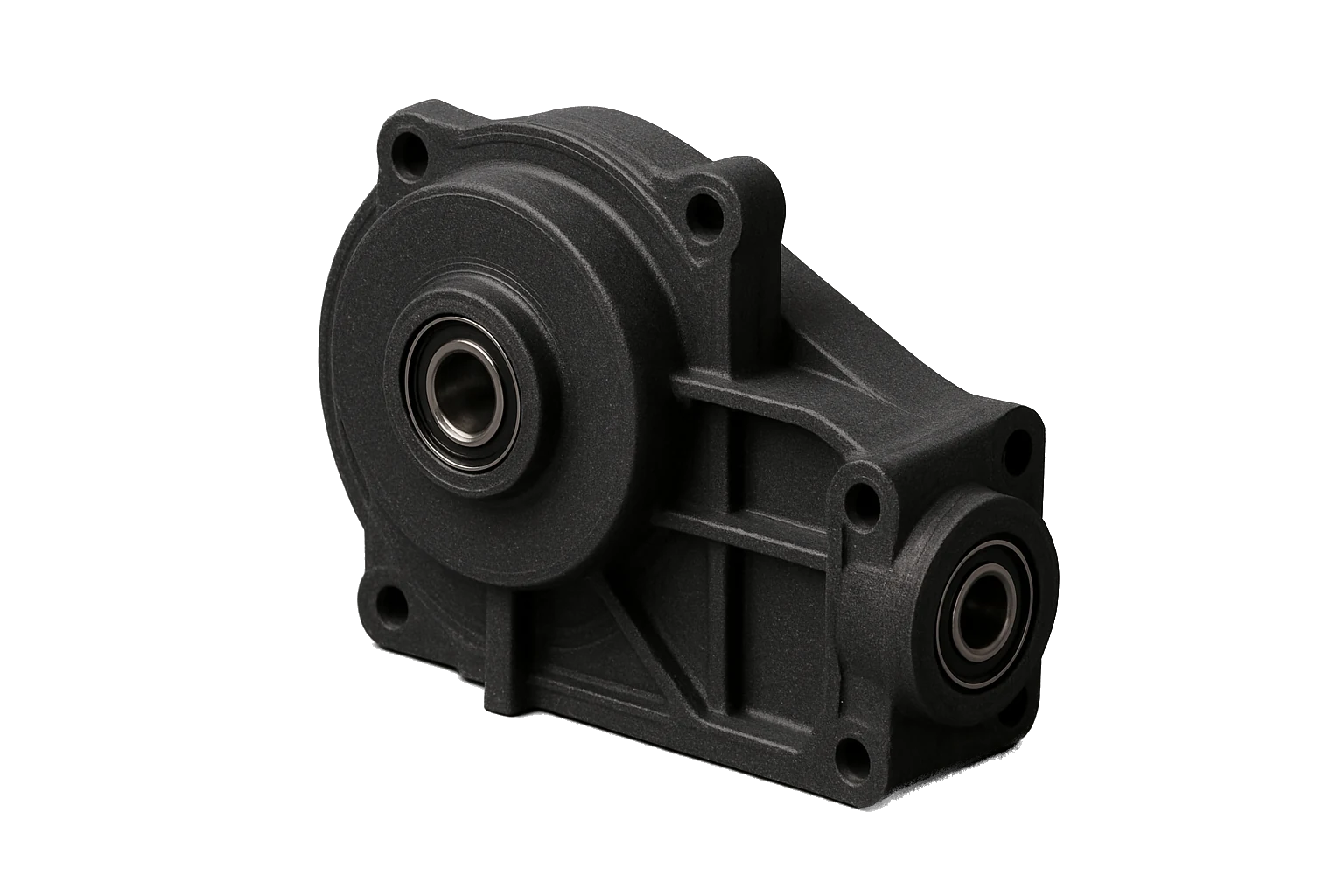
Motor and gearbox housings that stay true under heat.
Rigid, heat-tolerant housings for real mechanical assemblies.
Print motor and gearbox housings that hold their shape next to hot, hard-working drivetrains — PC+-CF brings the stiffness, dimensional stability, and heat resistance a load-bearing housing needs.
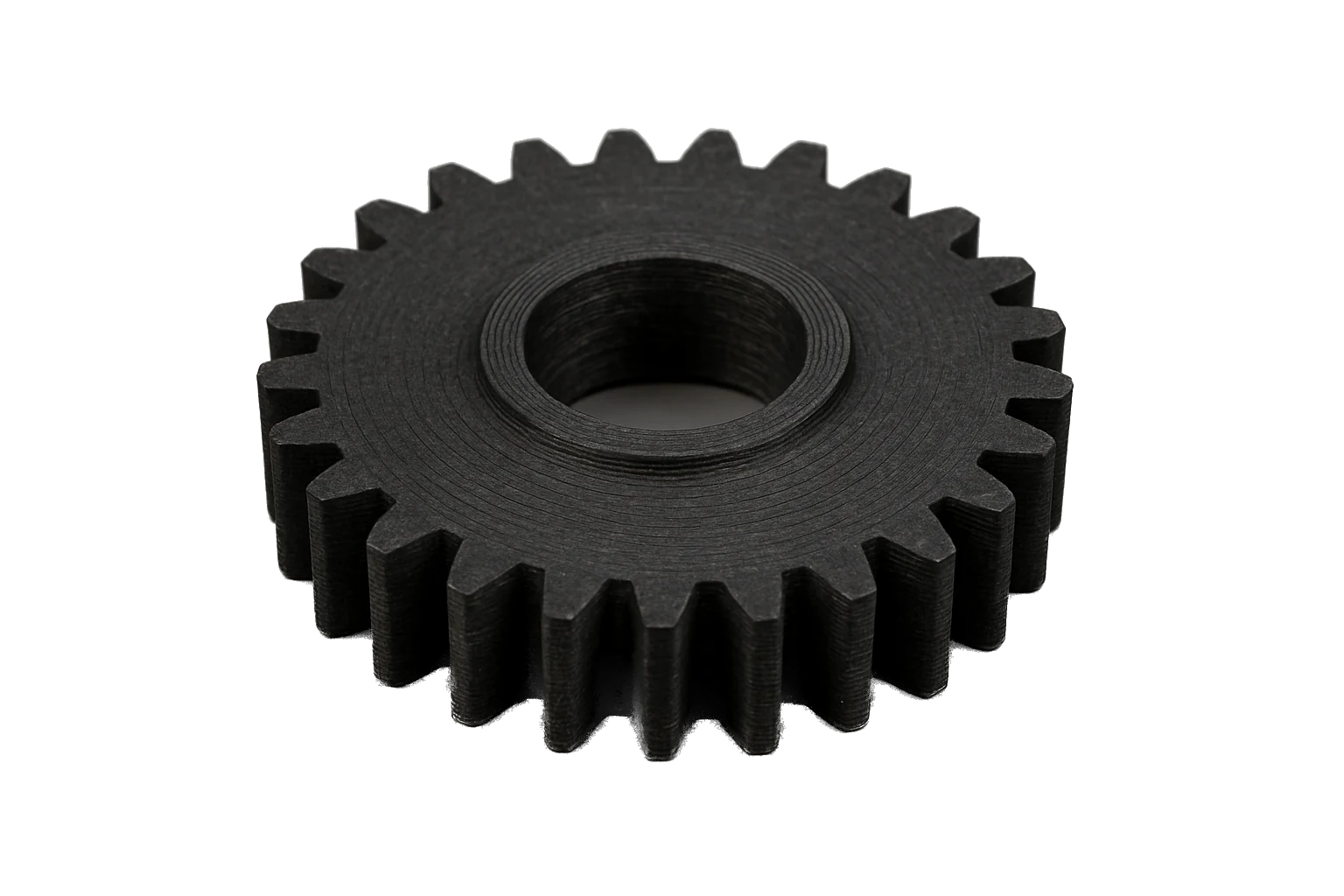
Structural gears and mechanical parts that last.
Stiff enough for real-world, load-bearing mechanical components.
Spur gears, cams, and structural mechanical components — PC+-CF brings the stiffness, strength, and heat resistance to move from prototype to a part that goes into service. Ask us about 3 kg spools and case pricing.
PC+-CF vs. plain PC vs. PC-ABS.
Pick by what the part has to survive. PC+-CF wins on stiffness, dimensional stability, and strength-to-weight; plain PC is easier and cheaper for high-heat parts; PC-ABS is the easier high-heat alloy when you don’t need carbon-fiber rigidity.
| Rev1 PC+-CF | Plain PC | PC-ABS | |
|---|---|---|---|
| Stiffness | Highest — carbon-fiber reinforced | High | Medium-high |
| Heat resistance | Highest (~140 °C) | Highest (~130 °C) | High (~110 °C) |
| Strength-to-weight | Best | High | Good |
| Dimensional stability | Excellent — low warp | Warps easily | Moderate |
| Ease of printing | Hardest — hardened nozzle | Demanding | Moderate |
| Nozzle | Hardened steel required | Brass OK | Brass OK |
| Cost | Premium | Higher | Moderate |
| Best for | Stiff structural / high-heat | Strength / heat | Tough functional / heat |
General material guidance; exact performance depends on part geometry, print settings, and grade. For easier high-heat parts choose plain PC or PC-ABS; for easy prints choose PLA or PETG; for UV and outdoor use choose ASA. PC+-CF is the pick when you need the most stiffness, dimensional stability, and strength-to-weight — and can run a hardened nozzle in an enclosed, high-temp printer.
Rev1 PC+-CF Technical Data
Mechanical & thermal properties
Typical PC-CF reference values for engineering reference. Printed-part performance varies with wall count, infill, layer height, and orientation — treat these as material-level guidance, not a part spec.
| Property | Typical Value | Method |
|---|---|---|
| Tensile strength | ~75 MPa | ISO 527 |
| Tensile modulus | ~4,500 MPa | ISO 527 |
| Elongation at break | ~4 % | ISO 527 |
| Flexural strength | ~110 MPa | ISO 178 |
| Flexural modulus | ~4,800 MPa | ISO 178 |
| Izod impact (notched) | ~12 kJ/m² | ISO 180 |
| Glass transition (Tg) | ~145 °C | DSC |
| Heat deflection (HDT, 0.45 MPa) | ~140 °C | ISO 75 |
| Shelf life (sealed, dry) | 12 months | — |
Specs, profiles, and a human to call.
Your trusted materials partner.

Every spool is checked for tight diameter tolerance and reliable, repeatable printing.
Call (248) 707-2950 and reach people who actually print and support these materials.
Case quantities and standing orders on Rev1 PC+-CF, including 3 kg spools.
FAQ
Rev1 PC+-CF — Common Questions
Do I need a hardened nozzle to print PC+-CF?
Yes — a hardened-steel or ruby nozzle is required. The chopped carbon fiber is abrasive and quickly wears out a standard brass nozzle. You also need a high-temp all-metal hotend (260–300 °C), a 100–120 °C bed, and an enclosure. It’s the most demanding filament in the lineup to print.
PC+-CF vs plain PC vs PC-ABS — which should I use?
Choose PC+-CF when you need the most stiffness, the best strength-to-weight, and dimensional stability with high heat resistance — and you can run a hardened nozzle in a high-temp, enclosed printer. For easier high-heat parts, plain PC or PC-ABS print without a hardened nozzle. For easy prints, use PLA or PETG.
What color and sizes are available?
One premium finish — Carbon Fiber matte black — on 1 kg and 3 kg spools. In-stock 1 kg spools ship fast from Michigan; 3 kg spools are made to order and ship in 1–3 weeks. Pick your spool size in the buy-box, or ask us about case quantities.
Does carbon fiber stop PC from warping?
It helps a lot — PC+-CF warps far less than plain PC and stays more dimensionally stable. You still want a hot, enclosed chamber, a 100–120 °C bed with a strong adhesive and a brim, part cooling very low or off, and dry filament for the flattest, strongest results.
How stiff and strong is PC+-CF?
The chopped carbon fiber raises stiffness and strength-to-weight well above plain PC — think higher tensile and flexural modulus with excellent dimensional stability, while keeping polycarbonate’s extreme impact strength. It trades some elongation for rigidity, which is exactly what structural parts want.
Why is PC+-CF harder to print than ABS?
PC+-CF prints hot and abrasive — a 260–300 °C all-metal hotend, a hardened nozzle, a 100–120 °C bed, an enclosure, and dry filament are all needed. It’s the hardest material in the lineup, so it’s an advanced pick, not a beginner one. If you don’t need its stiffness and heat, PC-ABS is easier and PLA or PETG are easier still.
How heat-resistant is PC+-CF?
It keeps polycarbonate’s heat resistance — it holds its shape past 130 °C with an HDT around 140 °C (Tg ~145 °C), well beyond ABS, PETG, and PLA. That makes it ideal for under-hood and high-heat load-bearing parts. For UV and outdoor exposure, choose ASA instead.
Is the 3 kg spool better value?
Yes — the 3 kg spool lowers cost per kilogram and means fewer spool changes on long or production runs. It’s the go-to for shops and print farms. 3 kg spools are made to order and ship in 1–3 weeks.
Can Rev1 quote bulk or 3 kg spools?
Yes. Tell us the quantity and spool size and we confirm stock and quote case pricing with standing-order scheduling, usually within one business day. Call (248) 707-2950.