Bambu Lab PETG HF High-Speed PETG Built for Functional Parts
High-Speed PETG Built for Functional Parts
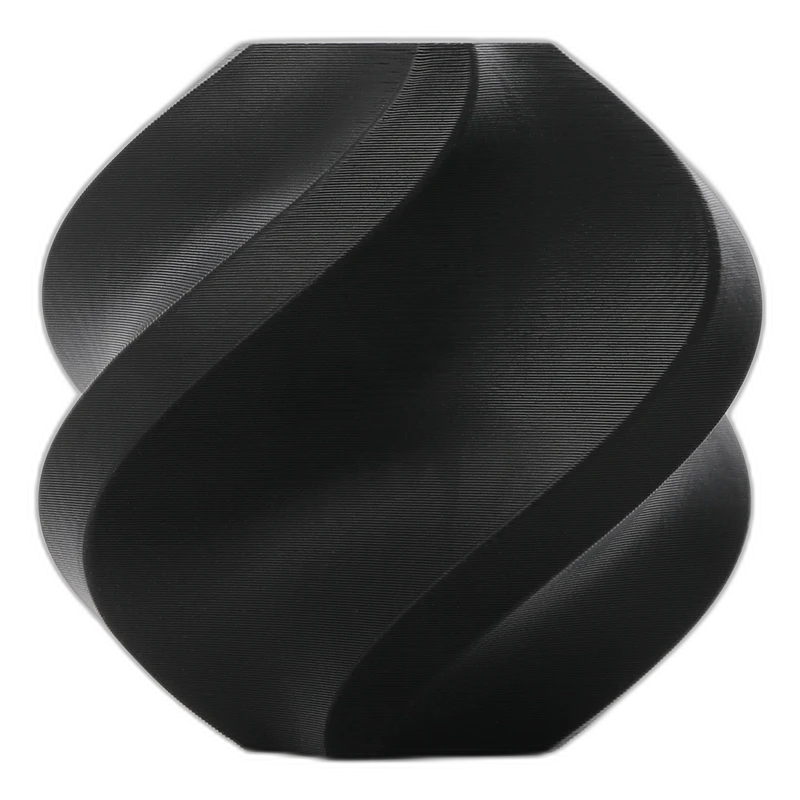
PETG HF (High-Flow) is Bambu Lab’s reformulated PETG engineered to run at up to 300 mm/s — twice the default speed of standard PETG. A tuned polymer melt reduces viscosity under shear without sacrificing the toughness, UV resistance, or chemical resistance that makes PETG the go-to material for functional, end-use parts. At 34 MPa tensile strength and 69 °C HDT, it outperforms PLA in both impact and heat while printing on any heated-bed FDM machine, including Bambu’s AMS multi-color system. Full specifications →
In stock in the USA — ships from Rev1. Need a print profile, volume pricing, or help choosing the right PETG? Call (248) 707-2950.
OEM-Fresh Filament. TDS-Backed Properties.
Every spool of Bambu Lab PETG HF ships with lot-traceable material backed by the official Technical Data Sheet and Safety Data Sheet. Rev1 Technologies is your authorized Bambu Lab reseller and US support partner, Auburn Hills, Michigan.


High-Flow PETG. Engineered for Speed Without Sacrifice.
Standard PETG is reliable, tough, and chemically resistant — but its viscosity under shear limits practical print speeds to around 120–150 mm/s before quality degrades. Bambu Lab’s PETG HF changes that equation with a modified rheology formula that lowers melt viscosity at high shear rates while preserving the polymer backbone that gives PETG its toughness, UV stability, and broad chemical resistance. The result is a filament that runs at up to 300 mm/s on calibrated hardware — twice the throughput of a standard PETG at the same quality floor.

Modified Rheology. Twice the Speed.
Tuning the melt flow index of a PETG formulation is a balance between speed and property retention. Bambu Lab’s PETG HF achieves this by modifying the polymer chain length distribution and adding a proprietary flow-enhancing package that activates under print-head shear — so the filament flows freely at 300 mm/s but resolves to a rigid, tough part on the bed.

Drop-In for AMS. Open for Everything Else.
PETG HF ships on a standard Bambu-geometry 1kg spool with the RFID tag the AMS reads to auto-load print profiles — no manual settings entry when running on X1, P1, or A1 hardware. The same 1.75 mm diameter and ±0.03 mm tolerance that makes it work flawlessly in the AMS makes it equally at home on any open 1.75 mm FDM machine with a heated bed. One formula, two ecosystems.
Tougher Than PLA. TDS-Verified Numbers.
With a tensile strength of 34 MPa, a flexural modulus of 2050 MPa, and a Charpy notched impact strength of 31.5 kJ/m², PETG HF delivers mechanical properties that outclass most PLA grades on impact resistance while matching or exceeding them on stiffness. These values come directly from Bambu Lab’s official Technical Data Sheet — tested to ISO 527, ISO 178, and ISO 179 standards — so they represent real, reproducible part properties, not marketing estimates.

34 MPa Tensile. 2050 MPa Modulus.
PETG HF achieves a tensile strength of 34 MPa and a flexural modulus of 2050 MPa — the backbone of stiff, load-bearing parts. Elongation at break of 8.6% means the material yields rather than shattering under sudden load, giving functional assemblies a warning before failure rather than a sudden snap. For snap-fit tabs, clip housings, and structural enclosures, this ductile-yet-stiff profile is the right combination.

31.5 kJ/m² Impact. Snap, Don’t Shatter.
At 31.5 kJ/m² Charpy notched impact strength, PETG HF absorbs significantly more impact energy than standard PLA before fracturing — a meaningful difference for enclosure walls, cable clips, cover panels, and any part that sees repeated assembly and disassembly. Density is 1.28 g/cm³, keeping parts light without compromising the structural integrity these numbers represent. All mechanical values tested and reported at the material level, not modeled.
69°C HDT. Outdoor-Capable. Chemically Stable.
PETG HF retains every thermal and chemical advantage that makes standard PETG the preferred polymer for outdoor enclosures, fluid-contact housings, and UV-exposed fixtures. With a heat deflection temperature of 69°C and Vicat softening point of 70°C, parts hold their geometry in environments that would distort PLA. Inherent resistance to water, dilute acids, alcohols, and UV means PETG HF handles real-world operating conditions that synthetic PLA simply cannot.

69°C HDT. Stable Where PLA Warps.
With a heat deflection temperature of 69°C under 0.45 MPa load, PETG HF parts stay dimensionally stable inside vehicle interiors, near electronics generating waste heat, and in applications where summer ambient temperatures can push past 50°C. The Vicat softening point of 70°C confirms surface integrity under point contact loads. PLA’s HDT of 50–55°C puts it at risk in the same environments; PETG HF is not.

UV, Water, and Chemical Stable. Print Once, Last Long.
PETG’s chemical resistance profile is one of its strongest selling points, and PETG HF preserves it fully. Inherent resistance to water absorption (<0.1% in 24 h) keeps dimensional accuracy high in humid environments. Resistance to dilute acids, aliphatic hydrocarbons, and common alcohols (IPA, ethanol) makes it appropriate for housings exposed to routine cleaning or fluid splatter. UV stability exceeds PLA and approaches that of ASA in short-duration outdoor exposure without any additive needed.
230–260°C Nozzle. 65–75°C Bed. Up to 300 mm/s.
PETG HF is not a set-and-forget profile — but on calibrated Bambu hardware it gets close. The RFID-tagged spool loads a factory-optimized profile automatically in Bambu Studio, covering nozzle temperature, bed adhesion, cooling fan curve, and retraction settings tuned for the HF rheology. On open printers, dial in the nozzle at 240°C to start, a 70°C bed with PEI or glass, moderate part cooling (40–60%), and reduce retraction below what you’d use for standard PETG — the HF formula oozes less. Dry the filament first; a damp spool degrades surface finish and increases stringing regardless of settings.

Nozzle & Bed: Dialed In at the Factory.
On Bambu X1, P1, or A1 hardware, PETG HF AMS profiles set nozzle temperature to 240°C (range 230–260°C), bed to 70°C, print speed to 200 mm/s default with burst capability up to 300 mm/s, and a flow calibration routine that compensates for the HF melt behavior in real time via the printer’s lidar and force sensor. On open printers, follow the same temperature envelope — the filament is not hardware-locked, just optimized.

Drying Before Use. Low Retraction. Moderate Cooling.
PETG HF is hygroscopic — moisture absorbed from the air increases stringing and causes surface artifacts even with a perfect profile. Dry at 65°C for 8 h in a blast oven (or 75–85°C on a Bambu X1 heatbed for 12 h) before first use and after any open-spool storage over 48 h. Retraction: 0.4–0.8 mm at Bowden, 0.2–0.4 mm at direct-drive — lower than standard PETG because HF cuts ooze by design. Part cooling: 40–60% — enough to resolve overhangs cleanly without introducing layer delamination on tall prints.
AMS-Native on Bambu. Open-Format on Everything Else.
Bambu Lab PETG HF carries the RFID identification that makes the AMS Automated Material System work seamlessly on X1 Carbon, X1E, P1P, P1S, A1, and A1 Mini printers. On machines without AMS — Creality, Prusa, Bambu A1 Lite, or any open 1.75 mm FDM machine with a heated bed — the filament runs without restriction. The AMS tag is not a lock; it’s a convenience feature for users who want profiles loaded automatically.

X1, P1, A1 Series — Plug In, Profile Loads.
On Bambu X1 Carbon, X1E, P1P, P1S, A1, and A1 Mini, inserting a Bambu PETG HF spool into the AMS triggers automatic RFID detection — Bambu Studio reads the material ID and sets nozzle temperature, bed temperature, flow rate, and cooling curve without manual input. Multi-color or multi-material prints using PETG HF as the structural material are coordinated by the AMS with automated purging between transitions.

Any Heated-Bed FDM Machine. No Lock-In.
PETG HF is not firmware-locked. Any 1.75 mm open-format machine with a 70°C bed (PEI, glass, or garolite) and a nozzle capable of 240°C runs it. The tolerance of ±0.03 mm ensures consistent flow on Bowden and direct-drive setups alike — no frequent clogs from diameter variation. Prusa MK4, Creality K1 and K2, Bambu H2D, and production FFF machines from industrial brands all qualify. If the machine can handle PETG, it can handle PETG HF — just set the nozzle 5–10°C higher than your standard PETG baseline.
Matte Surface. Tight Tolerance. No Stringing.
One of the known weaknesses of standard PETG is ooze — fine threads of material that bridge between features during travel moves, degrading surface quality on complex geometries. PETG HF’s tuned melt viscosity significantly reduces ooze at travel speeds above 150 mm/s, leaving cleaner details without the post-processing needed to clean standard PETG prints. Dimensional accuracy benefits from the ±0.03 mm diameter tolerance and the consistent flow properties of the HF melt, giving printed walls, holes, and snap-fit tolerances that require minimal sanding or fitting.

Matte Finish. Reduced Ooze at Travel Speed.
Standard PETG’s characteristic ooze and shine are byproducts of its high melt viscosity and tacky surface — both addressed in the HF formula. PETG HF prints to a matte, satin-like surface that photographs and renders cleanly without specular hot spots. Travel moves above 150 mm/s shear-thin the melt enough to cut stringing dramatically, so fine features like grid walls, pillars, and bridging spans emerge crisp without requiring the high-retraction workarounds standard PETG demands.

±0.03 mm Tolerance. Snap-Fits That Actually Snap.
Diameter consistency is the single biggest variable in FDM dimensional accuracy that the user cannot control during a print — and at ±0.03 mm, PETG HF is at the top tier of consumer filament tolerance. Combined with PETG’s lower shrink rate vs ABS or ASA, printed holes, slots, and interlocking features require less post-process fitting. Snap-fit hooks, press-fit inserts, and sliding channels land close to nominal on the first attempt — reducing the iteration cycle that makes prototyping in stiffer materials frustrating.
Functional Prototypes. Production Jigs. Outdoor Fixtures.
PETG HF’s combination of speed, toughness, chemical resistance, and UV stability makes it one of the most broadly applicable FDM filaments available. It handles the work that PLA fails in heat and impact, without the warping penalties and enclosure requirements of ABS or ASA. For engineering teams running Bambu hardware, it is a natural default for any part that needs to outlast a quick prototype but doesn’t require engineering polymer performance.

Manufacturing Tooling — Jigs, Fixtures, Templates.
PETG HF’s toughness (31.5 kJ/m² impact) and moderate HDT (69°C) make it a practical material for short-run manufacturing tooling. Assembly jigs, go/no-go gauges, PCB test fixtures, cable routing templates, and drill guides benefit from PETG’s dimensional stability and resistance to IPA cleaning that shop-floor tooling regularly sees. At 200–300 mm/s print speed, a production batch of tooling sets that would take a day in standard PETG takes half the time in PETG HF.

Electronics Enclosures. Outdoor Housings. End-Use Parts.
PETG HF is well-suited for electronics enclosures where UV exposure, occasional fluid splash, and periodic screw-in insert installation are part of the operating profile. The matte surface finish reads as a finished product rather than a prototype. Outdoor cable routing boxes, sensor mounts, and equipment guards benefit from PETG’s UV resistance and impact toughness — making PETG HF a viable end-use material for parts where the environment is demanding but not at the extreme end of the operating envelope.
Dry It First. Store It Sealed. Print Confidently.
PETG HF is hygroscopic — it absorbs moisture from ambient air, and even a few percent moisture content changes the melt behavior: increased stringing, surface bubbling, weaker layer bonds, and a characteristic popping sound from the hotend. Proper drying before first use and after any extended open-spool storage is the single most impactful step for consistent print quality, ahead of retraction tuning, temperature adjustments, or any other parameter. Bambu ships all spools vacuum-sealed; break the seal and keep the spool dry.

65°C / 8 h in a Blast Oven. Or the X1 Heatbed.
Bambu Lab specifies two drying methods. In a blast (convection) drying oven, dry at 65°C for 8 h. On a Bambu X1 heatbed (in preheat mode, spool resting directly on the bed), use 75–85°C for 12 h — a convenient option that requires no extra hardware. Both methods drive off absorbed moisture and restore the filament to a condition close to factory-sealed. Annealing printed PETG HF parts is not recommended by Bambu: HDT improvement is minimal, and warping risk is real for geometrically complex parts.
Real Parts. High Speed. Rev1-Tested.
PETG HF is print-ready at Rev1’s Auburn Hills facility on Bambu X1 Carbon and P1S hardware. The gallery below shows representative results across functional and structural applications at 200–300 mm/s print speeds. Every part was printed dry-filament, on PEI at 70°C bed, 240°C nozzle, 40–60% part cooling — Rev1’s baseline profile for this material.

PETG HF parts printed at Rev1 — jigs, enclosures, snap-fit assemblies, outdoor fixtures. 200–300 mm/s, 240°C nozzle, 70°C PEI bed.
The Brand That Redefined FDM Speed. Now Its Filament.
Bambu Lab launched in 2022 with a clear thesis: professional-grade FDM speed and reliability should be accessible to engineers, not just production lines with six-figure machine budgets. Their X1 Carbon validated that thesis by printing at speeds that made the industry’s prior standards look conservative. The PETG HF filament is the materials-side complement to that machine philosophy — a formulation that enables the speeds the hardware promises without forcing users to choose between pace and part quality.

Materials Engineered for the Same Hardware That Needs Them.
Bambu Lab’s filament line is developed in tandem with their printer hardware — the same engineering team that optimizes the motion system, hotend thermal profile, and cooling geometry tests the filament performance against it. PETG HF is not a generic formulation sold under the Bambu label; it’s a material with measured, published TDS values that Bambu Lab’s R&D team derived specifically for the high-speed melt flow environment their printers create. Buy the filament from the people who understand the machine.
PETG HF vs Standard PETG: Where the High-Flow Formula Wins
PETG HF competes against quality PETG grades from established filament manufacturers. The key differentiation is the high-flow formulation enabling speeds up to 300 mm/s — a capability most standard PETG grades cannot match — alongside AMS-native integration for Bambu hardware users. Mechanical properties are competitive across the category; the speed advantage is where PETG HF is unique.
| Feature | Bambu Lab PETG HF ~$28 / 1kg |
Prusament PETG ~$28 / 1kg |
Polymaker PolyMax PETG ~$36 / 1kg |
|---|---|---|---|
| Max Print Speed | 300 mm/s | ~150 mm/s | ~100 mm/s |
| Tensile Strength | 34 MPa (ISO 527) | ~52 MPa (ISO 527) | ~51 MPa (ISO 527) |
| Impact Strength | 31.5 kJ/m² | ~7 kJ/m² | >100 kJ/m² (no break) |
| HDT | 69°C | ~75°C | ~75°C |
| Diameter Tolerance | ±0.03 mm | ±0.02 mm | ±0.05 mm |
| AMS / RFID Auto-Profile | Yes (Bambu AMS) | No | No |
| Stringing Tendency | Low (HF formula) | Moderate | Low |
| Available Colors | Black, White, Gray, Blue, Forest Green + more | 15+ colors | 8+ colors |
| TDS Published | Yes — ISO tested | Yes — ISO tested | Yes — ISO tested |
Note: Prusament PETG and Polymaker PolyMax PETG comparison values are drawn from their published TDS documents. Street prices are approximate and may vary.
Bambu Lab PETG HF Technical Data
RESOURCES
Datasheets & Print Support
Everything you need to qualify, slice, and print Bambu Lab PETG HF with confidence.
WHY REV1 TECH
Authorized Bambu Lab Reseller. Additive Materials Specialists.
Rev1 Technologies is an authorized Bambu Lab reseller headquartered in Auburn Hills, MI, with hands-on expertise in industrial FFF, resin, and production print farms.


Rev1 Technologies serves engineers, print farms, and manufacturers across the USA. We don’t just ship spools — we help you pick the right material, dial in the profile, and keep production running.
FAQ
Frequently Asked Questions — Bambu Lab PETG HF
What makes PETG HF different from standard PETG filament?
PETG HF uses a modified rheology formulation that lowers the polymer’s melt viscosity under high shear rates — the conditions created inside a fast-moving hotend. Standard PETG becomes stringy and loses dimensional fidelity above about 120–150 mm/s because the melt can’t flow quickly enough through the nozzle without pressure buildup. PETG HF’s tuned melt flow index allows print speeds up to 300 mm/s while maintaining comparable mechanical properties (34 MPa tensile, 31.5 kJ/m² impact). The result is roughly twice the throughput of standard PETG at the same print quality, plus noticeably reduced stringing at travel speeds.
Is Bambu Lab PETG HF only compatible with Bambu printers?
No. PETG HF is a standard 1.75 mm filament that runs on any open FDM machine with a heated bed capable of 70°C and a hotend capable of 240°C. The Bambu AMS RFID tag on the spool enables automatic profile loading on Bambu X1, P1, and A1 series printers, but it doesn’t lock the filament to those machines. On a Prusa MK4, Creality K1, Bambu H2D, or any other open-format FDM printer, it behaves like a quality PETG formulation with a slightly lower retraction requirement than standard PETG. Just ensure your machine can hit 65–75°C bed temperature; PETG HF has low warp tendency and doesn’t require an enclosure.
Do I need to dry Bambu PETG HF before printing?
Yes — drying before first use is strongly recommended, and it’s the most impactful single step for consistent results. PETG is hygroscopic: it absorbs moisture from ambient air after the vacuum seal is opened. Moisture in the filament causes popping and crackling at the nozzle, surface bubbling, increased stringing, and weaker layer adhesion. Bambu Lab specifies two methods: a blast (convection) oven at 65°C for 8 hours, or the Bambu X1 heatbed at 75–85°C for 12 hours with the spool resting directly on the bed. After drying, print promptly or store in a sealed container with fresh desiccant. Annealing finished PETG HF parts is not recommended by Bambu Lab; the HDT improvement is minimal and geometric distortion risk is real.
How does PETG HF compare to PLA for functional and structural parts?
PETG HF outperforms PLA in three areas that matter for functional parts: impact resistance, heat deflection temperature, and chemical/UV stability. PETG HF’s 31.5 kJ/m² Charpy notched impact strength is significantly higher than most PLA grades (typically 8–15 kJ/m²), meaning PETG HF parts absorb energy before fracturing rather than shattering. Its HDT of 69°C vs PLA’s 50–55°C matters for any part exposed to summer ambient temperatures, near electronics, or inside a vehicle. And its UV stability and resistance to moisture and alcohols keeps PETG HF usable outdoors and in cleaning-fluid environments where PLA would degrade. PLA wins on print ease, surface resolution on very fine features, and biodegradability — but for parts that need to survive real use, PETG HF is the better choice.
What nozzle size and material works best with PETG HF?
PETG HF runs well with standard brass nozzles in 0.4, 0.6, and 0.8 mm sizes. It doesn’t contain abrasive fillers, so hardened steel is not required — though it can be used without issue. The 0.4 mm nozzle is the Bambu default and produces the best surface detail. A 0.6 mm nozzle significantly increases throughput for larger parts while maintaining acceptable surface quality — a useful combination at 200–300 mm/s speeds where volumetric flow rate, not linear speed, often becomes the limiting factor. At high speeds with a 0.4 mm nozzle, watch for under-extrusion caused by volumetric limits; Bambu Studio’s flow calibration will flag this and cap speed accordingly.
Can PETG HF be used for outdoor applications?
Yes, within limits. PETG HF’s UV resistance, moisture resistance, and 69°C HDT make it suitable for semi-permanent outdoor fixtures in temperate climates — cable routing boxes, sensor mounts, bracket clips, and cover panels that see sunlight and rain. It is not appropriate for applications with continuous temperatures above 65°C (e.g., under-hood automotive, surfaces in direct intense sun in desert climates) or long-term UV exposure measured in years. For those applications, ASA or UV-stabilized PETG-CF grades are more appropriate. For one-to-three-year outdoor life in a standard temperate environment, PETG HF is a reasonable and cost-effective choice.
How should I store unused Bambu Lab PETG HF spools?
Store PETG HF spools in a sealed container with fresh silica gel or desiccant packs, away from direct sunlight and humidity above 50% RH. Bambu ships all spools vacuum-sealed; once the seal is broken, use within 48 hours or reseal. Dry boxes that maintain <15% RH extend open-spool life significantly. Alternatively, store in a zip-lock bag with desiccant inside the original cardboard box. If a spool has been open for more than a week in a typical workshop environment (>40% RH), redry it at 65°C / 8 h before printing. Moisture is the single biggest quality variable in PETG storage; temperature matters much less than humidity control.
Is PETG HF available in multiple colors, and can it be used with the Bambu AMS for multi-color printing?
PETG HF is available in Black, White, Gray, Dark Gray, Blue, and Forest Green — all carrying the Bambu RFID tag and AMS-compatible on X1, P1, and A1 printers. Select your color from the swatch selector above; the hero image updates to show the actual spool color. Multi-color prints using PETG HF require all AMS slots to be loaded with the same material type. For single-color high-speed functional printing, all available PETG HF colors behave identically in terms of mechanical properties and print settings — color choice is purely aesthetic, with no measured mechanical difference between opaque variants.