3DXTECH SIMUBONE™  •  3DXTECH  •  REV1 TECH

3DXTech SimuBone™ Bone Simulation Filament Radio-Opaque Bone Phantom Filament for Surgical Training

Radio-Opaque Bone Phantom Filament for Surgical Training

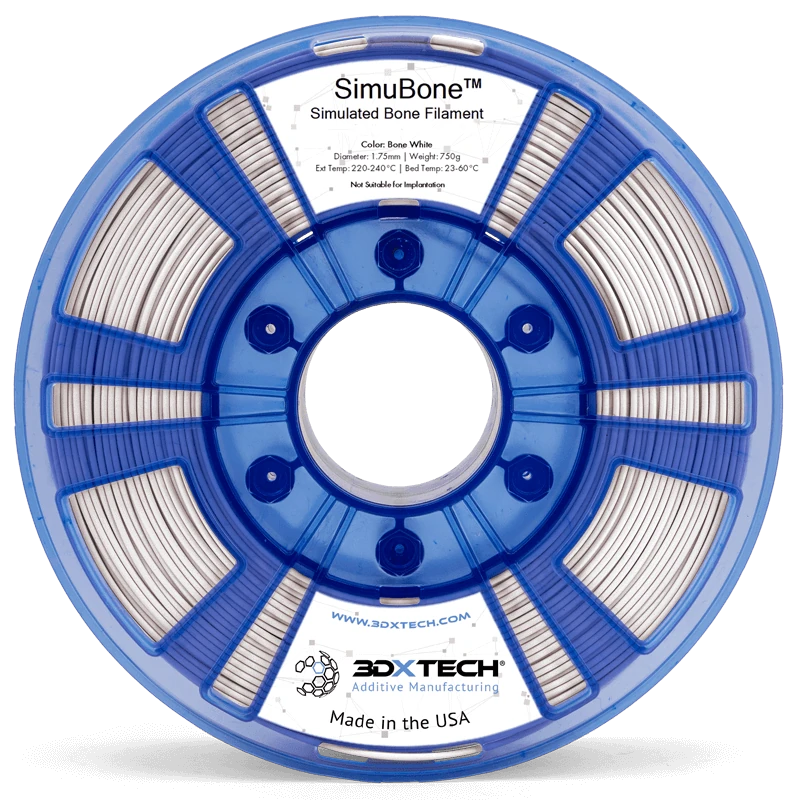
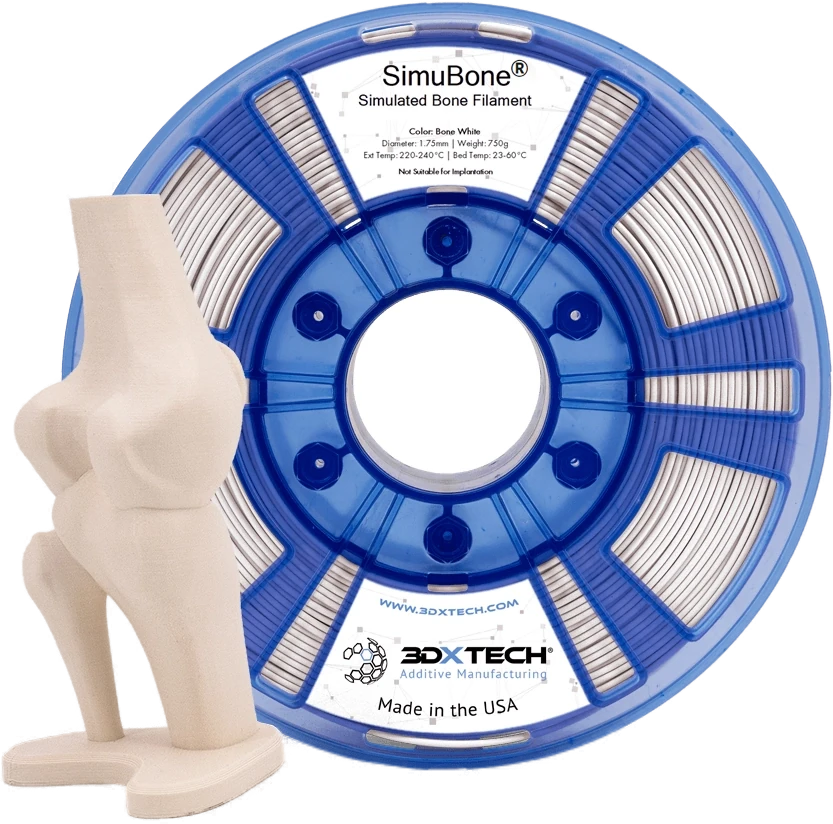
3DXTech’s SimuBone™ is a PLA-based bone simulation compound engineered to replicate the mechanical behavior and appearance of cortical bone. Radio-opaque additive enables CT and X-ray visibility. ISO 22196:2011 certified antibacterial at 99.9% efficacy. Optimized for drilling, sawing, and screw retention analogous to cortical bone. Antique White color. Prints on any standard FFF printer. Made in Grand Rapids, Michigan.

Radio Opaque CT / X-Ray Visible
ISO 22196 Antibacterial Cert.
$98 750g Spool
220–240°C Extruder Range

Select Spool Size

750g in stock. Contact Rev1 to confirm availability.

3DXTech SimuBone bone simulation filament 1.75mm antique white 750g spool

WHY SimuBone™

Bone-True Mechanics. Radio-Opaque. Certified Antibacterial.

SimuBone™ is 3DXTech’s PLA-based bone simulation filament engineered to replicate cortical bone behavior in surgical training, orthopedic education, and medical device testing. Radio-opaque additive enables CT and X-ray imaging. ISO 22196:2011 certified 99.9% antibacterial. Optimized for drilling, sawing, and screw retention. Standard nozzle. Prints on any open FFF printer. Made in Grand Rapids, Michigan.

Radio-Opaque Additive

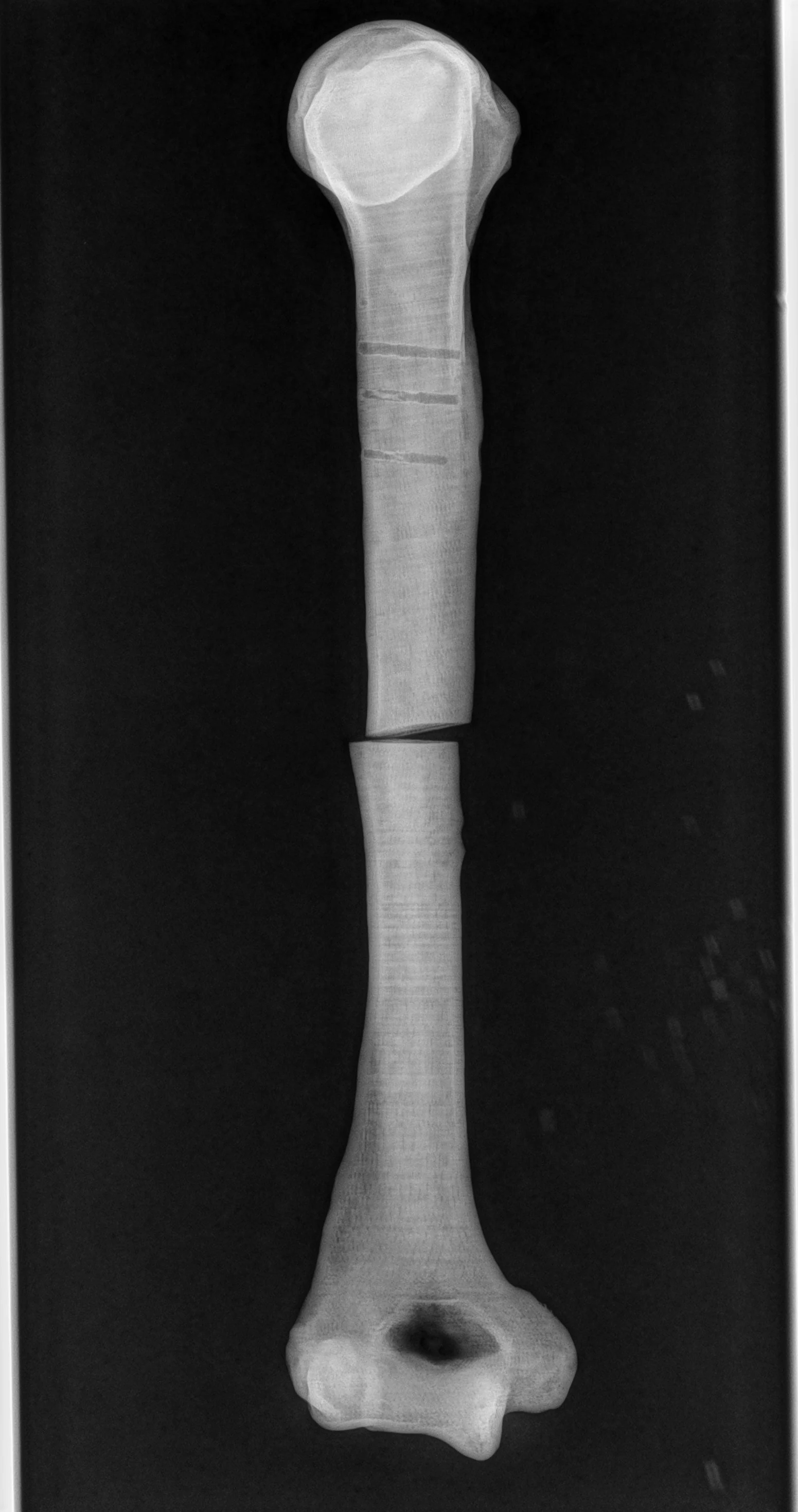
Radio-opaque filler provides enhanced visibility on X-ray and CT imaging — enabling printed bone models to serve as functional phantoms for imaging workflows, surgical planning, and radiographic training. Standard PLA is radiolucent; SimuBone is not.

🛡

ISO 22196 Antibacterial

Certified antibacterial per ISO 22196:2011 with 99.9% efficacy. Designed for medical simulation and surgical training environments where contamination control matters. Independent third-party certification — not a marketing claim.

🔨

Bone-Like Machinability

Formulated for drilling, sawing, and screw retention analogous to cortical bone. Enables realistic surgical technique practice: bone drill training, plating fixation exercises, and orthopedic screw insertion without cadaveric tissue.

🏭

Standard FFF Printer

PLA-based compound prints at 220–240°C on any open FFF platform. No hardened nozzle required. No heated chamber needed. Antique White color replicates natural osseous tissue appearance for visually accurate surgical training models.

MATERIAL SCIENCE

PLA-Based Bone Simulation Compound

SimuBone™ is engineered at the formulation level to reproduce the mechanical signature of cortical bone — stiffness, drill resistance, and screw retention — without the cost, biohazard handling, or supply limitations of cadaveric material.

What Makes SimuBone Different

SimuBone is not a standard PLA. The base resin is compounded with a radio-opaque additive and an ISO 22196-certified antibacterial agent, producing a material that behaves mechanically and radiographically like cortical bone. The Antique White color closely mimics natural osseous tissue for visually accurate models.

Tensile strength of 65 MPa and flexural strength of 122 MPa — verified per ISO 527 and ISO 178 — sit within the range of human cortical bone mechanical data published in the literature. Flexural modulus of 3,355 MPa and tensile modulus of 3,410 MPa reflect the stiffness signature of compact bone without metal-like hardness that defeats surgical drill training.

Minimal moisture sensitivity and no significant odor during printing make SimuBone practical for clinical simulation lab environments. No specialized ventilation beyond standard FFF printing is required.

3DXTech SimuBone printed humerus bone model showing bone-simulation fidelity for surgical training

PRINT PARAMETERS

Standard PLA-Class Processing — Any FFF Printer

SimuBone™ prints like standard PLA. No heated chamber, no all-metal hot end, no hardened nozzle required. Bed can be unheated (room temperature) or lightly heated to 60°C. 220–240°C extruder range is compatible with virtually every consumer and prosumer FFF platform.

220–240°C Extruder Range

Standard PLA-class hot end range. No all-metal hot end required. Compatible with Bambu, Prusa, Creality, and virtually any open FFF platform. Lower temperature than PETG or engineering-grade materials.

23–60°C Bed Temperature

Room temperature (unheated) to lightly heated bed. Standard PLA adhesion surfaces apply: PEI, glass, textured PEI. No enclosure required. Accessible on virtually any modern desktop FFF printer.

0.10mm+ Layer Height

Layer height of 0.10mm or higher. Finer layer heights (0.10–0.15mm) recommended for surgical training models requiring dimensional accuracy and smooth surface finish for realistic screw and drill interaction.

65°C / 4 hr Drying Protocol

Dry at 65°C for 4 hours before printing. SimuBone has minimal moisture absorption vs. nylon or PETG, but drying before a critical simulation print run ensures consistent surface quality and mechanical properties.

  • Extruder Temp 220–240°C — standard PLA hot end range; no all-metal hot end required
  • Bed Temp 23–60°C — unheated or lightly heated; PEI or glass build surface
  • Enclosure Not required — standard open FFF compatible; no chamber needed
  • Nozzle Standard nozzle acceptable — no hardened nozzle required; standard brass or steel nozzle works
  • Layer Height 0.10mm or higher — fine layers recommended for dimensional accuracy on surgical training models
  • Drying 65°C / 4 hours before printing — minimal moisture absorption; drying ensures optimal print quality

HARDWARE

Prints on Any Standard Open FFF Printer

SimuBone™ requires no special hardware. PLA-class processing temperature (220–240°C) and room-temperature bed make it compatible with every modern desktop and professional FFF platform. Standard nozzle. No chamber. Ideal for medical simulation labs using Bambu, Prusa, Creality, Ultimaker, or any comparable desktop platform.

🔧

Standard Nozzle

No hardened steel nozzle required. SimuBone contains no abrasive reinforcement fibers — standard brass or steel nozzles handle it without wear. No nozzle upgrade cost barrier for labs running PLA-class printers.

📄

No Enclosure Required

PLA-based formulation does not require a heated enclosure. Standard open FFF platforms — Bambu Lab X1, Prusa MK4, Creality K-series — are fully compatible. Lower processing complexity than PETG+CF or any engineering-grade filament.

🏢

Medical Simulation Lab Ready

Minimal odor and no hazardous fume profile beyond standard PLA. Suitable for printing in clinical simulation laboratory environments. Standard FFF ventilation applies. No special facility requirements for SimuBone printing.

SimuBone™ is a simulation material for training, research, and device development. It is not an implantable medical device and is not intended for human or animal surgical implantation. Consult institutional guidelines for simulation material use in clinical education settings.

SPECIFICATIONS

SimuBone™ — Full Technical Data

Source: 3DXTech SimuBone TDS Rev 1.0. ISO-standard test specimens. 1.75mm Antique White filament.

Material Properties

Polymer BasePLA-based bone simulation compound
Diameter1.75mm / 2.85mm
ColorAntique White (bone-colored)
Density1.34 g/cc (ISO 1183)
Glass Transition (Tg)55°C (DSC)
HDT (0.45 MPa, ISO 75)89°C
Tensile Strength65 MPa (ISO 527)
Tensile Modulus3,410 MPa (ISO 527)
Tensile Elongation4% (ISO 527)
Flexural Strength122 MPa (ISO 178)
Flexural Modulus3,355 MPa (ISO 178)

Print Parameters

Extruder Temp220–240°C
Bed Temp23–60°C (room temp or lightly heated)
EnclosureNot required (standard PLA-class printer)
Drying Protocol65°C / 4 hours
NozzleStandard nozzle (no hardened nozzle required)
Layer Height0.10mm or higher

Certifications & Availability

Antibacterial Cert.ISO 22196:2011 (99.9% efficacy)
Quality ManagementISO 9001:2015 certified
Radio OpacityRadio-opaque additive (CT/X-ray visible)
750g / 1.75mm$98 (in stock)
2.85mmAvailable — contact for pricing
2kgContact (special order)
OriginGrand Rapids, MI, USA

SPOOL SELECTION

750g In Stock. Antique White. 1.75mm & 2.85mm.

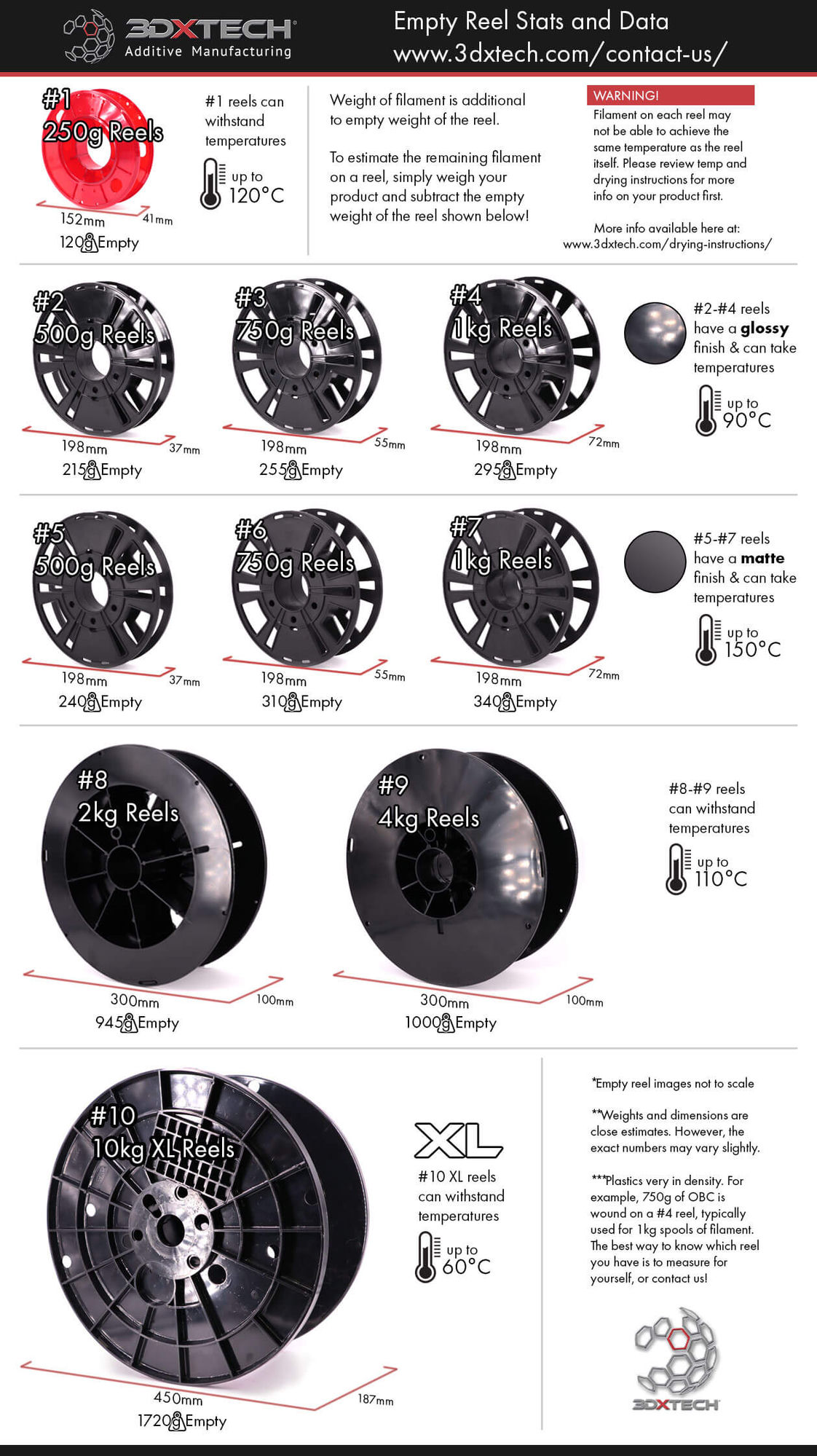
SimuBone™ is available in 750g Antique White (1.75mm) at $98 from stock. 2.85mm diameter available — contact for pricing. 2kg spools available by special order. Reel specifications and dimensions available below.

Contact
2.85mm
Contact for Pricing
  • Antique White
  • Same material formulation
  • Contact Rev1 for lead time
Special Order
2kg
Contact for Pricing
  • 1.75mm diameter
  • Special order — contact Rev1
  • Suitable for high-volume simulation labs

Need exact reel dimensions for your material management system?

CERTIFICATIONS & PRODUCT IMAGES

ISO 22196 Antibacterial — 99.9% Efficacy Certified

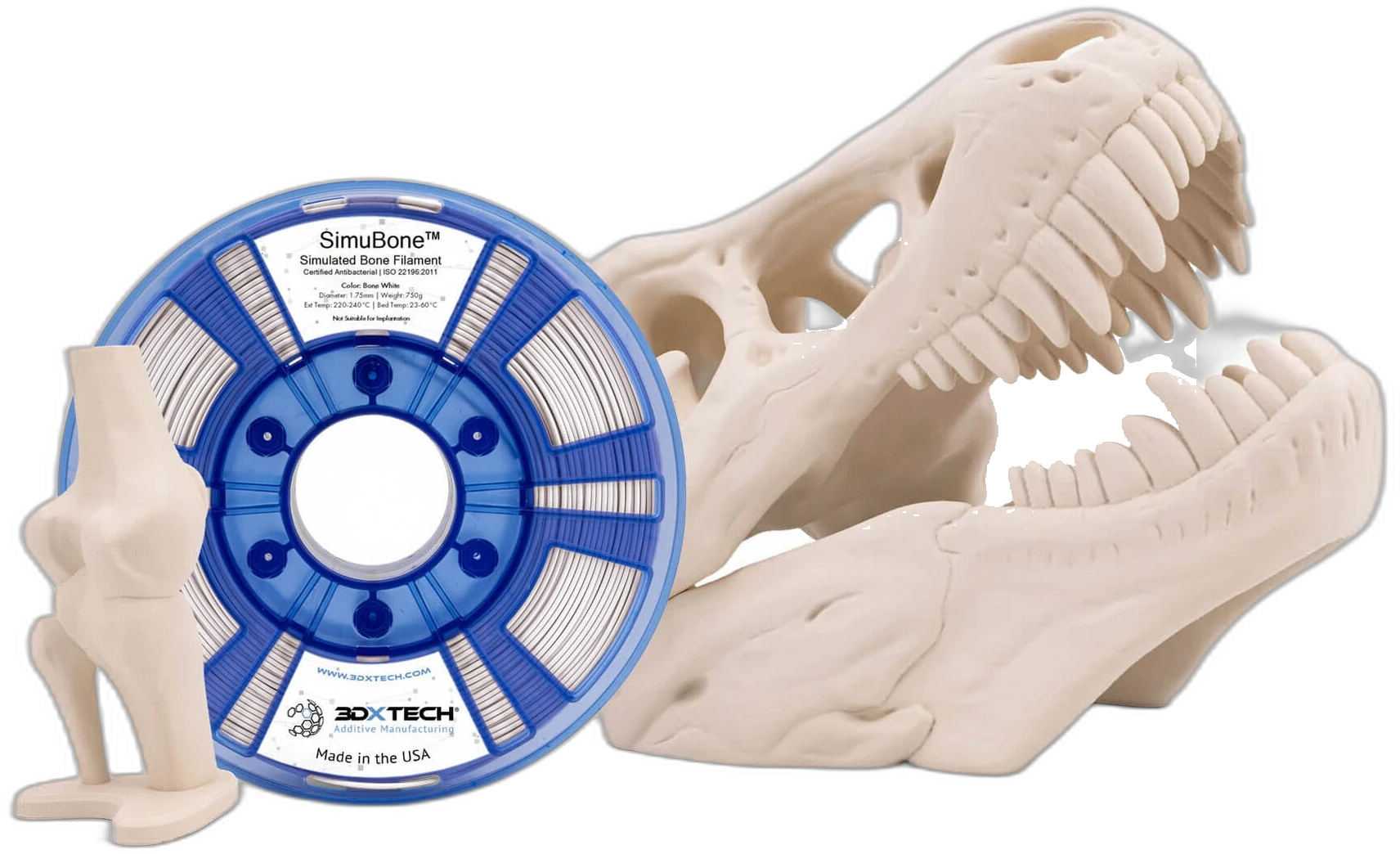
SimuBone™ carries ISO 22196:2011 antibacterial certification at 99.9% kill rate — independent third-party testing. ISO 9001:2015 manufacturing quality certification. Antique White bone-simulation color throughout. Shown below: spool and printed bone model application views.

APPLICATIONS

Surgical Training. Orthopedic Education. Imaging Phantoms.

SimuBone™ targets medical simulation, surgical education, orthopedic device development, and imaging phantom fabrication. Radio-opaque additive and bone-like machinability open applications unavailable to standard PLA or generic bone-white filaments.

01

Pre-Operative Surgical Planning Models

Patient-specific anatomical models for pre-operative review and surgical rehearsal. Antique White color and bone-like stiffness enable realistic spatial planning. Radio-opaque formulation allows models to be verified against CT/X-ray data from the actual patient case.

02

Orthopedic Training & Education

Reproducible bone models for resident and fellow training in orthopedic drilling, sawing, and fixation. Consistent material properties across print runs enable standardized skill assessment. No biohazard handling, unlimited supply, and known mechanical properties vs. cadaveric bone.

03

Bone Tissue Phantom Models

Imaging phantoms for CT and X-ray calibration, quality assurance, and protocol development. Radio-opaque additive provides Hounsfield unit response that standard PLA cannot achieve. Consistent geometry and density from print-to-print for reproducible phantom studies.

04

Medical Device Development & Testing

Surrogate bone models for orthopedic implant and instrument development. Screw pull-out, drill bit evaluation, plate fixation testing — all without cadaveric sourcing delays or regulatory compliance overhead for tissue use. Reproducible and cost-effective at $98/750g.

05

Patient-Specific Bone Replicas

Print from patient CT or MRI DICOM data to produce custom anatomical replicas for individual case planning, patient communication, or medical education. Bone-white appearance and accurate geometry enable realistic surgical simulation specific to the patient case.

06

Drill & Screw Retention Training

Drilling resistance and screw retention properties analogous to cortical bone make SimuBone ideal for practical surgical technique training. Residents practice cortical drill technique, depth gauging, and screw insertion on printed bone models before first clinical cases.

MATERIAL CARE

Dry Before Printing. Store Sealed. Minimal Moisture Sensitivity.

SimuBone™ has low moisture sensitivity compared to nylon or PETG. Drying at 65°C for 4 hours before a critical simulation print run ensures consistent surface quality and mechanical properties. Sealed storage with desiccant between print sessions is recommended.

01

Dry Before Critical Prints

65°C for 4 hours before printing high-fidelity surgical training models. SimuBone has minimal moisture absorption, but drying ensures optimal surface quality and consistent mechanical properties in the finished model.

02

Room Temperature Storage

Store in original sealed packaging or an airtight bag with desiccant at room temperature. No refrigeration required. SimuBone is not sensitive to UV degradation in normal indoor storage conditions.

03

Minimal Odor Profile

SimuBone produces minimal odor during printing — consistent with standard PLA-class materials. Suitable for medical simulation labs with standard ventilation. No special fume extraction equipment required beyond normal lab practice.

04

Handle Like Standard PLA

No special personal protective equipment required beyond standard FFF printing precautions. The antibacterial additive is incorporated into the filament matrix and does not require special handling. SimuBone is not an implant material.

HOW IT COMPARES

SimuBone™ vs. Standard PLA vs. Cadaver Bone

Buyers evaluating SimuBone typically compare against standard PLA (for a cost baseline) and cadaveric tissue (for fidelity). SimuBone uniquely combines radio-opacity, antibacterial certification, bone-like machinability, consistent properties, and no biohazard handling requirements.

Feature
SimuBone™
3DXTech / Rev1 Tech
Standard PLA
Generic / Various
Cadaver Bone
Anatomical Supply
Radio Opacity (CT/X-Ray)
Yes -- radio-opaque additive ★
No -- radiolucent
Yes (natural)
Antibacterial Certification
ISO 22196:2011 -- 99.9% ★
None
Biohazard -- requires protocols
Bone-Like Machinability
Optimized for drill/saw/screw ★
Generic -- no bone-analog formulation
Yes (variable by donor)
Consistent Properties
ISO-tested, lot-controlled ★
Variable by brand
Variable by donor, age, preservation
Supply & Availability
Unlimited from stock ★
Unlimited
Limited -- procurement lead time
Biohazard Handling Required
No ★
No
Yes -- regulated tissue handling
Cost Per Training Model
Dramatically lower ★
Low (no bone-analog value)
High -- procurement + disposal
Starting Price
$98 / 750g
~$20–40 / 750g
Institutional procurement

MATERIAL PERFORMANCE PROFILE

SimuBone™ — Relative Property Scale

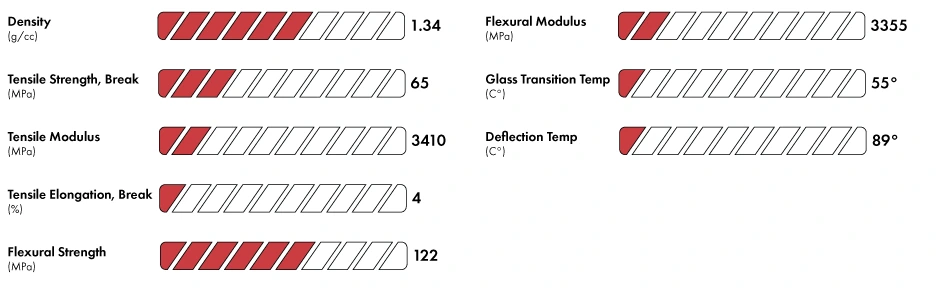
Nine-bar relative scale. Reference maximum: ThermaX PEEK at ~11,000 MPa tensile modulus = 9 bars. Values per ISO 527 / ISO 178 / ISO 75 / ISO 1183 on 3DXTech SimuBone TDS Rev 1.0. Note: Tg of 55°C reflects PLA-based formulation -- SimuBone models are not rated for elevated-temperature environments. Keep finished models at or below room temperature for dimensional stability.

Tensile Modulus 3,410 MPa
Tensile Strength 65 MPa
Flexural Modulus 3,355 MPa
Flexural Strength 122 MPa
Tensile Elongation 4%
Glass Transition (Tg) 55°C
Heat Deflection (HDT) 89°C
Density 1.34 g/cc
Print Temp (Extruder) ✓  220–240°C extruder -- standard PLA-class printer; no all-metal hot end required; prints on virtually any open FFF machine

Mechanical values per ISO 527 / ISO 178. Thermal values per DSC / ISO 75. Density per ISO 1183. Source: 3DXTech SimuBone TDS Rev 1.0, 1.75mm Antique White filament. Note: Tg 55°C is PLA-based -- not for elevated-temperature use; keep simulation models at room temperature for dimensional stability.

🏭

ISO 9001:2015 Certified

Production under a certified quality management system at 3DXTech’s Grand Rapids facility. Lot traceability and process controls throughout filament fabrication for consistent batch-to-batch mechanical properties.

🛡

ISO 22196:2011 Antibacterial

Independent third-party certification at 99.9% antibacterial efficacy per ISO 22196:2011. Designed for medical simulation environments where contamination control is a facility requirement. Not a marketing claim — independently verified.

📍

Made in Grand Rapids, MI

Filament compounded, extruded, and wound in-house at 3DXTech’s Michigan facility. Direct factory quality control — not overseas commodity production. Full traceability for institutional procurement requirements.

RESOURCES

Downloads & Technical Support

Everything you need to qualify and print SimuBone™ for your simulation lab or research application. Processing parameters, reel dimensions, and technical support from Rev1.

📄
SimuBone™ Product Page & TDS 3DXTech official product page — TDS Rev 1.0 download available
Filament Drying Instructions 3DXTech drying guide — all materials
💬
Rev1 Technical Support Printer qualification, material selection, simulation application support

WHY REV1 TECH

Authorized 3DXTech Reseller. Medical AM Specialists.

Rev1 Technologies is an authorized 3DXTech reseller headquartered in Auburn Hills, MI, with direct technical expertise in specialty FFF materials and the medical simulation, research, and device development applications that demand them. SimuBone prints at 220–240°C on any standard open FFF platform — our team can help qualify your printer and workflow before you order.

Authorized 3DXTech Reseller

Every spool ships through the authorized channel. MAP pricing guaranteed. Full traceability from 3DXTech’s Grand Rapids facility to your institution. Suitable for institutional purchase orders and procurement compliance requirements.

Platform Expertise

SimuBone prints like PLA — compatible with virtually every modern FFF platform. Our team has qualified specialty materials across Bambu, Prusa, Creality, Ultimaker, and professional desktop platforms. We can advise on print profile settings for surgical-grade model quality.

Pre-Sales Technical Support

Questions about qualifying SimuBone for your simulation lab, imaging phantom protocol, or device testing program? Contact Rev1 before you order — that conversation is free and can save significant qualification time.

FREQUENTLY ASKED

SimuBone™ — Buyer & Researcher Questions Answered

What is SimuBone™?

SimuBone™ is 3DXTech’s PLA-based bone simulation filament. Available in Antique White (1.75mm, 750g at $98), it is formulated to replicate the mechanical behavior and appearance of cortical bone. Key features: radio-opaque additive for CT/X-ray visibility, ISO 22196:2011 antibacterial certification at 99.9% efficacy, and machinability optimized for drilling, sawing, and screw retention analogous to cortical bone. Prints on any standard FFF printer at 220–240°C. Made in Grand Rapids, Michigan.

Is SimuBone radio-opaque? Can it be seen on CT or X-ray?

Yes. SimuBone contains a radio-opaque additive that provides enhanced visibility on X-ray and CT imaging. Standard PLA is radiolucent — it is essentially invisible on CT and X-ray. SimuBone’s radio-opaque formulation enables printed bone models to be used as imaging phantoms for CT/X-ray calibration, quality assurance, and protocol development, as well as for surgical planning workflows where the model must correlate with imaging data from the patient case.

What is the ISO 22196 antibacterial certification?

ISO 22196:2011 is an internationally recognized standard for measuring antibacterial activity on plastics and other non-porous surfaces. SimuBone carries third-party certification at 99.9% efficacy under this standard. This is an independently tested and certified property — not a marketing additive claim. The certification supports use in medical simulation environments where contamination control is a facility or accreditation requirement for simulation materials.

Can SimuBone be used for surgical training and resident education?

Yes — this is a primary design intent of SimuBone. The material is formulated to replicate drilling resistance, sawing behavior, and screw retention analogous to cortical bone, enabling realistic surgical technique practice without cadaveric tissue. Printed bone models support resident and fellow training in orthopedic drilling, plating, and fixation techniques. Consistent, reproducible material properties enable standardized assessment across training sessions and learner cohorts.

How does SimuBone perform for drilling and screw retention?

SimuBone is specifically formulated for drilling, sawing, and screw retention analogous to cortical bone — this is a core differentiator from standard PLA, which has different drill feel and significantly lower screw retention. The 65 MPa tensile strength, 3,410 MPa tensile modulus, and 122 MPa flexural strength position SimuBone within the cortical bone mechanical range described in the orthopedic biomechanics literature. Consult the SimuBone TDS Rev 1.0 for complete mechanical data.

How does SimuBone compare to cadaver bone for simulation?

SimuBone offers several practical advantages over cadaveric bone for simulation: dramatically lower cost per training model, unlimited and immediate availability from stock, consistent and documented mechanical properties (vs. variability across donors, age, and preservation method), no biohazard handling or regulated tissue disposal requirements, and no procurement lead time. Trade-off: cadaveric bone provides exact anatomical geometry and native tissue heterogeneity. SimuBone is best for standardized training, high-volume practice, and imaging phantoms where consistency matters more than anatomical variability.

How does SimuBone compare to standard PLA?

Standard PLA lacks the key properties that define SimuBone as a bone simulation material: PLA is radiolucent (invisible on CT/X-ray), has no antibacterial certification, is not formulated for bone-analog drilling or screw retention, and is typically available only in non-bone colors. SimuBone adds the radio-opaque additive, ISO 22196 antibacterial certification, bone-analog machinability, and Antique White bone-like color at $98/750g vs. ~$20–40 for commodity PLA. If you need CT/X-ray visibility or bone-realistic drill feel, standard PLA cannot substitute.

How difficult is SimuBone to print?

SimuBone is one of the most accessible specialty materials 3DXTech makes. PLA-based formulation prints at 220–240°C on any open FFF platform. No heated chamber, no all-metal hot end, no hardened nozzle required. Bed can be unheated (room temperature) or lightly heated to 60°C. Layer height 0.10mm or higher. Dry at 65°C for 4 hours before printing. If you can print standard PLA, you can print SimuBone — the material handling difficulty is essentially identical.

Auburn Hills, Michigan's premier source for industrial 3D printers, 3D scanners, materials, and software. Serving engineers and manufacturers across North America.

Products
Company
Contact
Payment methods
AMEXApple PayGoogle PayPayPalShop PayUnionPayVISA
Pay over time

© 2026 Rev1 Technologies. All rights reserved.