3DXTech FibreX PEEK+GF20 20% Glass-Fiber Reinforced PEEK
Ultra-high-temperature PEEK, stiffened and stabilized with 20% glass fiber.
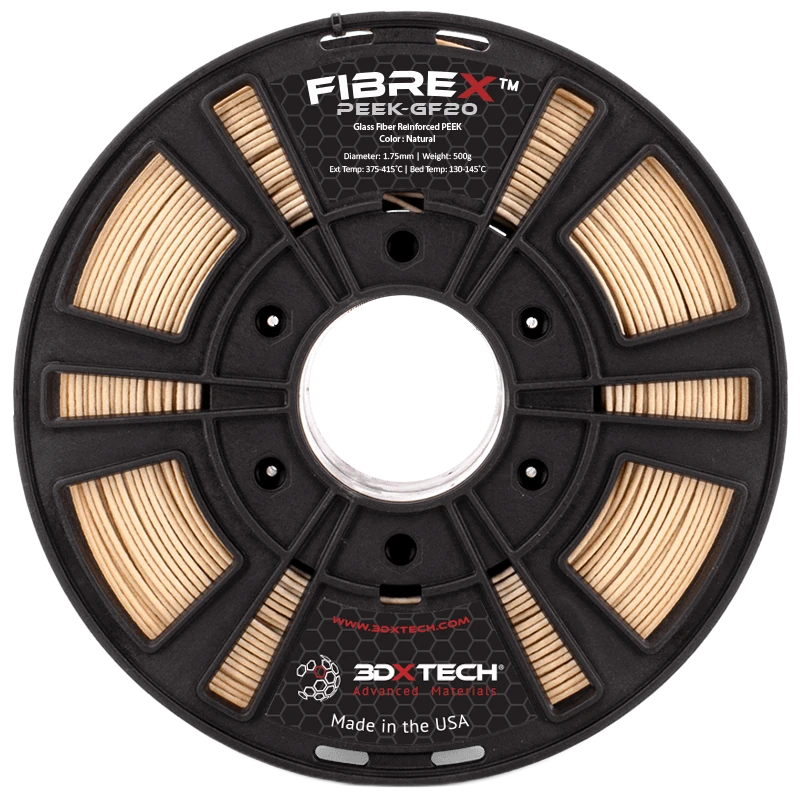
3DXTech FibreX™ PEEK+GF20 takes one of the highest-performance polymers on earth — PEEK — and reinforces it with 20% glass fiber for higher stiffness, lower warp, and improved dimensional stability. A ~300°C heat-deflection temperature, broad chemical resistance, and inherent flame retardance make it a true metal-replacement filament for the most demanding parts. USA-made and compounded. Full specifications →
Made in the USA — ships from Rev1. Need a high-temp print profile, a larger reel, or help qualifying glass-filled PEEK for your application? Call (248) 707-2950.
USA-made glass-filled PEEK, with a real datasheet behind it.
3DXTech compounds FibreX PEEK+GF20 in the USA with published mechanical, thermal, and chemical data — no mystery PEEK. Rev1 Technologies is your authorized 3DXTech reseller and US support partner, Auburn Hills, Michigan.

PEEK, reinforced with glass fiber for stiffness and stability.
PEEK (PolyEtherEtherKetone) already sits at the top of the engineering-polymer pyramid: exceptional strength, an extremely high service temperature, and broad chemical and hydrolysis resistance. FibreX PEEK+GF20 adds 20% glass-fiber reinforcement, which raises stiffness and flexural modulus, lowers warp, and improves dimensional stability — so large, load-bearing parts hold their shape through the print and in service. 3DXTech compounds it in the USA to consistent, printable 1.75 mm filament, letting you produce real glass-filled PEEK parts — brackets, manifolds, seals, and end-use components — on a high-temperature 3D printer instead of machining them from billet.
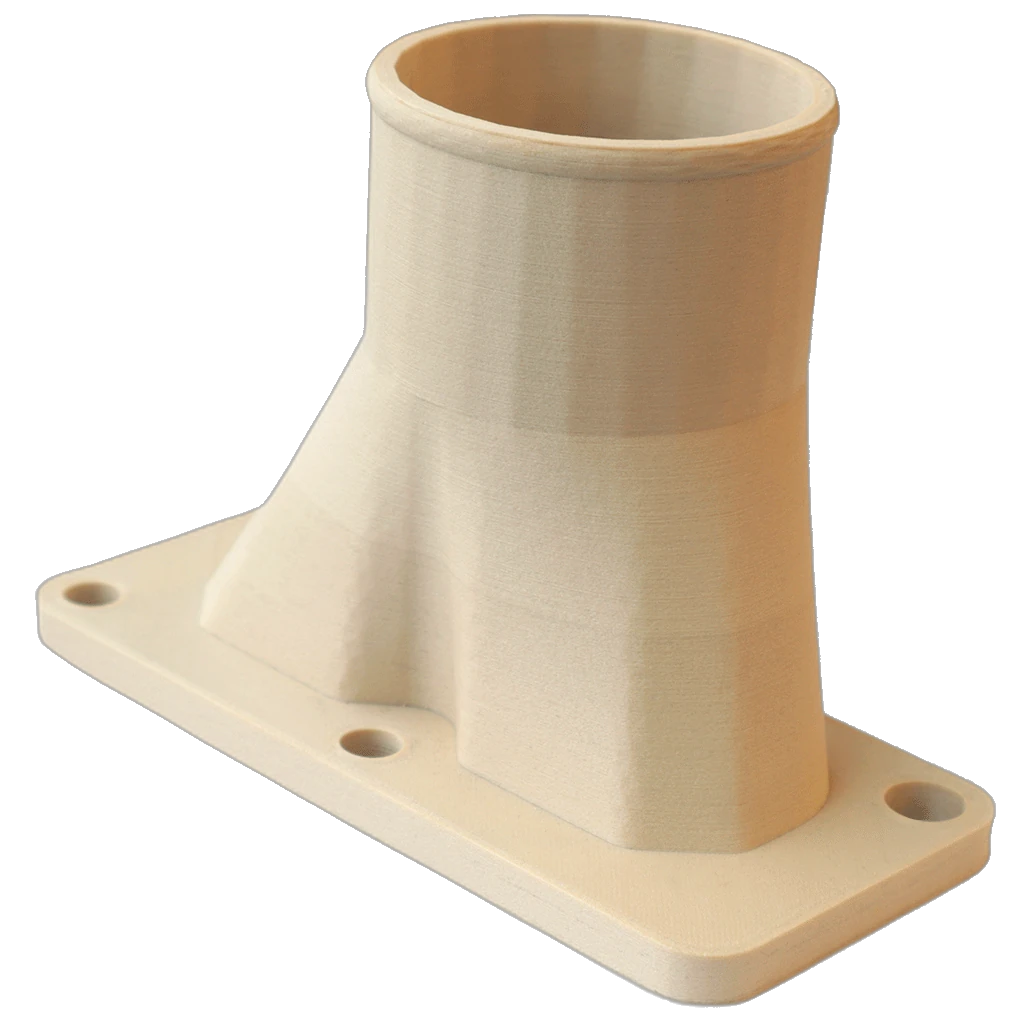
Print end-use parts that survive heat, chemicals, and load.
The same polymer family used in aerospace, medical, and oil-and-gas hardware — stiffened with glass fiber, now from a spool.
PEEK holds its strength and stiffness at temperatures where most thermoplastics have long since softened, resists a wide range of solvents and fuels, and is inherently flame retardant with low smoke. The 20% glass-fiber loading adds rigidity and dimensional control, making PEEK+GF20 a go-to for structural brackets, downhole tools, sterilizable fixtures, and semiconductor handling where contamination and outgassing matter.
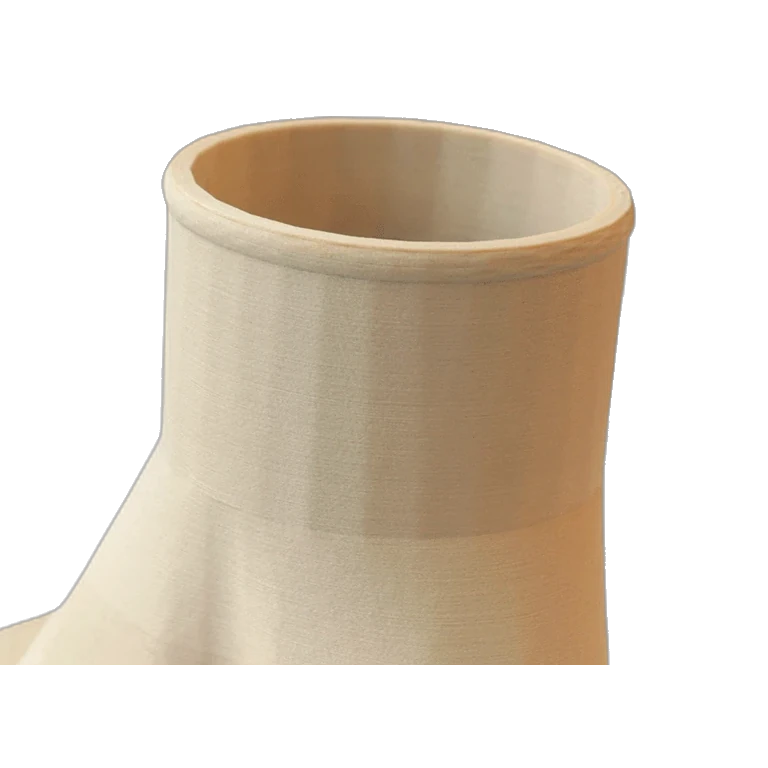
Stiff and dimensionally stable, print after print.
The 20% glass loading is what turns PEEK into a metal-replacement filament for structural parts.
Unfilled PEEK is strong but can warp and creep on large parts. Adding 20% short glass fiber raises the flexural modulus to about 7625 MPa, cuts warp, and stabilizes dimensions across the print bed — so flanges stay flat, bores stay round, and tolerances hold. The trade is a small drop in elongation (about 2.5%) in exchange for rigidity and heat stability, which is exactly what load-bearing brackets and fixtures need.
Numbers that put it above ABS, PC, and unfilled nylon.
All figures from the 3DXTech FibreX PEEK+GF20 technical data sheet (ISO test methods) — see the full TDS for methods and the complete property table.
Retains form under load at temperatures far beyond engineering plastics like PC or nylon; glass transition near 143°C.
High strength that holds up under sustained mechanical load and repeated cycling.
The 20% glass fiber delivers high rigidity — stiff, dimensionally stable parts with low warp.
Resists most solvents, fuels, and hydrolysis — survives autoclave and aggressive cleaning, inherently flame retardant.
Strong in bending as well as tension — the glass fiber carries load without cracking under flex.
Lightweight for its strength, delivering a high strength-to-weight ratio versus the metals it replaces.
It needs a real high-temp printer — and a hardened nozzle.
Glass-filled PEEK is demanding: it prints hot, needs an actively heated chamber to crystallize and avoid warping, must be dried before use, and the glass fiber is abrasive — a hardened-steel nozzle is required. Match these and results are repeatable.
An all-metal 410°C+ hotend with a hardened-steel nozzle (0.4 mm min) — the glass fiber wears brass quickly.
High bed temperature plus a suitable adhesive for first-layer grip on a large, hot part.
An actively heated chamber is essential for crystallization, layer bonding, and dimensional stability.
Dry the filament at 130°C for 4 hours before printing and keep it dry — PEEK picks up moisture that ruins surface quality.
Print at 0.25 mm layers or higher for reliable flow and strong bonding with the glass-filled melt.
A sealed, draft-free enclosure holds chamber heat steady so large PEEK parts crystallize and bond evenly.
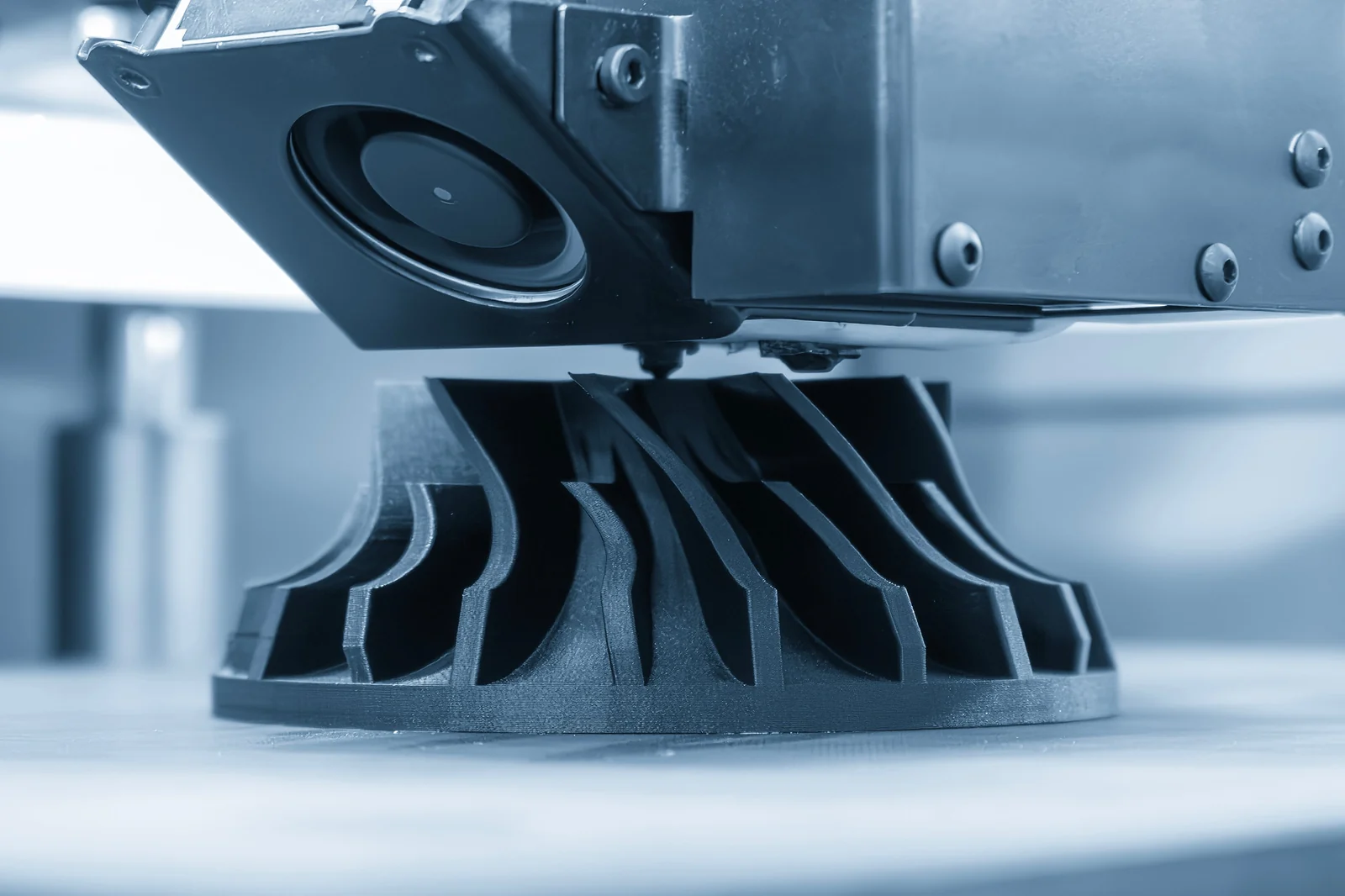
Built for industrial high-temperature printers.
Complex, load-bearing geometry printed in-chamber at 400°C-class temperatures.
FibreX PEEK+GF20 is made for the machines that can reach it — the CreatBot PEEK-series and other 410°C+ hotend printers with actively heated chambers. In a stable, enclosed environment the glass-filled melt lays down cleanly on demanding geometry like impellers and manifolds, crystallizes as it cools, and produces dense, dimensionally accurate parts. Rev1 supplies both the material and the printers, and can hand you a validated profile so your first spool prints right.
The industries that print glass-filled PEEK.
3DXTech's published property chart.
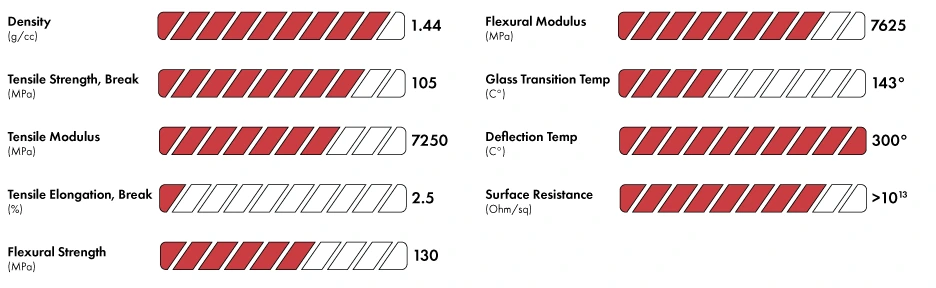
The quick-reference numbers, straight from 3DXTech.
Click the chart to enlarge it — the same figures are in the full specifications table below.
3DXTech publishes a property chart for FibreX PEEK+GF20 so you can size it up fast: density 1.44 g/cc, tensile strength 105 MPa, tensile modulus 7250 MPa, flexural strength 130 MPa, flexural modulus 7625 MPa, glass transition 143°C, and a 300°C deflection temperature. Click it to read the full-size version, and see the complete mechanical, thermal, and print data in the specifications section.
Check the reel fits your printer.
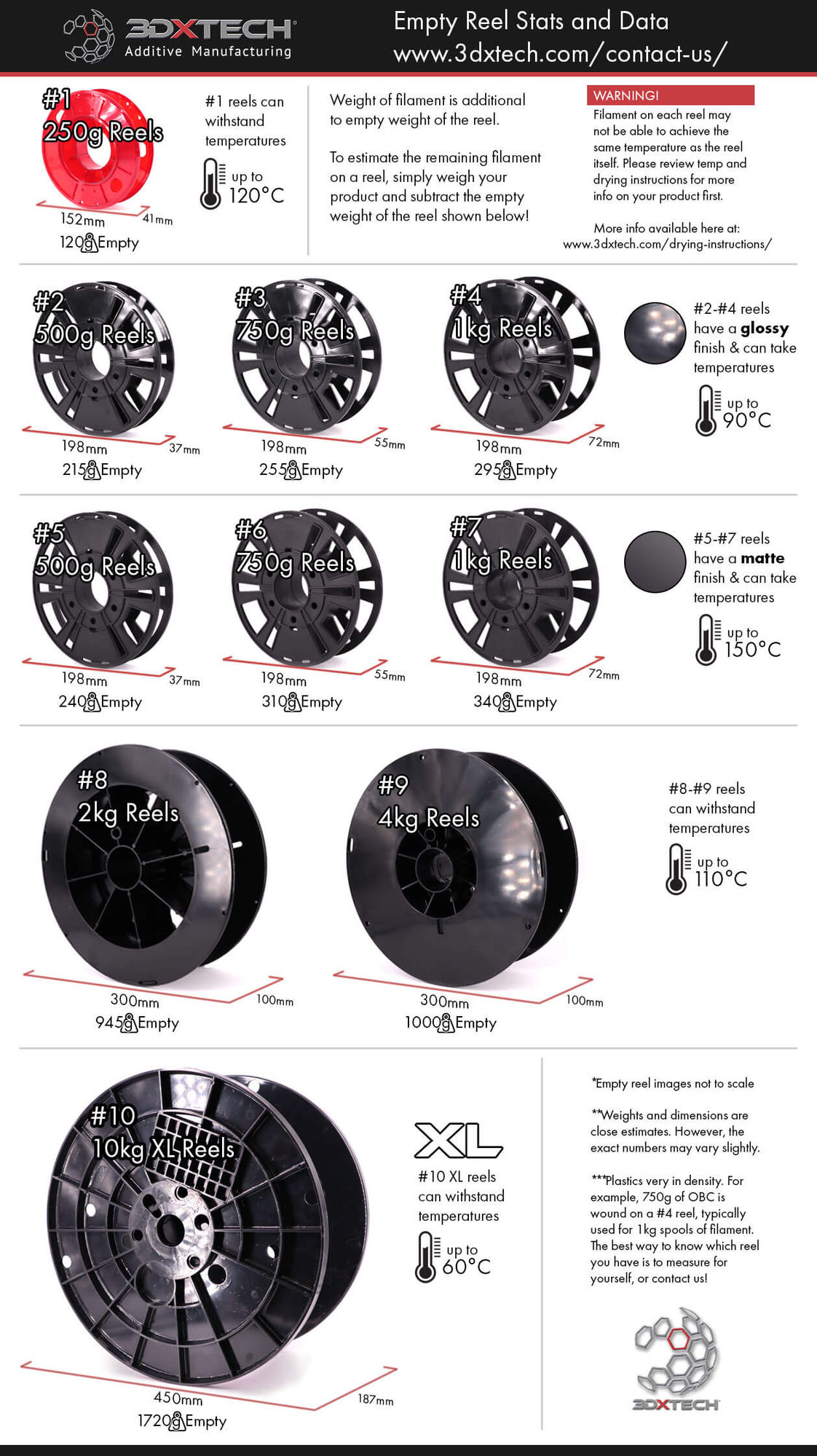
Standard spool dimensions — confirm it fits your AMS or dry box.
FibreX PEEK+GF20 ships on consistent, standard 3DXTech reels.
Before you buy, check the outer diameter, width, and center bore against your printer's spool holder, automated material system, or drybox. The reel diagram shows the standard 3DXTech spool dimensions for the 250 g, 500 g, and 1 kg sizes — all 1.75 mm, natural. Start with a small spool to qualify your high-temp profile, then scale up to a 1 kg production reel.
View reel dimensions →PEEK+GF20 vs. other high-performance polymers.
Approximate positioning among printable high-temp polymers; confirm exact figures against each TDS.
| FibreX PEEK+GF20 | CarbonX PEEK+CF10 | PEKK-A | |
|---|---|---|---|
| Reinforcement | 20% glass fiber | 10% carbon fiber | Unfilled |
| Heat deflection | ~300°C | ~300°C | ~250°C use |
| Flexural modulus | ~7625 MPa | higher (CF) | lower (unfilled) |
| Print difficulty | High (chamber + hardened nozzle) | High (chamber + hardened nozzle) | High (chamber) |
| Approx. price (500 g) | ~$395 | ~$400+ | similar or higher |
| Best for | Stiff, low-warp, dimensionally stable PEEK parts | Max stiffness / strength-to-weight | Tunable crystallinity |
Comparison among printable high-performance polymers; prices vary by reel size, retailer, and date.
3DXTech FibreX PEEK+GF20 Technical Data
RESOURCES
Datasheet & Print Support
Everything you need to qualify and print FibreX PEEK+GF20.
WHY REV1 TECH
Authorized 3DXTech Reseller. High-Performance Materials Specialists.
Rev1 Technologies is an authorized 3DXTech reseller in Auburn Hills, MI, supplying genuine USA-made engineering filament with real print support.
We help you pick the right high-performance polymer, dial in the high-temp profile, and keep production running.
FAQ
3DXTech FibreX PEEK+GF20 — Common Questions
What printer do I need for PEEK+GF20?
A true high-temperature printer: an all-metal 410°C+ hotend with a hardened-steel nozzle, a 130–145°C bed, and an actively heated chamber (70–140°C). The heated chamber is essential for crystallization and dimensional stability — PEEK will warp and delaminate without it.
Why does it need a hardened nozzle?
The 20% glass fiber is abrasive and chews through standard brass nozzles quickly. Use a hardened-steel or other abrasion-resistant nozzle, 0.4 mm minimum, to maintain dimensional accuracy over the life of the spool.
Do I have to dry it?
Yes. PEEK absorbs moisture that causes poor surface finish and weak layers. Dry the filament at 130°C for 4 hours before printing and keep it in a dry box during long prints.
What does the glass fiber add over unfilled PEEK?
The 20% glass-fiber reinforcement raises stiffness and flexural modulus (~7625 MPa), lowers warp, and improves dimensional stability, so large structural parts hold their shape. It trades a little of unfilled PEEK’s elongation for rigidity and heat stability.
Which reel size should I buy?
Start with a 250 g or 500 g spool to validate your profile and the part, then scale to 1 kg for production. Pick the reel size in the buy-box; price scales with the spool.
How does it compare to carbon-filled PEEK?
Glass fiber gives excellent stiffness and dimensional stability at a lower cost than carbon fiber, and is electrically insulating. Carbon-filled PEEK (e.g. CarbonX PEEK+CF10) is stiffer and stronger for its weight but more expensive. We’ll help you choose.
Is it made in the USA?
Yes — 3DXTech compounds FibreX PEEK+GF20 in the USA with a published technical data sheet and lot traceability.
Can Rev1 help qualify PEEK+GF20 for my application?
Yes. Tell us the temperature, chemistry, and loads and our materials team confirms fit, suggests print settings, and can quote case or standing-order pricing. Call (248) 707-2950.
Is the printed part electrically insulating?
Yes. Unlike carbon-filled grades, glass fiber is non-conductive, so FibreX PEEK+GF20 keeps PEEK’s high surface resistance (>10¹³ Ohm/sq) — a good fit for high-temperature electrical insulators, bobbins, and connector bodies.