3DXTech CarbonX™ PEKK-A+CF15 Aerospace-Grade Carbon-Fiber PEKK — Ultra-High-Temp, Ultra-Stiff
Aerospace-Grade Carbon-Fiber PEKK — Ultra-High-Temp, Ultra-Stiff
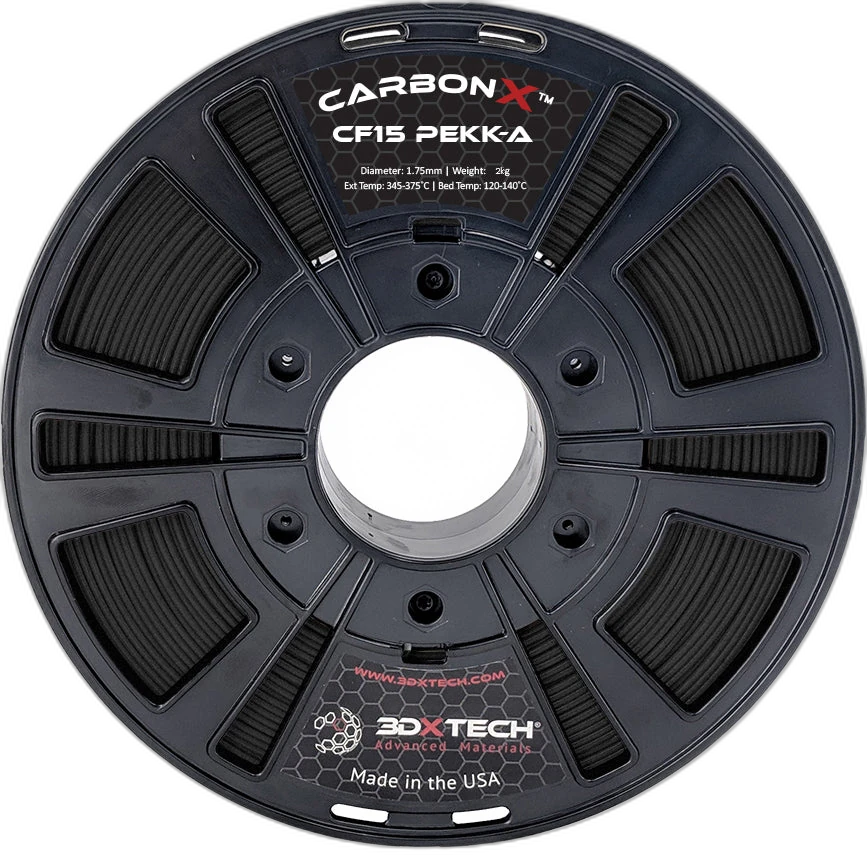
An aerospace-grade high-performance filament that reinforces 3DXTech's PEKK-A (60/40 copolymer) with 15% high-modulus chopped carbon fiber. It delivers exceptional stiffness, high-temperature performance, and chemical resistance — with an inherently flame-resistant UL94 V-0 base resin — while printing more easily than carbon-fiber PEEK. Built for aerospace, defense, and motorsport parts that must survive heat and load. Full specifications →
Made in the USA — ships from Rev1. Need the 2 kg reel (special order, MOQ 10) or bulk aerospace quantities? Call (248) 707-2950.
USA-made aerospace PEKK, with a real datasheet behind it.
3DXTech compounds CarbonX PEKK-A+CF15 in Grand Rapids, Michigan with published print and material data — no mystery filament. Rev1 Technologies is your authorized 3DXTech reseller and US support partner, Auburn Hills, Michigan.

The high-temp performance of PEKK — with the stiffness of carbon fiber.
PEKK sits in the elite PAEK family alongside PEEK — exceptional mechanical, thermal, and chemical resistance — but it is meaningfully easier to print. CarbonX PEKK-A+CF15 takes 3DXTech's PEKK-A (60/40 copolymer) base and reinforces it with 15% high-modulus chopped carbon fiber to deliver extreme stiffness, dimensional stability, and light weight versus metal. Its base resin is inherently flame resistant (UL94 V-0), and it withstands sustained heat that would soften engineering thermoplastics like nylon, PC, or ASA. It's the material aerospace, defense, and motorsport reach for when a part has to be light, rigid, and heat-proof.
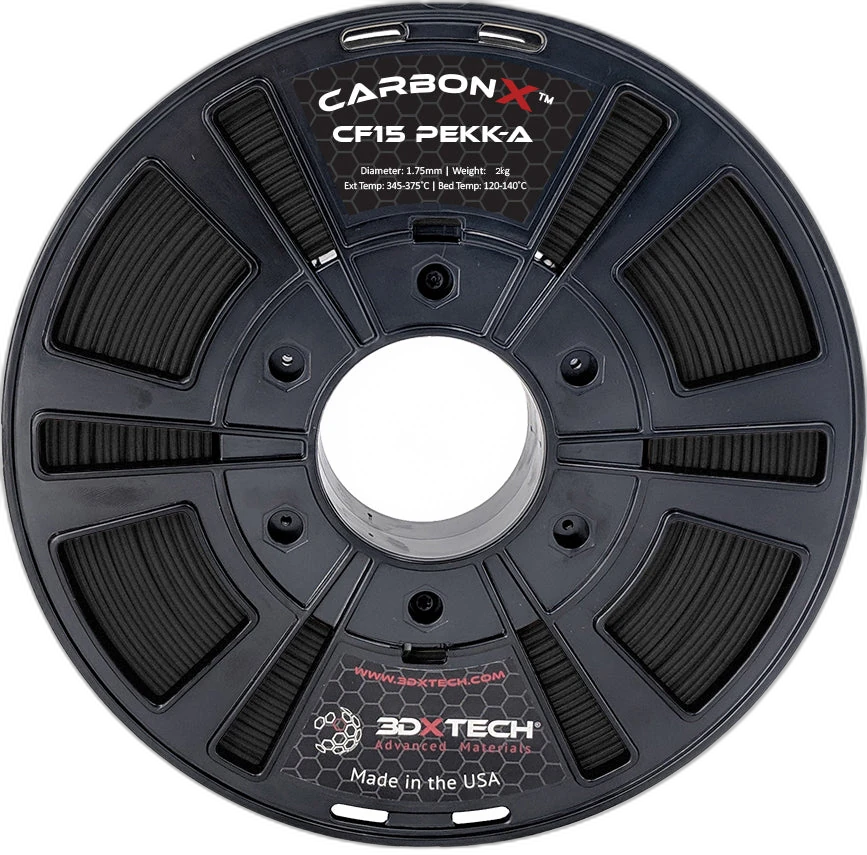
Extreme stiffness and heat resistance — and easier to print than CF PEEK.
Carbon fiber for rigidity; PEKK-A for high-temp and chemical performance.
The 15% carbon-fiber reinforcement pushes the tensile modulus to 9,125 MPa — roughly triple a carbon-fiber ASA and stiffer than most CF-nylons — while lowering the coefficient of thermal expansion so parts hold tolerance. Because the PEKK-A matrix has a 165°C glass transition and a 285°C heat-deflection temperature, printed parts stay rigid at temperatures that would deform ordinary filaments. And unlike CF PEEK, PEKK-A prints in a slightly lower, more forgiving window — a practical on-ramp to high-temp PAEK printing.
Metal-replacement stiffness, high-temp stable, chemically tough.
CarbonX PEKK-A+CF15 is built for the most demanding structural, high-temperature applications. All values from the 3DXTech TDS Rev 1.0 (ISO test methods). Click the property chart to read it full-size.
Extreme stiffness (ISO 527) from 15% carbon fiber — parts stay rigid under structural load.
Very rigid in bending (ISO 178) with 178 MPa flexural strength — a true engineering composite.
High break strength per ISO 527 at ~3.15% elongation — a stiff, high-strength filament.
ISO 75 heat-deflection temperature — parts hold shape far above PEI, nylon, and PC.
DSC glass-transition temperature; melt temperature 305°C — true PAEK-family thermal performance.
Inherently flame-resistant PEKK-A base resin with excellent chemical resistance — ideal for aerospace interiors.
A high-temp material — but the friendliest way into PAEK printing.
These are 3DXTech's recommended starting conditions. PEKK-A needs a high-temp hotend and a heated chamber, but it is more forgiving than carbon-fiber PEEK. Carbon fiber is abrasive, so a hardened nozzle is mandatory.
A high-temp all-metal hotend; up to 430°C available headroom. Lower and more forgiving than CF PEEK.
A high-temp heated bed with a PEKK-friendly adhesive gives reliable first-layer grip.
A heated chamber is recommended to manage crystallinity and keep large parts flat and strong.
Use a hardened-steel or ruby nozzle — carbon fiber wears brass fast. 0.6 mm+ preferred for CF flow.
Run 0.25 mm or thicker layers for the best strength and consistent flow with the filled filament.
Dry the filament at 120–140°C before printing — PAEK materials are sensitive to moisture.
Built for aerospace, defense, and high-temperature structural parts.
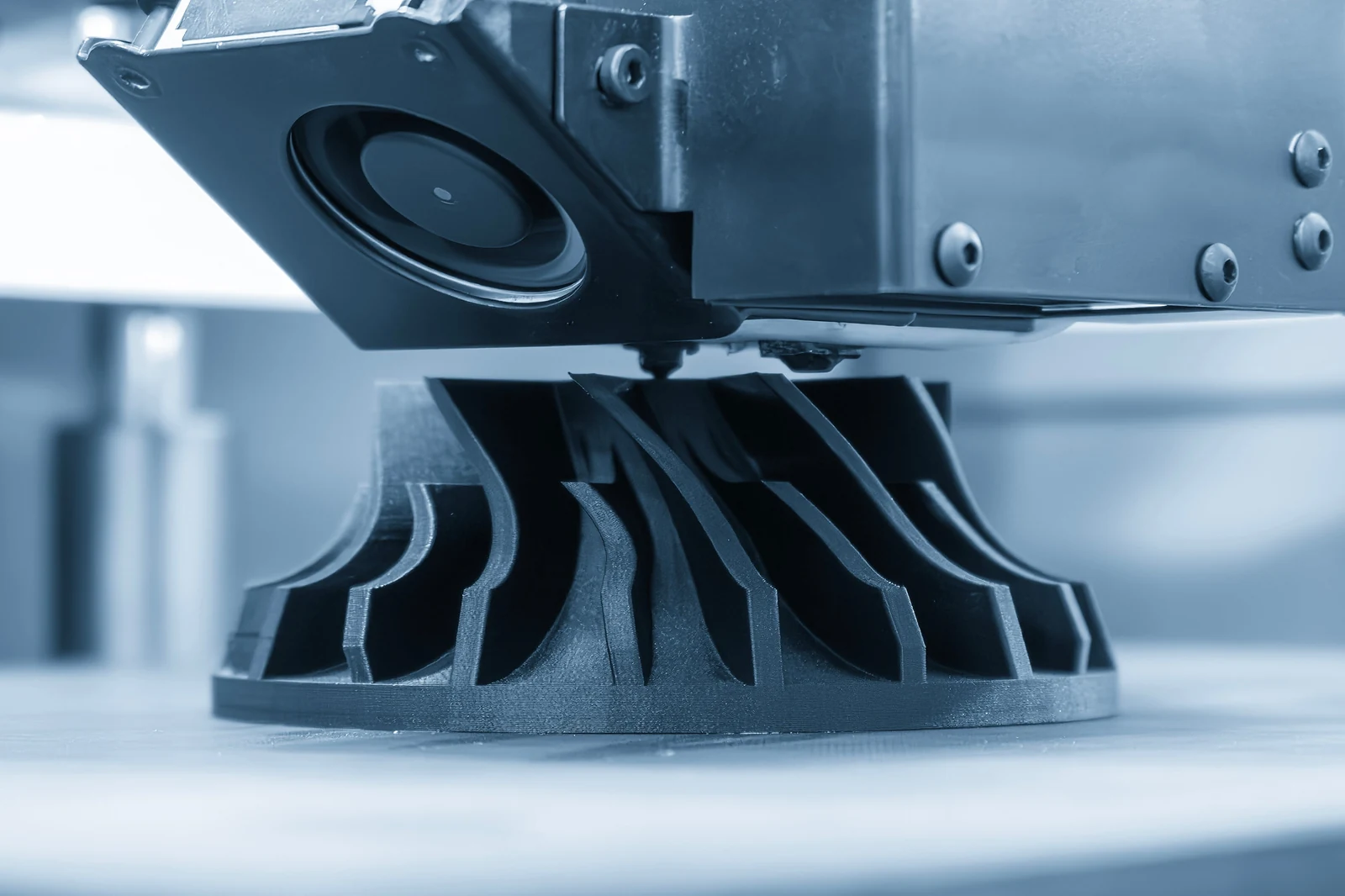
A printed part that stays rigid where metal or PEEK would be over-spec.
Light, stiff, heat-stable, and chemically resistant.
Carbon-fiber PEKK is a textbook metal-replacement material: the 15% fiber loading gives a printed part the stiffness-to-weight of a structural composite, the PEKK-A matrix holds tolerance and shape past 200°C, and the inherently flame-resistant, chemical-resistant chemistry suits aerospace interiors and under-hood hardware. The matte carbon-fiber surface needs no finishing.
Matte carbon-fiber black — one diameter, three reel sizes.
CarbonX PEKK-A+CF15 ships in a single, purpose-built color: a deep matte carbon-fiber black that shows off the fiber-loaded surface this aerospace grade is known for. Carbon fiber is inherently black — there are no other color options for this material. It's available in 1.75 mm on 250 g, 750 g, and 2 kg reels; start with a 250 g or 750 g spool to dial in your high-temp profile, then scale up. The 750 g reel fits the size envelope of popular automated material systems like the Bambu AMS, Creality CFS, and Anycubic ACE Pro — though a high-temp material like PEKK-A is best run from a heated dry box. The 2 kg reel is a special order with a 10-unit minimum — choose your reel in the buy-box, or ask us about aerospace bulk and standing-order pricing.
Check the reel fits your printer.
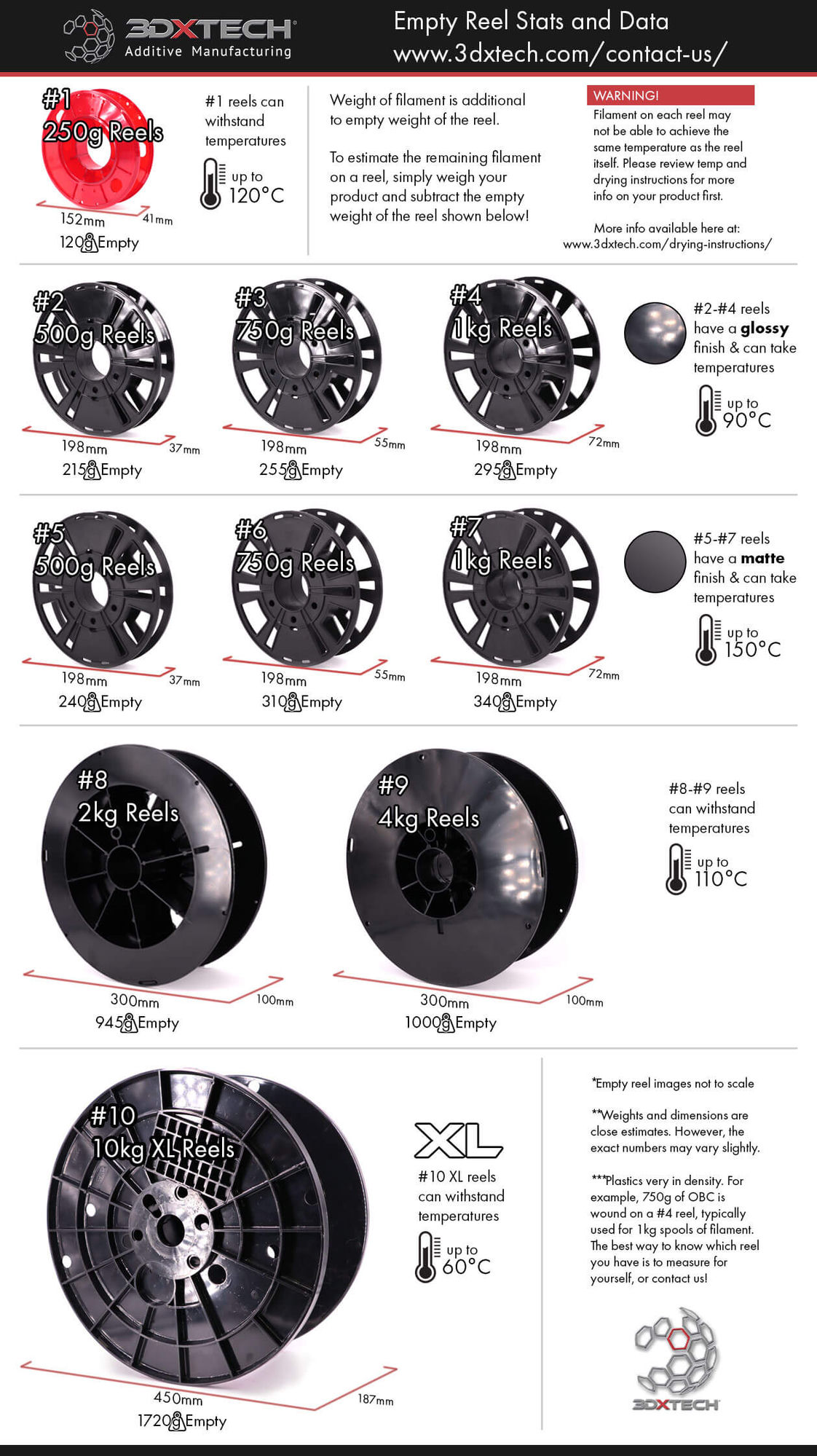
Standard spool dimensions — confirm it fits your AMS or dry box.
3DXTech ships CarbonX on consistent, standard reels.
The 750 g reel fits within the size requirements of popular automated material systems like the Bambu AMS, Creality CFS, and Anycubic ACE Pro — though a high-temp material like PEKK-A is best run from a heated dry box. Before you buy, check the outer diameter, width, and center bore against your printer's spool holder or drybox. Open the full 3DXTech reel infographic for exact 250 g, 750 g, and 2 kg spool dimensions.
View reel dimensions →Carbon-fiber PEKK-A vs. CF PEEK, CF PEI, and CF-nylon.
Approximate positioning against commonly evaluated high-performance alternatives — confirm exact figures against each technical data sheet.
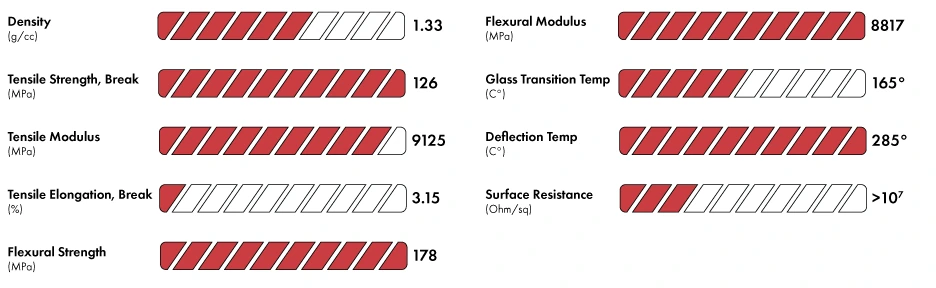
A 9,125 MPa tensile modulus — approaching a metal-replacement composite.
15% carbon fiber lifts PEKK-A into structural, load-bearing, high-temperature territory.
The carbon reinforcement does the structural work: a 9,125 MPa tensile modulus and 8,817 MPa flexural modulus keep printed parts extremely rigid under load, with 126 MPa tensile strength and 178 MPa flexural strength. A ~3.15% elongation is typical of a stiff, fiber-filled composite. The thermal envelope is the real story — a 165°C glass transition, a 305°C melting point, and a 285°C deflection temperature at 0.45 MPa — far above PEI, nylon, or PC.
| CarbonX PEKK-A+CF15 | CarbonX PEEK+CF10 (3DXTech) | CarbonX PEI+CF (3DXTech) | Ultrafuse PA6-CF (BASF) | |
|---|---|---|---|---|
| Base polymer | PEKK-A + 15% CF | PEEK + 10% CF | PEI (ULTEM) + CF | Nylon 6 + CF |
| Tensile modulus | 9,125 MPa | ~8,000 MPa | ~6,000 MPa | ~5,900 MPa |
| Deflection / service temp | Very high (285°C HDT) | Highest (PEEK) | Very high (PEI) | Moderate |
| Ease of printing | Easier than CF PEEK | Hardest — 400°C+ | Hard — high-temp | Harder — hygroscopic |
| Flame resistance | UL94 V-0 base | UL94 V-0 base | UL94 V-0 base | No |
| Best for | Aerospace stiff high-temp parts | Max-temp PEEK parts | ULTEM-class flame/temp parts | Stiff, tough indoor parts |
Qualitative comparison; confirm exact properties against each TDS. Prices vary by reel size and date.
3DXTech CarbonX PEKK-A+CF15 Technical Data
Source: 3DXTech CarbonX™ Carbon Fiber PEKK-A CF15 [AERO] TDS Rev 1.0. Test specimens printed on open-source FDM/FFF at 390°C / 140°C bed, 0.4 mm nozzle, 0.25 mm layer, 100% infill, XY flat.
RESOURCES
Datasheet & Print Support
Everything you need to qualify and print CarbonX PEKK-A+CF15.
WHY REV1 TECH
Authorized 3DXTech Reseller. Engineering-Materials Specialists.
Rev1 Technologies is an authorized 3DXTech reseller in Auburn Hills, MI, supplying genuine USA-made engineering filament with real print support.
We help you pick the right high-performance polymer, dial in the profile, and keep production running.
FAQ
3DXTech CarbonX PEKK-A+CF15 — Common Questions
What temperature does CarbonX PEKK-A+CF15 print at?
It needs a high-temp hotend: roughly 360–390°C at the extruder (with headroom to 430°C), a 120–140°C bed, and a heated chamber up to 140°C. That is a lower, more forgiving window than carbon-fiber PEEK, which makes PEKK-A a practical first step into PAEK-family high-temp printing.
How is PEKK different from PEEK?
Both are PAEK-family high-performance polymers with excellent mechanical, thermal, and chemical resistance. PEKK-A prints in a slightly lower temperature window and is more forgiving of crystallinity than PEEK, so it is easier to print reliably — while still delivering very high stiffness and heat resistance. For the absolute maximum service temperature, PEEK still leads.
Why do I need a hardened nozzle?
The carbon fiber that gives this filament its 9,125 MPa stiffness is abrasive and will quickly wear out a standard brass nozzle. Use a hardened-steel or ruby nozzle, 0.4 mm minimum; a 0.6 mm or larger nozzle gives smoother flow and fewer clogs with the filled filament.
What diameters and reel sizes are available?
1.75 mm in Black, on 250 g reels ($88.00), 750 g reels ($250.00), and 2 kg reels ($665.00). The 2 kg reel is a special order with a 10-unit minimum — contact Rev1 to arrange it or to discuss aerospace bulk pricing. The 750 g reel fits Bambu AMS, Creality CFS, and Anycubic ACE Pro systems.
Is it flame resistant?
Yes — the PEKK-A base resin is inherently flame resistant with a UL94 V-0 rating, which is one reason carbon-fiber PEKK is favored for aerospace interiors and defense hardware. It also has excellent chemical resistance. For a specific flammability or FST certification, request the full documentation from Rev1.
How stiff is it, really?
Very. The 15% carbon fiber gives a 9,125 MPa tensile modulus and 8,817 MPa flexural modulus — stiffer than most carbon-fiber nylons and roughly triple a carbon-fiber ASA. Combined with a 285°C heat-deflection temperature, that makes it a genuine metal-replacement candidate for light, rigid, heat-stable parts.
Do I need to dry it before printing?
Yes. Like all PAEK-family materials, PEKK-A is sensitive to moisture. Dry the filament at 120–140°C before a print, and run it from a heated dry box for the best surface quality and mechanical performance, especially on long high-temperature jobs.
Is it ESD-safe or conductive?
No. Its surface resistance is greater than 10⁷ Ohm/sq, so it is electrically insulative — a structural high-temp filament, not an ESD-safe grade. For ESD-safe parts, 3DXTech offers a dedicated 3DXSTAT ESD line; ask Rev1 for the right grade.
Can my printer run PEKK-A+CF15?
You need a printer that reaches 360–390°C at the nozzle with an all-metal high-temp hotend, a bed that hits 120–140°C, and ideally a heated chamber — plus a hardened nozzle for the carbon fiber. Machines built for PAEK/high-temp materials (or a capable industrial FFF printer) are the right fit. Not sure if yours qualifies? Send us the model and we'll confirm before you buy.