3DXTech CarbonX HTN+CF Carbon-Fiber High-Temp Nylon for Parts That Take the Heat
Carbon-Fiber High-Temp Nylon for Parts That Take the Heat
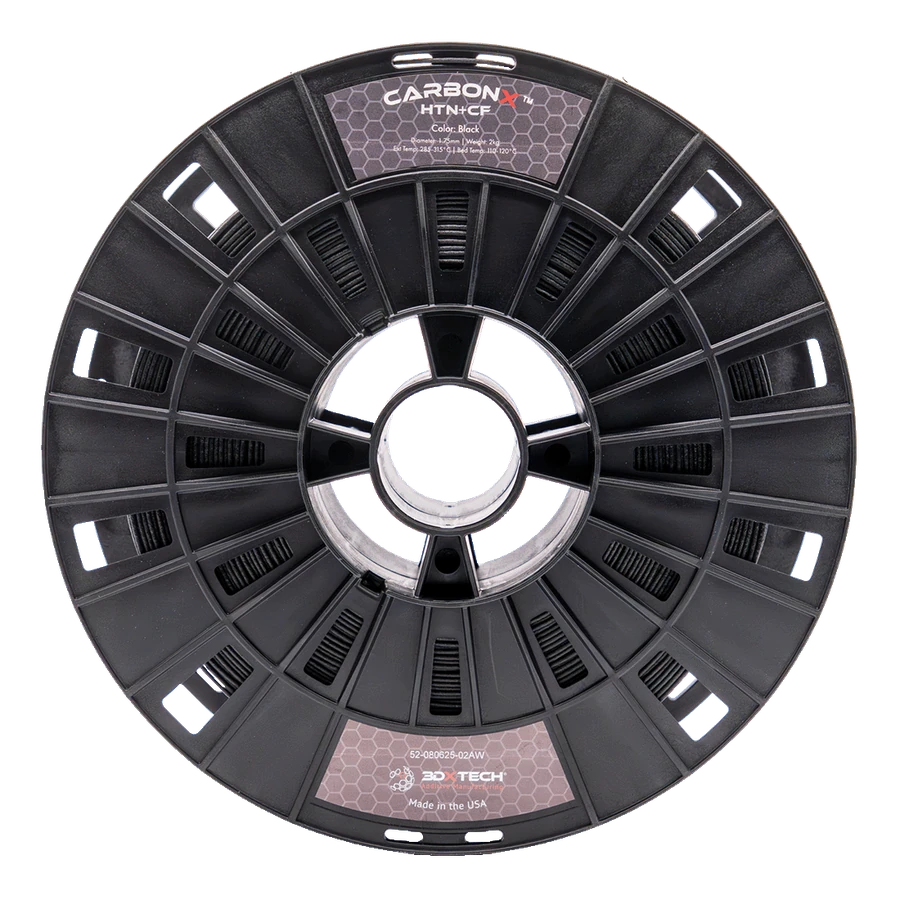
High-temperature nylon reinforced with high-modulus carbon fiber — engineered for high-strength, heat-resistant parts, tools, and fixtures. HTN+CF holds shape to a 240 °C heat-deflection temperature with 8,200 MPa tensile modulus, absorbs little moisture, and resists the chemicals that swell ordinary nylons. Where PA6-CF softens, HTN+CF keeps working. Full specifications →
Availability and lead time vary by reel size — contact Rev1 to confirm before ordering. Need a print profile or a hardened-nozzle recommendation? Call (248) 707-2950.
USA-made CF nylon, with a real datasheet behind it.
3DXTech compounds CarbonX HTN+CF in its Grand Rapids, Michigan facility with a published technical data sheet and lot traceability — consistent fiber loading, batch after batch. Rev1 Technologies is your authorized 3DXTech reseller and US support partner, Auburn Hills, Michigan.


The carbon-fiber nylon for parts that run hot.
Carbon-fiber PA6 and PA12 cover a lot of ground — until the part has to keep its stiffness at elevated temperature. That’s where CarbonX HTN+CF comes in: a high-temperature nylon backbone reinforced with high-modulus carbon fiber, purpose-built for high-strength parts that sit near heat sources. It carries an 8,200 MPa tensile modulus and, critically, a 240 °C heat-deflection temperature — roughly the service band where common CF nylons give up. Add the low moisture absorption and chemical resistance the HTN family is known for, and you get a filament that stays dimensionally honest in under-hood, tooling, and industrial-fixture roles where temperature and chemistry both bite.
Stiff when it’s cold, still stiff when it’s hot.
A 240 °C heat-deflection temperature is the headline number here.
The carbon fiber delivers the stiffness — 8,200 MPa tensile modulus, 95 MPa flexural strength — while the high-temp nylon matrix holds those properties up to a 240 °C HDT (0.45 MPa) and a 265 °C melt point. That combination is what lets HTN+CF replace machined parts in hot, load-bearing spots. This is an engineering material: it wants a dry filament, a hardened nozzle, and a printer that reaches high-temp conditions.
The numbers that let it run hot.
All figures from the 3DXTech CarbonX CF-HTN technical data sheet (TDS Rev 2.0) — see the full TDS for test methods and standards.
Deflection temperature at 0.45 MPa (ISO 75) — the property that sets HTN+CF apart from ordinary CF nylons.
High-modulus carbon fiber (ISO 527) — the stiffness of a structural material.
Break strength on printed specimens (ISO 527) for demanding functional parts.
With a 7,895 MPa flexural modulus (ISO 178) — resists bending under sustained load.
High melt point (DSC) — part of what gives HTN+CF its wide service window.
Consistent density (ISO 1183) with >10&sup9; Ω/sq surface resistance (ASTM D257).
Treat it like the high-temp engineering nylon it is.
A high-temp CF nylon needs a dry filament, an abrasion-resistant nozzle, and a printer that reaches engineering temperatures. Match your machine’s HTN profile and confirm against the TDS.
Nylons are hygroscopic — dry the filament before printing and keep it in a dry box. Wet HTN prints rough and weak.
Carbon fiber is abrasive — use a hardened steel or ruby nozzle. A brass nozzle will wear out fast.
Run an all-metal high-temp hotend at your machine’s HTN extrusion range — see the TDS for guidance.
A hot bed with adhesive and an enclosed/heated chamber help large HTN parts stay flat and bonded.
Annealing high-temp nylons can raise crystallinity and service temperature — validate for your part.
Use the published TDS as your starting point and dial in for your printer and geometry.
Hot, load-bearing, chemically hostile.
HTN+CF earns its place where standard CF nylons run out of temperature.
Check the reel fits your printer.
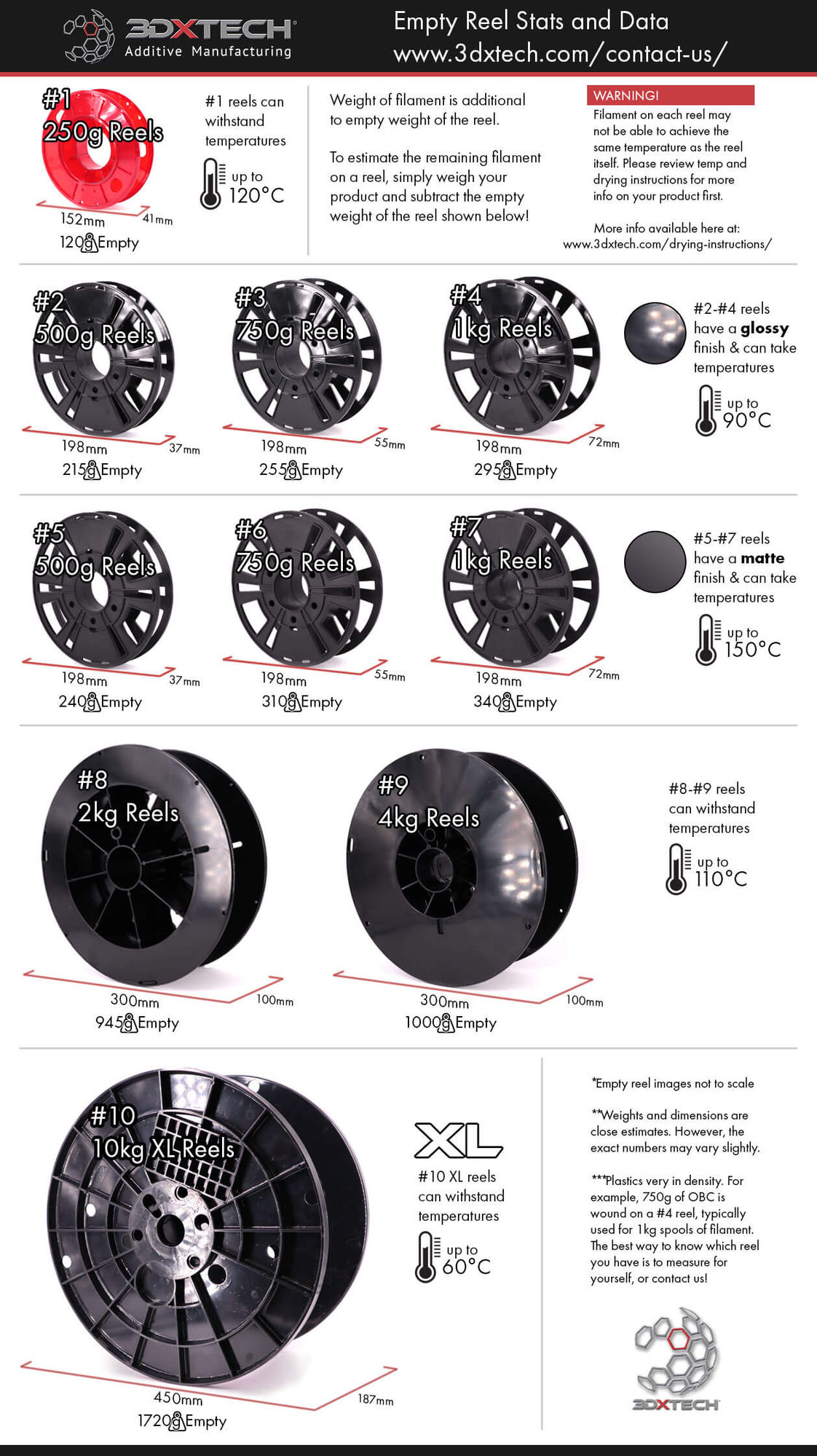
Standard spool dimensions — confirm it fits your dry box.
3DXTech ships HTN+CF on consistent, standard reels.
Before you buy, check the outer diameter, width, and center bore against your printer’s spool holder or drybox — especially for the 2 kg reel, which is larger than a 1 kg spool. Open the full 3DXTech reel infographic for exact dimensions.
View reel dimensions →HTN+CF vs. the other CF nylons.
Where HTN+CF sits against the CF nylons engineers reach for — confirm exact figures against each TDS.
| CarbonX HTN+CF | CarbonX Nylon 6+CF | CarbonX Nylon 12+CF | |
|---|---|---|---|
| Heat deflection (0.45 MPa) | 240°C | Lower | Lower |
| Tensile modulus | 8,200 MPa | High | 8,000 MPa |
| Moisture uptake | Low | Higher (PA6) | Low (PA12) |
| Relative cost | Highest of the three | Lower | Mid |
| Best for | Hot, load-bearing structural parts | General structural CF nylon | Chemically exposed structural parts |
Qualitative comparison among the CarbonX nylon family; confirm exact properties against each TDS. Availability and pricing vary by reel size and date.
3DXTech CarbonX HTN+CF Technical Data
RESOURCES
Datasheets & Print Support
Everything you need to qualify and print CarbonX HTN+CF.
WHY REV1 TECH
Authorized 3DXTech Reseller. High-Temp Materials Specialists.
Rev1 Technologies is an authorized 3DXTech reseller in Auburn Hills, MI, supplying genuine USA-made engineering filament with real print support.
We help you pick the right CF nylon grade, dial in high-temp settings, and keep production running.
FAQ
3DXTech CarbonX HTN+CF — Common Questions
What is HTN+CF for?
High-strength, heat-resistant parts — under-hood brackets, tooling, fixtures, and structural end-use components that must stay stiff at elevated temperature. It’s a high-temp nylon reinforced with carbon fiber.
How hot can parts run?
The heat-deflection temperature is 240 °C at 0.45 MPa (ISO 75) with a 265 °C melt point — well above common CF nylons. Actual service temperature depends on your load and geometry; qualify your own part.
Do I need a hardened nozzle?
Yes — the carbon fiber is abrasive and will wear a brass nozzle quickly. Use a hardened steel or ruby nozzle.
Does it need drying?
Yes. Like all nylons it’s hygroscopic — dry the filament before printing and keep it in a dry box. HTN absorbs less moisture than PA6, but drying still matters for surface quality and strength.
What printer do I need?
An all-metal high-temp hotend, a hardened nozzle, and ideally a heated bed and enclosed chamber. Match your machine’s high-temp nylon profile and confirm against the TDS.
How does it compare to Nylon 6+CF or 12+CF?
Similar stiffness, much higher heat resistance — HTN+CF’s 240 °C HDT is its reason to exist. If your parts don’t run hot, the PA6 or PA12 CF grades are more economical. We stock all three.
Which reel size should I buy?
Start with a 750 g spool to validate your settings, then move to the 2 kg reel for production. Pick the size in the buy-box — price scales with the spool.
Is it made in the USA?
Yes — 3DXTech compounds CarbonX HTN+CF in its Grand Rapids, Michigan facility with a published technical data sheet and lot traceability.
Can Rev1 help me set it up?
Yes. Tell us your service temperature, load case, printer, and geometry and our materials team confirms fit, suggests print settings, and quotes the right reel. Call (248) 707-2950.