CarbonX ABS+CF • 3DXTECH • REV1 TECH
3DXTech CarbonX™ ABS+CF Lightweight CF-ABS for Stiff Structural Prototypes
Lightweight CF-ABS — 105°C Tg · 5,210 MPa Modulus · Lowest-Cost CF Option
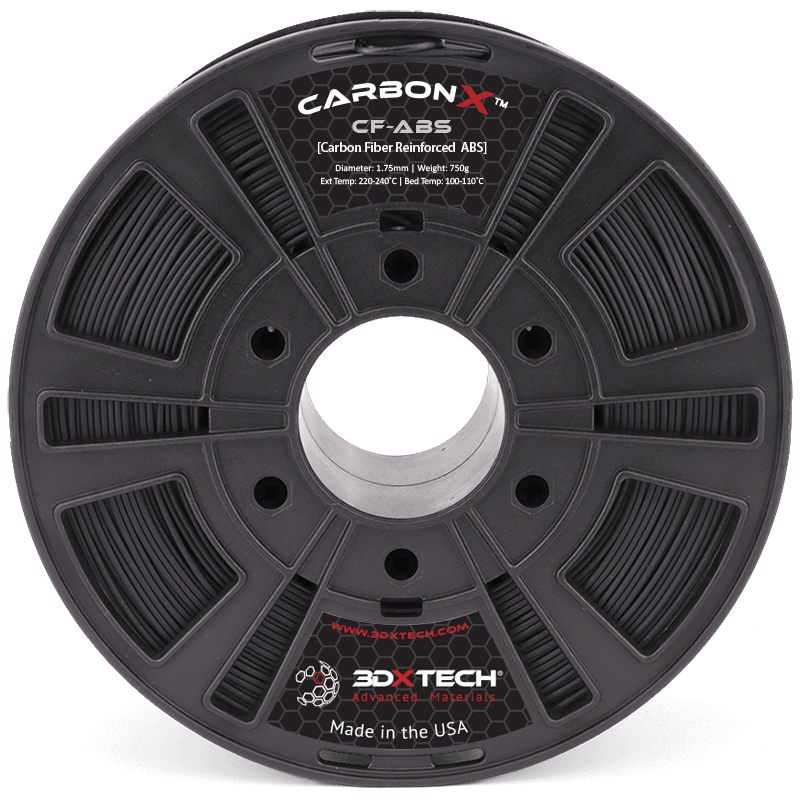
3DXTech’s CarbonX ABS+CF reinforces familiar ABS base resin with chopped carbon fiber, delivering 5,210 MPa tensile modulus and 2.5× the stiffness of unfilled ABS. Heated enclosure recommended to reduce warping. Hardened steel nozzle required. Lightest density in the CarbonX CF line at 1.11 g/cc. Made in Grand Rapids, Michigan.
Select Spool Size
750g in stock. Contact Rev1 to confirm availability.
WHY CarbonX ABS+CF
Lowest-Cost CF Option. 105°C Tg. Familiar ABS Processing.
CarbonX™ ABS+CF is 3DXTech’s entry-level carbon fiber reinforced filament — delivering 5,210 MPa tensile modulus and the CF stiffness upgrade in a material most FDM operators already know. At $48/750g it is the lowest-cost CF option in the line. Heated enclosure recommended. Hardened steel nozzle ≥0.4mm required. Black color. Made in Grand Rapids, Michigan.
5,210 MPa Tensile Modulus
Chopped carbon fiber reinforcement raises tensile modulus to 5,210 MPa — 2.5× the stiffness of unfilled ABS at ~2,100 MPa. Carbon fiber alignment during FFF extrusion maximizes in-layer stiffness for structural brackets, jigs, and functional prototypes.
105°C Tg / 76°C HDT
Improved heat resistance vs. standard ABS. The 105°C glass transition is one of the higher values in the CarbonX CF line, extending the use envelope for structural parts, fixtures, and enclosures operating above room temperature under moderate load.
Lowest-Cost CF Option at $48
Entry point for CF-grade stiffness without the premium of PC+CF or PEEK+CF. At $48/750g, ABS+CF delivers the stiffness jump from unfilled ABS for prototyping budgets where higher-performance CF materials are not yet justified.
Familiar ABS Processing
ABS is one of the most widely used FDM materials. Operators familiar with ABS slicing profiles, bed adhesion, and enclosure practices can apply that knowledge directly to ABS+CF with minimal parameter adjustment. Standard ABS profiles are a reliable starting point.
PRINTING WITH CarbonX ABS+CF
CF Stiffness on ABS Processing Conditions
CarbonX ABS+CF prints at 220–240°C — standard ABS hot end range. Heated enclosure is recommended to reduce warping, consistent with standard ABS best practice. Dry at 80°C for 4 hours before printing. Hardened steel nozzle ≥0.4mm mandatory.
- Extruder Temp 220–240°C — standard ABS hot end range; all-metal hot end not required for most platforms reaching 240°C
- Bed Temp 100–115°C — PEI or glass build surface with ABS-appropriate adhesion (ABS slurry, glue stick, or PEI); standard ABS bed protocols apply
- Enclosure Heated enclosure RECOMMENDED — ABS is prone to warping and layer delamination on open platforms; enclosure eliminates most warping issues at typical part sizes
- Nozzle Hardened steel ≥0.4mm MANDATORY — carbon fiber is abrasive and will wear brass nozzles rapidly
- Layer Height 0.25mm or higher recommended for consistent CF fiber distribution and layer adhesion
- Drying 80°C / 4 hours before printing — ABS absorbs moisture; dry before every session for best results
THERMAL DATA
105°C Tg — Elevated Heat Resistance on Standard ABS Platforms
Four thermal milestones defining CarbonX™ ABS+CF’s operating envelope — verified against 3DXTech CarbonX ABS+CF TDS.
Glass transition temperature of the ABS+CF matrix. Significantly improved vs. standard ABS (~95–100°C), enabling use in elevated-temperature environments where unfilled ABS would approach its softening point. Parts maintain structural integrity below Tg.
Heat deflection temperature under load. Suitable for applications up to ~70°C continuous service with moderate load. Carbon fiber reinforcement stabilizes the polymer matrix under thermal load vs. unfilled ABS.
Standard ABS hot end range — compatible with printers reaching 240°C. Lower processing requirement vs. PC+CF (280–310°C) or PEEK+CF (340–380°C). Accessible on most enclosed FFF platforms.
Required before every print session. ABS absorbs moisture; wet filament causes rough surface texture, reduced layer adhesion, and occasional popping during extrusion. 80°C for 4 hours eliminates moisture contamination.
APPLICATIONS
Jigs. Fixtures. Brackets. Rapid Structural Prototypes.
CarbonX™ ABS+CF combines familiar ABS processing with carbon fiber stiffness — enabling lightweight structural parts at the industry’s entry-level CF price point. 5,210 MPa tensile modulus and 105°C Tg handle structural prototyping and functional applications where standard ABS lacks the stiffness margin.
Jigs, Fixtures & Tooling
CF stiffness in a familiar ABS matrix for manufacturing jigs, fixtures, and tooling inserts. 5,210 MPa modulus provides rigidity for dimensional inspection fixtures and production tooling where standard ABS flex is unacceptable.
Structural Brackets & Mounts
Lightweight structural mounting hardware and brackets where standard ABS lacks the required stiffness. CF reinforcement reduces part deflection under load at 1.11 g/cc density — lightest in the CarbonX CF line.
Rapid Structural Prototypes
Short-run structural prototypes requiring CF mechanical performance at ABS processing conditions. Operators already running ABS can transition to ABS+CF with minimal parameter changes — same profiles, same hardware, same enclosure.
Hardened steel nozzle ≥0.4mm mandatory. Carbon fiber is abrasive — brass nozzles wear rapidly with CF filaments. Heated enclosure recommended to minimize ABS warping on larger parts. Consult 3DXTech CarbonX ABS+CF TDS for complete mechanical data and test methodology.
SPECIFICATIONS
CarbonX™ ABS+CF — Full Technical Data
Source: 3DXTech CarbonX ABS+CF TDS. ISO-standard test specimens. 1.75mm black filament.
Material Properties
| Polymer | ABS + Chopped Carbon Fiber (acrylonitrile butadiene styrene) |
| Diameter | 1.75mm / 2.85mm |
| Color | Black |
| Glass Transition (Tg) | 105°C (DSC) |
| HDT (0.45 MPa, ISO 75) | 76°C |
| Density | 1.11 g/cc (ISO 1183) — lightest in line |
| Tensile Strength | 46 MPa (ISO 527) |
| Tensile Modulus | 5,210 MPa (ISO 527) |
| Tensile Elongation | 2% (ISO 527) |
| Flexural Strength | 76 MPa (ISO 178) |
| Flexural Modulus | 5,260 MPa (ISO 178) |
| Surface Resistance | >10⁸ Ω/sq (standard CF — non-ESD) |
Print Parameters
| Extruder Temp | 220–240°C |
| Bed Temp | 100–115°C |
| Enclosure | Recommended (heated enclosure reduces ABS warping) |
| Drying Protocol | 80°C / 4 hours |
| Nozzle | Hardened steel ≥0.4mm |
| Layer Height | 0.25mm or higher |
Availability
| 750g / 1.75mm | $48 (in stock) |
| 2.85mm | Available — contact for pricing |
| SKU | 3DXT-CX-ABSCF-175-750 |
| Origin | Grand Rapids, MI, USA |
SPOOL SELECTION
750g In Stock. Black. 1.75mm.
CarbonX™ ABS+CF is available in 750g Black (1.75mm) at $48 from stock. Single spool size — entry-level CF pricing for prototyping and short-run production tooling. 2.85mm diameter available; contact for pricing.
- 1.75mm diameter — Black
- CF reinforcement — chopped carbon fiber
- Ships from stock
- Lowest-cost CF option in the line
PRODUCT IMAGES
CarbonX™ ABS+CF — Spool & Detail Views
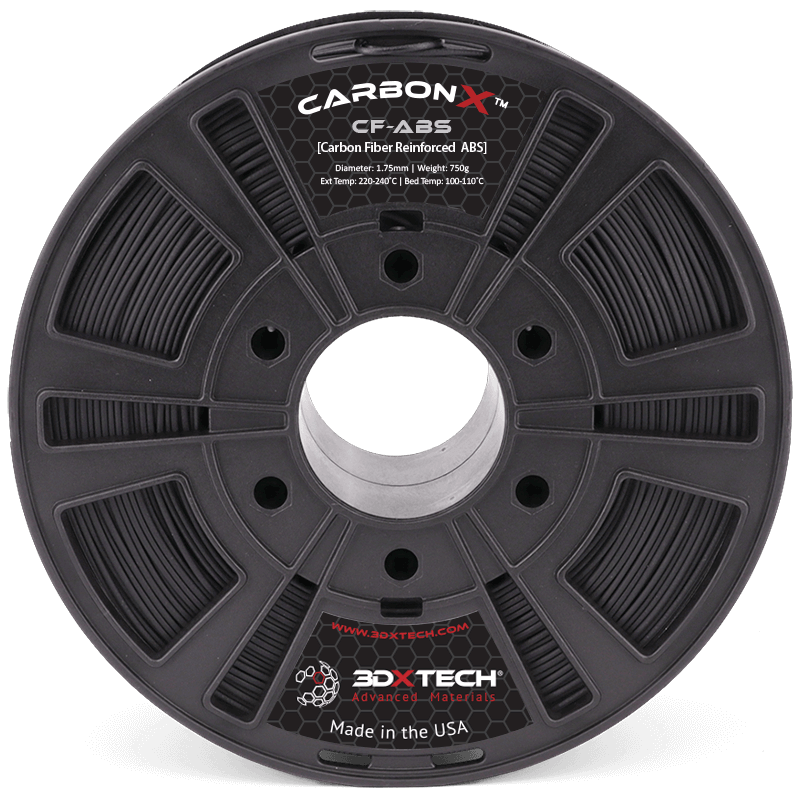
750g Black spool, 1.75mm. CF reinforcement produces consistent black color throughout the filament. Hardened steel nozzle required. Heated enclosure recommended.
WHERE IT WORKS
Where CF-Reinforced ABS Outperforms Standard Alternatives
When you need structural stiffness beyond unfilled ABS and cost justification for PC+CF is not yet clear — CarbonX ABS+CF delivers 5,210 MPa modulus at 220–240°C with familiar ABS parameter sets and the lowest entry price in the CF line at $48/750g.
Manufacturing Jigs & Fixtures
CF stiffness reduces fixture flex for dimensional inspection and assembly fixtures. ABS+CF delivers 5,210 MPa modulus rigidity in a familiar ABS matrix — operators already running ABS can qualify ABS+CF with minimal process change.
Structural Brackets & Mounts
Mounting hardware, brackets, and structural mounts requiring CF stiffness at ABS cost. At 1.11 g/cc, ABS+CF is the lightest density in the CarbonX CF range — ideal for weight-sensitive structural mounting applications.
Entry-Level CF Prototyping
Teams evaluating carbon fiber reinforced filaments for the first time. ABS+CF at $48 is the lowest-cost entry point to CF-grade stiffness in the 3DXTech line — validate CF performance before committing to higher-performance grades.
Consumer Electronics Housings
Structural enclosures and housings requiring CF stiffness. 105°C Tg handles internal heat from electronics. Black opaque appearance suitable for consumer product prototypes. Familiar ABS finish and post-processing characteristics.
Automotive Interior Prototypes
Interior trim prototypes, clips, and panel mounts where CF stiffness is required and ABS surface quality is the target. ABS+CF inherits ABS’s established automotive interior performance baseline at 2.5× the stiffness.
Production Tooling Inserts
Short-run production tooling where standard ABS lacks the stiffness margin. CF reinforcement reduces tool deflection and increases part life. Heated enclosure reduces warping during large-format tooling prints.
MATERIAL CARE
Dry Before Printing. Store Sealed. Use Enclosure for Best Results.
CarbonX™ ABS+CF requires drying at 80°C for 4 hours before printing. ABS absorbs ambient moisture. A heated enclosure significantly reduces warping on larger parts. Follow this protocol to maintain print quality and mechanical properties session-to-session.
Dry Before Every Session
80°C for 4 hours minimum. Even a sealed spool benefits from a fresh drying cycle. Wet ABS+CF shows rough surface texture, reduced layer adhesion, and occasional popping during extrusion.
Use a Heated Enclosure
ABS is prone to warping and layer delamination on open-frame printers. A heated enclosure maintains an elevated ambient temperature during printing, dramatically reducing warping on larger parts and improving layer adhesion.
Store Sealed With Desiccant
Return unused filament to an airtight bag or container with fresh desiccant immediately after printing. Long-term storage in original sealed packaging with desiccant is acceptable.
Recognize Wet Filament Symptoms
Popping or crackling during extrusion, rough surface texture, reduced layer adhesion, and inconsistent extrusion width are signs of moisture contamination. Re-dry at 80°C for 4 hours and restart the print.
HOW IT COMPARES
CarbonX™ ABS+CF vs. Commonly Evaluated Alternatives
Buyers evaluating CarbonX ABS+CF typically compare against standard ABS for a baseline, CarbonX PETG+CF for a comparable CF option, CarbonX ASA+CF for outdoor UV stability, and generic CF-ABS alternatives. ABS+CF uniquely combines familiar processing, lowest CF price, and 105°C Tg.
3DXTech / Rev1 Tech
Generic / Various
3DXTech
Various
MATERIAL PERFORMANCE PROFILE
CarbonX™ ABS+CF — Relative Property Scale
Nine-bar relative scale. Reference maximum: ThermaX PEEK at ~11,000 MPa tensile modulus = 9 bars. Values per ISO 527 / ISO 178 / ISO 75 / ISO 1183 on 3DXTech CarbonX ABS+CF TDS.
ISO 9001:2015 Certified
Production under a certified quality management system. Lot traceability and process controls throughout filament fabrication at 3DXTech’s Grand Rapids facility.
Made in Grand Rapids, MI
Filament extruded and wound in-house at 3DXTech’s Michigan facility. Direct factory quality control — not overseas commodity production.
Technical Data Sheet Available
Full processing parameters, mechanical properties, and test methodology published in the CarbonX ABS+CF TDS. Available via 3DXTech. Contact Rev1 for pre-sales technical support.
RESOURCES
Downloads & Technical Support
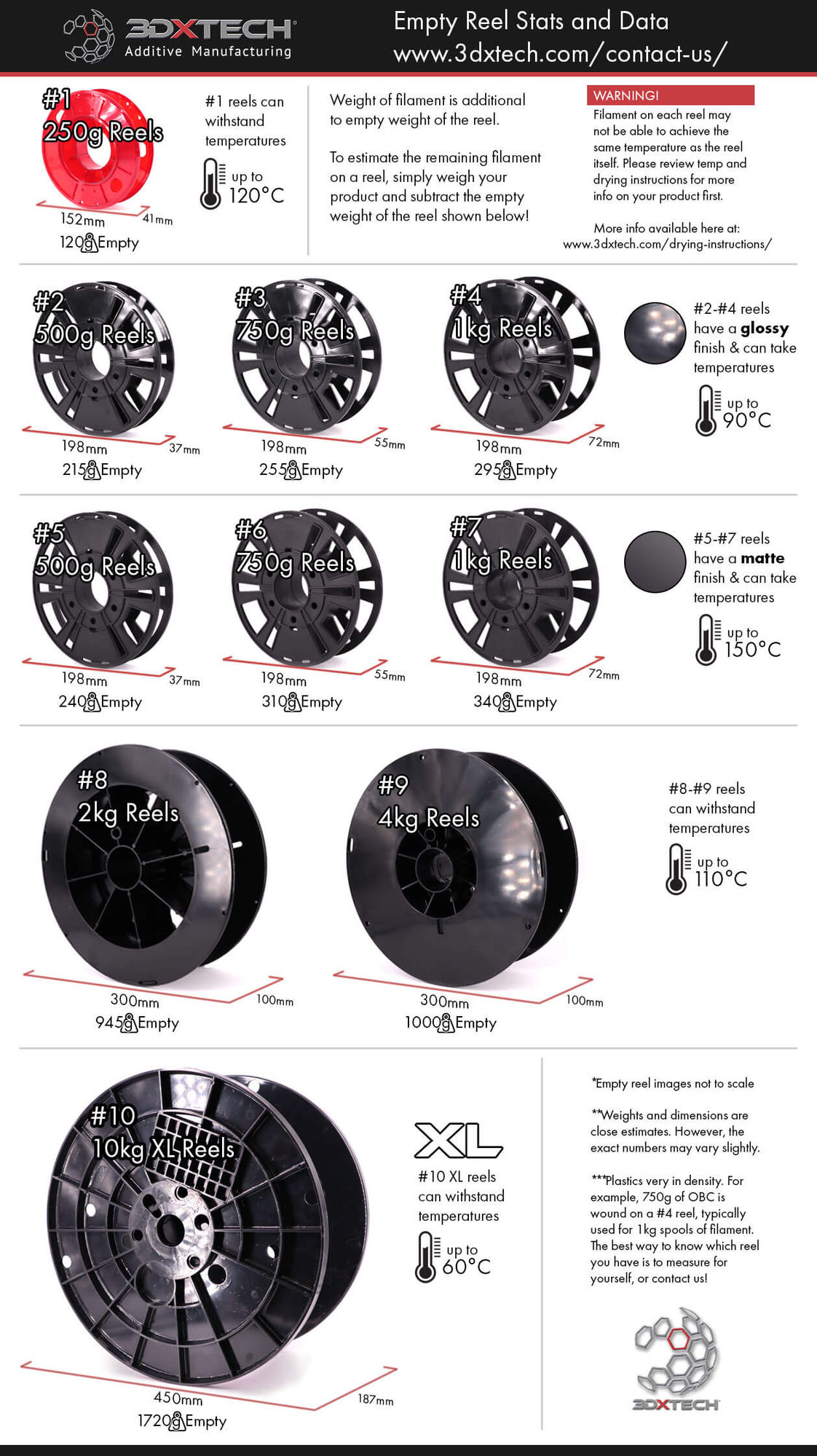
Everything you need to qualify and print CarbonX™ ABS+CF with confidence. Processing parameters, reel dimensions, and technical support from Rev1.
WHY REV1 TECH
Authorized 3DXTech Reseller. Industrial AM Specialists.
Rev1 Technologies is an authorized 3DXTech reseller headquartered in Auburn Hills, MI, with direct technical expertise in high-performance FFF materials and the printers that run them. CarbonX ABS+CF prints at 220–240°C — compatible with any enclosed FFF platform with a hardened steel nozzle. Heated enclosure recommended for best results.
Authorized Reseller
Every spool ships direct from the authorized channel. MAP pricing guaranteed. Single-channel license compliance — not a grey-market distributor.
ABS Platform Expertise
ABS+CF runs on any enclosed FFF platform capable of 240°C — Bambu X1/P1, Qidi, Creality Ender with enclosure, Prusa with enclosure, and industrial platforms from Stratasys, Ultimaker, and others. Our team has run ABS on these platforms and can guide enclosure setup and profile tuning.
Pre-Sales Technical Support
Questions about print settings, enclosure requirements, or qualifying ABS+CF for your application? Contact Rev1 before you order — that conversation is free.
FREQUENTLY ASKED
CarbonX™ ABS+CF — Buyer & Engineer Questions Answered
What is CarbonX™ ABS+CF?
CarbonX™ ABS+CF is 3DXTech’s carbon fiber reinforced ABS (acrylonitrile butadiene styrene) filament. Available in Black (1.75mm, 750g at $48), it delivers 5,210 MPa tensile modulus and 46 MPa tensile strength — 2.5× stiffer than standard ABS. It is the lowest-cost CF option in the CarbonX line. Heated enclosure recommended. Hardened steel nozzle ≥0.4mm mandatory. Made in Grand Rapids, Michigan.
What mechanical properties does CarbonX ABS+CF deliver?
CarbonX ABS+CF delivers 46 MPa tensile strength, 5,210 MPa tensile modulus, 76 MPa flexural strength, and 5,260 MPa flexural modulus at 2% elongation. Glass transition (Tg) is 105°C and HDT is 76°C at 0.45 MPa. Density is 1.11 g/cc — the lightest in the CarbonX CF line. All values per ISO 527 / ISO 178 on 1.75mm black filament.
Does CarbonX ABS+CF require a heated chamber?
A heated enclosure is recommended but not strictly required. ABS is prone to warping and layer delamination on open-frame printers, particularly on larger parts. A heated enclosure significantly reduces these issues. Unlike CarbonX PETG+CF (which is chamber-optional), ABS+CF will produce better results on enclosed platforms. Bambu X1, Qidi, and industrial enclosed printers are well-suited.
What nozzle do I need for CarbonX ABS+CF?
Hardened steel nozzle ≥0.4mm is mandatory. Carbon fiber is abrasive and will rapidly wear brass nozzles — typically within the first few hundred grams of filament. Ruby nozzles or other wear-resistant alternatives are also acceptable. Standard brass nozzles are not compatible.
What are the print settings for CarbonX ABS+CF?
Extruder: 220–240°C. Bed: 100–115°C. Enclosure: recommended (heated). Nozzle: hardened steel ≥0.4mm. Layer height: 0.25mm or higher. Drying: 80°C for 4 hours before every print session. Standard FFF profile for ABS applies as a starting point — ABS slicing profiles translate directly with minimal adjustment.
How is CarbonX ABS+CF different from standard ABS?
CarbonX ABS+CF has 2.5× the tensile modulus of unfilled ABS (5,210 MPa vs. ~2,100 MPa) and improved Tg (105°C vs. ~95–100°C). Trade-off: elongation drops from ~5–8% to 2% — CF grades are stiffer but less ductile than unfilled ABS. Color is permanently black. Processing is very similar to standard ABS, making it one of the easiest CF transitions for existing ABS users.
How does CarbonX ABS+CF compare to CarbonX PETG+CF?
ABS+CF is $2 less per spool ($48 vs. $50), has a higher Tg (105°C vs. 80°C), and lower density (1.11 g/cc vs. 1.34 g/cc). PETG+CF has slightly higher tensile modulus (5,230 MPa vs. 5,210 MPa), better chemical resistance, and does not require a heated enclosure. Choose ABS+CF if you already have an enclosure and want the lowest CF price; choose PETG+CF for open-platform printing or chemical-resistance applications.
Where is CarbonX ABS+CF made?
CarbonX™ ABS+CF is manufactured in-house by 3DXTech in Grand Rapids, Michigan, USA under ISO 9001:2015 certification. Filament is extruded and wound at the 3DXTech facility with full lot traceability throughout production. Rev1 Technologies is an authorized 3DXTech reseller based in Auburn Hills, MI.