3DXTech 3DXSTAT ESD-PLA Static-Dissipative PLA — Easy ESD-Safe Printing for Electronics Fixtures
Static-Dissipative PLA — Easy ESD-Safe Printing for Electronics Fixtures
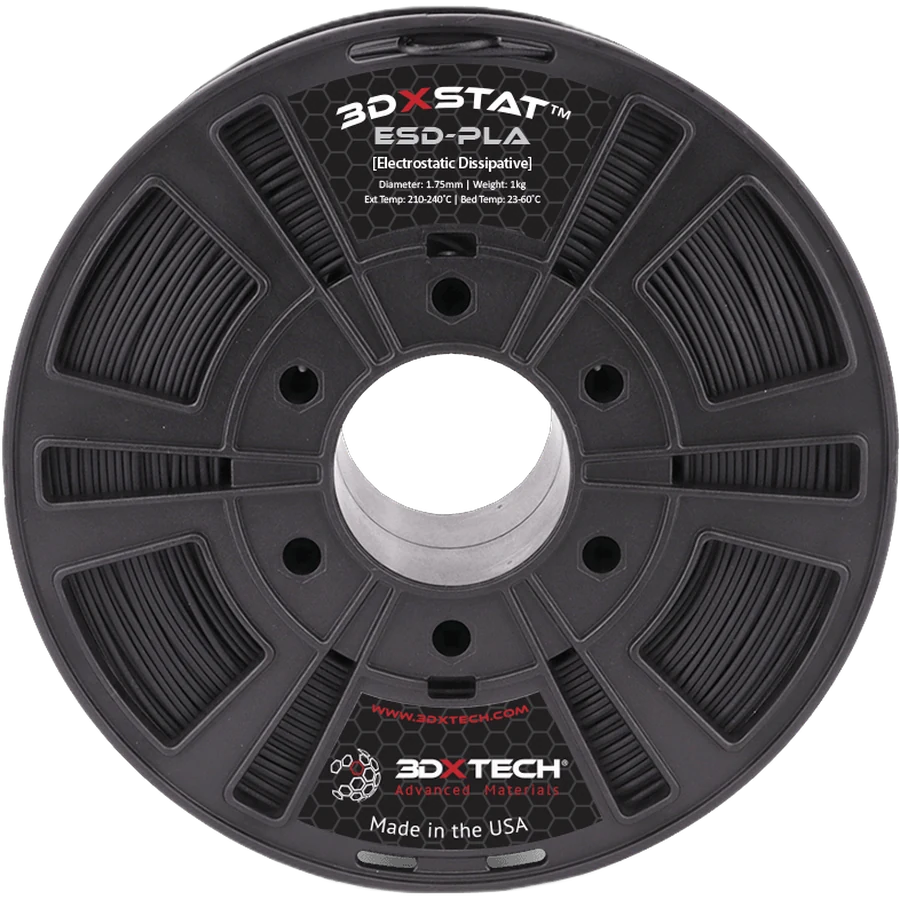
3DXSTAT™ ESD-PLA is an advanced ESD-safe compound engineered to protect delicate electronics from static discharge. It pairs the low-warpage, easy-printing behavior of PLA with multi-wall carbon-nanotube (MWCNT) technology to hold a controlled, static-dissipative surface resistance — so you can print jigs, fixtures, and trays for ESD-sensitive assembly on virtually any desktop printer, no heated chamber required. Compounded in the USA. Full specifications →
Made in the USA — ships from Rev1. Need 2.85 mm, 2 kg reels, or bulk/case pricing for a production line? Call (248) 707-2950.
Real ESD-safe filament, with a published datasheet behind it.
3DXTech compounds 3DXSTAT™ ESD-PLA in Grand Rapids, Michigan using multi-wall carbon-nanotube technology, with a published TDS and a target surface resistance of 104–109 Ω — no mystery “anti-static” filament. Rev1 Technologies is your authorized 3DXTech reseller and US support partner, Auburn Hills, Michigan.


Static protection — on the printer you already own.
Most ESD-safe filaments make you choose between static protection and printability — they demand a heated chamber, a hardened hotend, and careful tuning. 3DXSTAT™ ESD-PLA takes a different route. By starting from a low-warpage PLA base and reinforcing it with multi-wall carbon nanotubes, 3DXTech built an ESD compound that prints on virtually any desktop machine, with no enclosure, at everyday PLA temperatures. For electronics assembly, service benches, and low-heat fixturing where budget and turnaround matter, it delivers genuine electrostatic-dissipative performance without the industrial overhead.
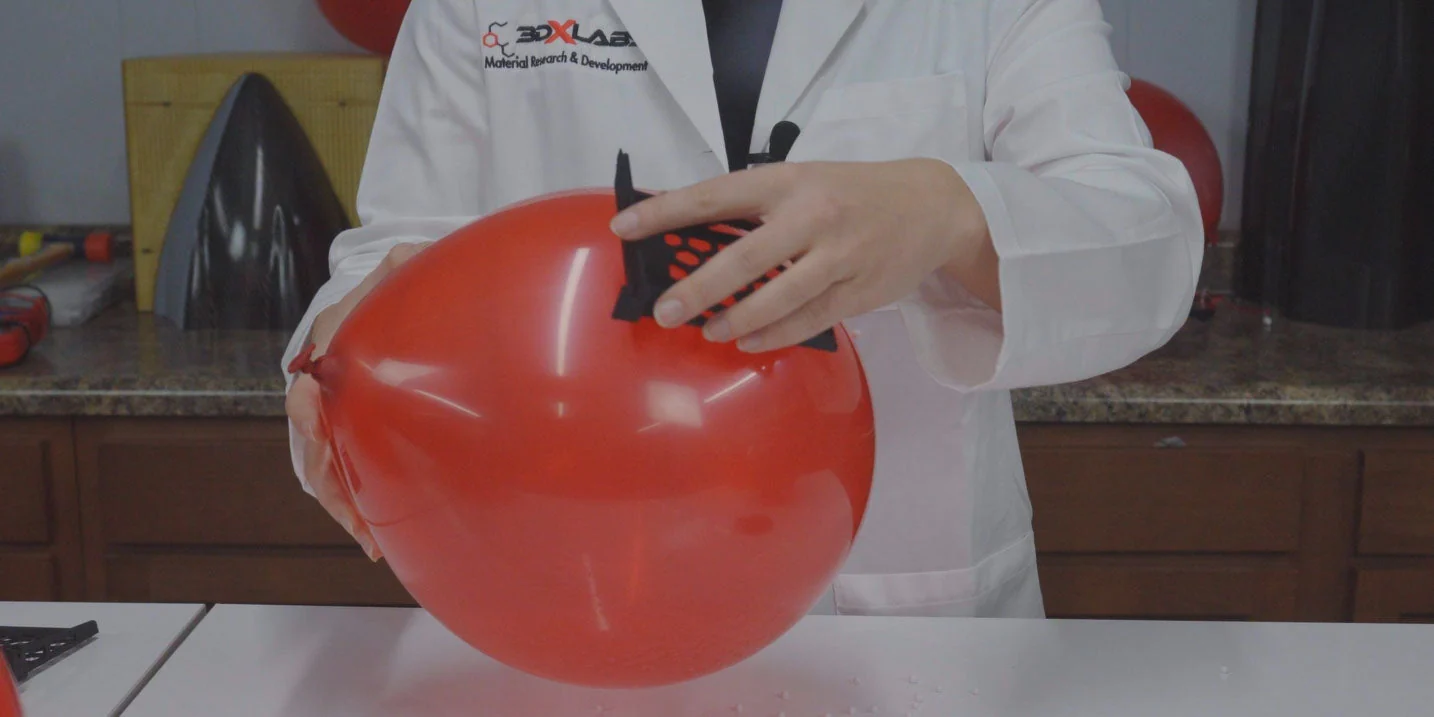
A controlled path for static to drain away.
Parts that don’t build up or discharge a damaging spark.
Standard PLA is an insulator — it lets charge accumulate on a part’s surface until it discharges all at once, which is exactly what damages sensitive components. ESD-PLA is engineered to sit in the static-dissipative window (a target surface resistance of 104–109 Ω), so charge bleeds away in a slow, controlled way instead of arcing. That’s the difference between a fixture that protects a populated PCB and one that quietly kills it.
Real, third-party-tested engineering properties.
Values from 3DXTech’s published Technical Data Sheet (Rev 1.0). Mechanical figures were generated by an independent, third-party lab for an unbiased evaluation; electrical, thermal, and physical values follow the ASTM and ISO methods noted below.
Static-dissipative range (ASTM D257) — the whole point of an ESD-safe material.
DSC-measured Tg — ample margin for room-temperature electronics fixturing.
Deflection temp at 0.45 MPa (ISO 75) — sized for low-heat, light-duty parts.
Flat orientation (ASTM D638); 3.1 GPa tensile modulus — stiff, dimensionally stable parts.
Unnotched, flat (ASTM D256) — carbon-nanotube reinforcement adds toughness over plain PLA.
ISO 1183 — predictable part weights and spool yield for production planning.
Prints like PLA — no chamber, no exotic hardware.
3DXTech’s recommended starting conditions. Because the base is low-warpage PLA, ESD-PLA runs on ordinary desktop printers — 3DXTech’s own reference profile prints it fast and solid on a Bambu P1S. A hardened or wear-resistant nozzle is recommended because the compound is carbon-nanotube filled.
Everyday PLA hotend range — no high-temperature machine required.
Runs from an unheated bed up to 60°C; low warpage means first-layer grip is easy.
Prints open-frame on virtually any desktop printer — the PLA base resists warping without an enclosure.
A hardened or wear-resistant nozzle is recommended — carbon-nanotube compounds are mildly abrasive to brass.
3DXTech’s Bambu P1S reference profile: 246 mm/s, 0.20 mm layer, solid infill.
PLA is mildly hygroscopic — drying at ~45°C keeps the surface clean and the ESD compound consistent.
Fixtures, trays, and housings for ESD-sensitive work.
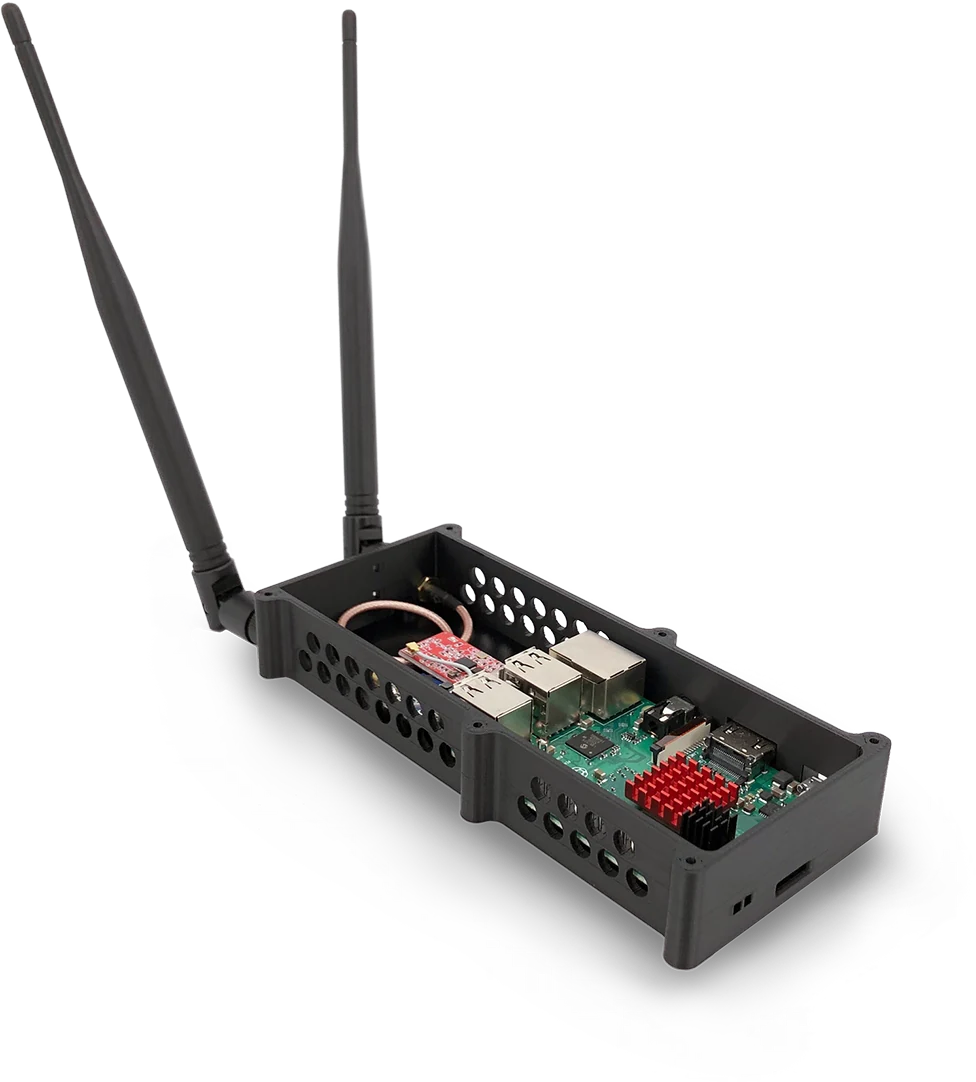
Protect the board while you build and service it.
Enclosures, jigs, trays, and tools that live around live electronics.
Because it’s ESD-safe, easy to print, and inexpensive, 3DXSTAT™ ESD-PLA is a natural fit for the parts that surround sensitive electronics — enclosures and housings for single-board computers and controllers, component trays and bins, assembly jigs and fixtures, and hand tools for the ESD workbench. Print them in-house, on the machine you already own, and iterate the design the same afternoon.
Carbon nanotubes give static a controlled way out.
ESD protection isn’t magic — it’s a conductive network built into the polymer. 3DXTech disperses multi-wall carbon nanotubes through the PLA so charge can migrate and dissipate instead of accumulating and arcing.
Multi-wall carbon nanotubes, precisely compounded.
Enough conductive path to dissipate — without turning the part conductive.
Static-dissipative materials sit deliberately between insulators and conductors. 3DXTech uses cutting-edge multi-wall carbon-nanotube technology and precision compounding to place ESD-PLA in the 104–109 Ω window: high enough that the part isn’t a conductor, low enough that surface charge drains away in a slow, controlled manner. The nanotubes also add dimensional reinforcement, which is part of why the parts stay flat and stiff.
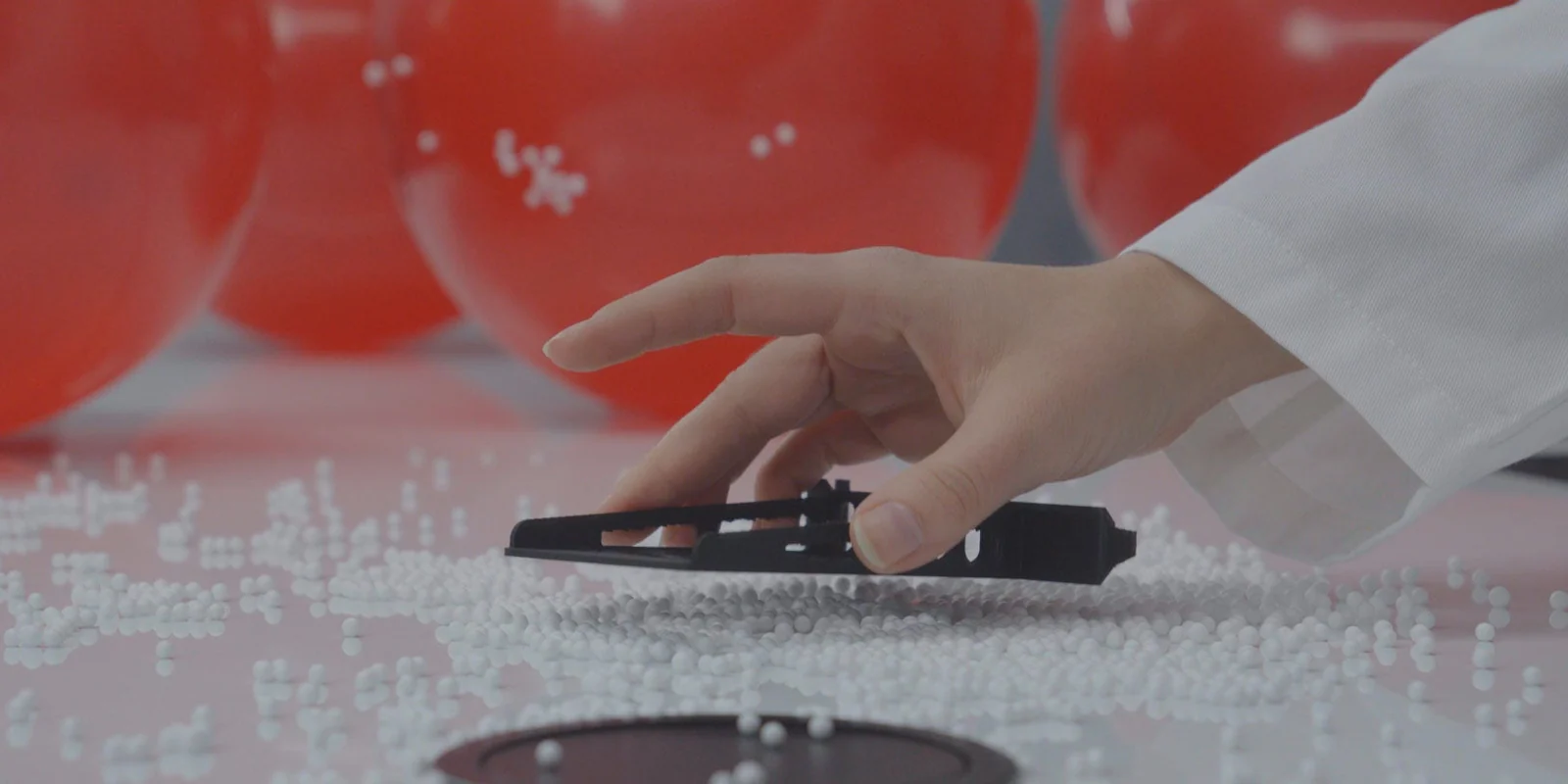
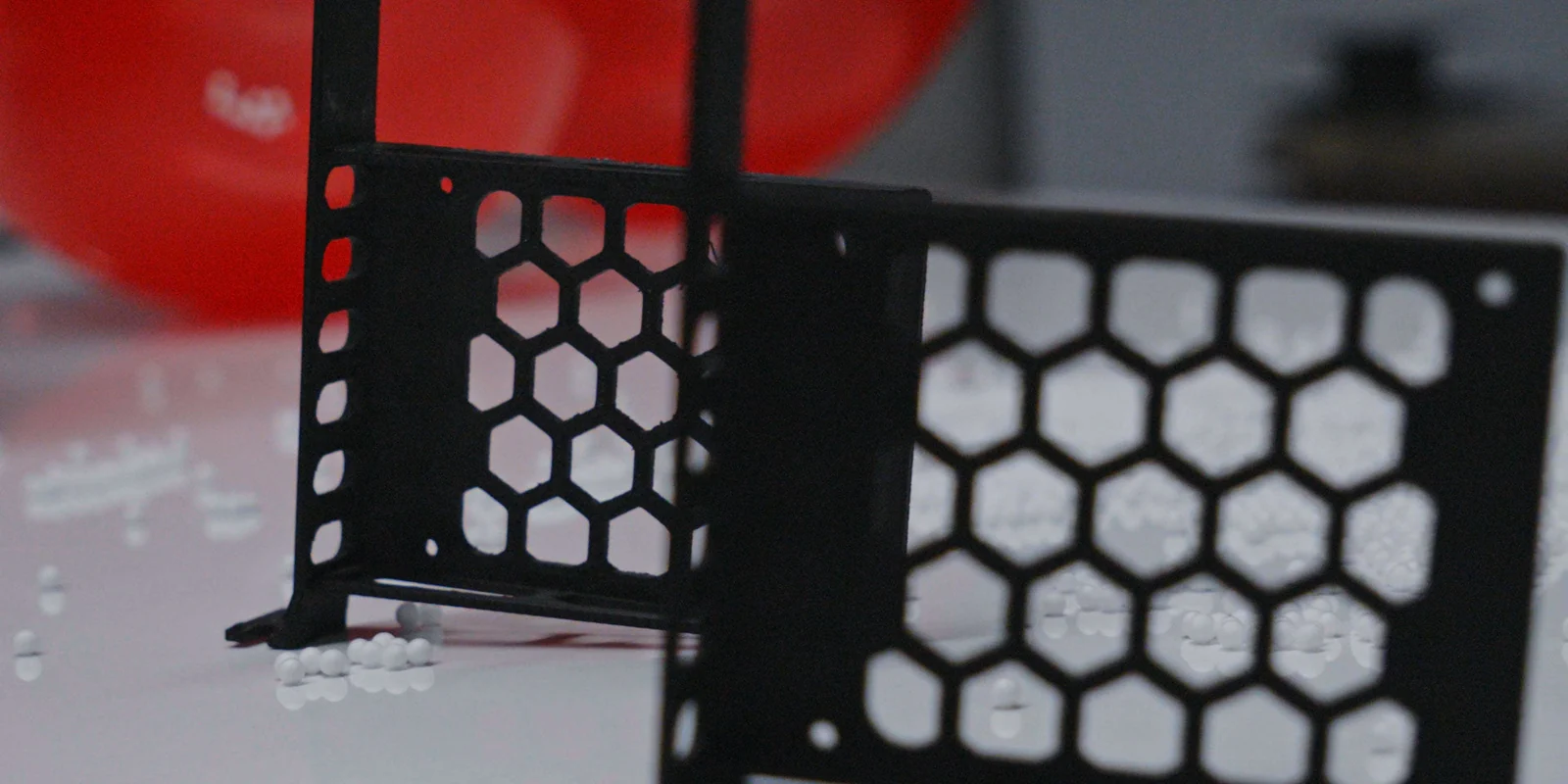
Foam beads that cling to everything — but not to this.
The simplest demonstration of why an ESD-safe part matters.
Charged foam packing beads cling to ordinary plastic because static holds them there. An ESD-dissipative part doesn’t give that charge anywhere to grip, so the beads fall away. On the assembly line the stakes are higher than a tidy bench: an insulating fixture can hold a charge and release it into a component you’re handling. ESD-PLA is designed so your fixtures, trays, and enclosures are part of the static-control system instead of a hidden hazard in it.
Check the reel fits your printer.
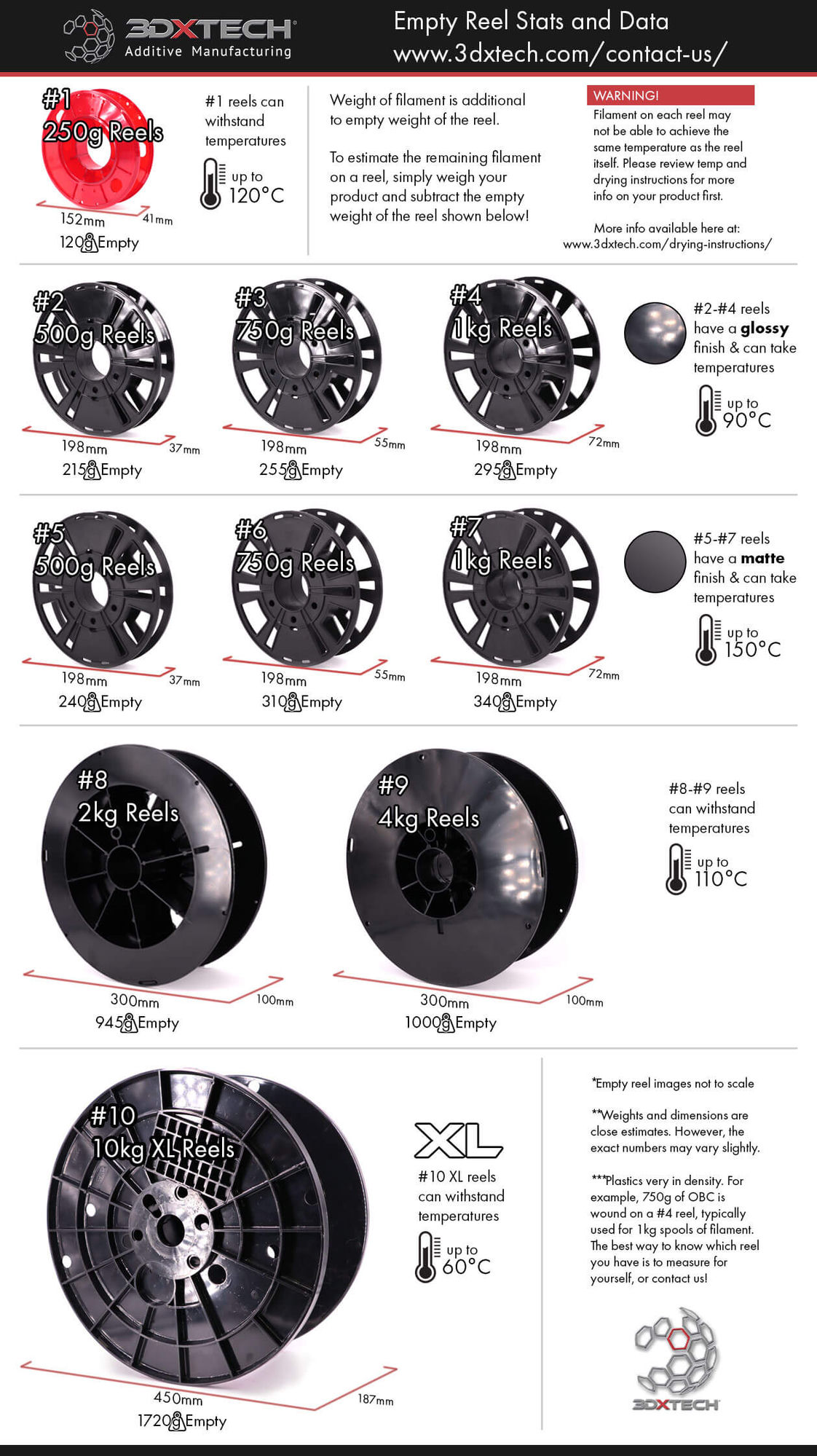
Standard spool dimensions — confirm it fits your AMS or dry box.
3DXTech ships ESD-PLA on consistent, standard reels.
Before you buy, check the outer diameter, width, and center bore against your printer’s spool holder, automated material system, or drybox — the 750 g reel is sized to fit popular AMS-style systems. Open the full 3DXTech reel infographic for the exact dimensions of each spool.
View reel dimensions →ESD-PLA vs. ESD-ABS vs. ESD-PETG — picking the right ESD-safe material.
Approximate positioning among the common static-dissipative filaments — ESD-PLA is the easy, low-heat entry point; step up to ESD-ABS or ESD-PETG when parts see more heat, chemicals, or handling. Confirm exact figures against each technical data sheet.
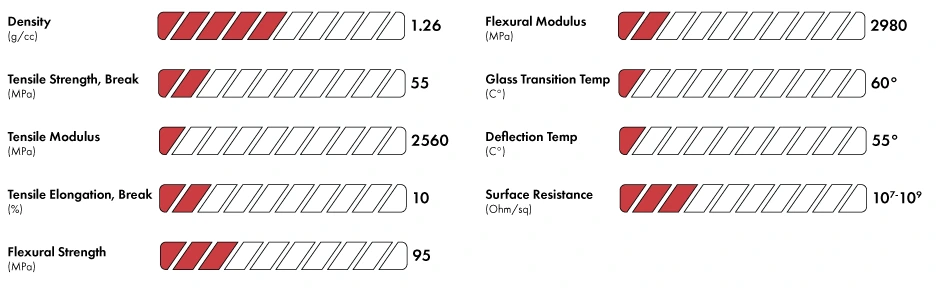
3DXTech’s published property chart.
The quick-reference numbers, straight from the manufacturer — click the chart to enlarge it.
3DXTech publishes a property chart for 3DXSTAT™ ESD-PLA so you can size it up fast — density, tensile and flexural strength, thermal points, and surface resistance on one bar. It’s small on the page; click it to read the full-size version. The complete third-party-tested mechanical, thermal, and electrical data is in the readable specifications table below.
| 3DXSTAT ESD-PLA | ESD-ABS | ESD-PETG | |
|---|---|---|---|
| Ease of printing | Easiest (PLA base) | Moderate | Easy |
| Heated chamber | Not needed | Recommended | Not needed |
| Surface resistance | 104–109 Ω | Static-dissipative | Static-dissipative |
| Heat resistance | Low (55°C HDT) | High | Moderate |
| Warpage | Very low | Higher | Low |
| Chemical resistance | Moderate | Good | Good |
| Best for | Low-heat ESD fixtures, prototypes, budget | Durable, higher-temp ESD tooling | Tougher, chemical-facing ESD parts |
Qualitative comparison among common ESD-safe filaments; confirm exact properties against each TDS. Prices vary by reel size and date.
3DXTech 3DXSTAT ESD-PLA Technical Data
RESOURCES
Datasheets & Print Support
Everything you need to qualify and print 3DXSTAT ESD-PLA.
WHY REV1 TECH
Authorized 3DXTech Reseller. Engineering-Materials Specialists.
Rev1 Technologies is an authorized 3DXTech reseller in Auburn Hills, MI, supplying genuine USA-made filament with real print support.
We help you pick the right ESD material, dial in the profile, and keep production running.
FAQ
3DXTech ESD-PLA — Common Questions
What is ESD-PLA and what is it for?
3DXSTAT™ ESD-PLA is a static-dissipative PLA compound. It’s designed for parts used around static-sensitive electronics — enclosures, jigs, fixtures, and trays — where you need the surface to bleed off static charge in a controlled way rather than let it build up and discharge.
What surface resistance does it have?
3DXTech targets a surface resistance of 104–109 Ω (ASTM D257) — the static-dissipative range. That’s high enough that the part isn’t electrically conductive, but low enough to drain surface charge safely instead of holding it.
Do I need a special printer?
No. Because the base is low-warpage PLA, ESD-PLA prints on virtually any desktop printer at 210–240°C with a bed from unheated up to 60°C. No heated chamber or enclosure is required — that’s its biggest advantage over ESD-ABS or ESD-PC.
Do I need a hardened nozzle?
It’s recommended. ESD-PLA is compounded with carbon nanotubes, which are mildly abrasive over time. A hardened-steel or other wear-resistant nozzle will outlast standard brass; brass will print it but wears faster.
How heat-resistant is it?
It’s a low-heat material — glass transition around 60°C and a heat-deflection temperature of 55°C at 0.45 MPa. It’s ideal for room-temperature ESD fixtures and prototypes; for parts that see real heat, step up to ESD-ABS, ESD-PETG, or ESD-PC.
What sizes and colors are available?
Black, in 1.75 mm and 2.85 mm diameters, on 750 g and 2 kg reels. The 750 g reel is sized to fit popular AMS-style automated material systems. Ask us about bulk pricing for production lines.
Should I dry it before printing?
Yes, if it’s absorbed moisture. Like all PLA it’s mildly hygroscopic; drying at roughly 45°C for about 4 hours restores a clean surface finish and keeps the ESD compound consistent.
Will the ESD properties wear off over time?
No. ESD-PLA is inherently dissipative — the static protection comes from a carbon-nanotube network compounded through the whole material, not a surface spray or a migratory anti-static additive that blooms out and fades. The dissipative behavior is built into every layer of the part and doesn’t wash off or wear away with handling.
Is it made in the USA?
Yes — 3DXTech manufactures and compounds 3DXSTAT ESD-PLA in its 68,000 sq-ft facility in Grand Rapids, Michigan, with a published TDS, SDS, and lot traceability.