3DXTech 3DXSTAT ESD-PETG Static-Dissipative ESD-Safe PETG Filament — 107–109 Ω/sq
Static-Dissipative ESD-Safe PETG Filament — 107–109 Ω/sq
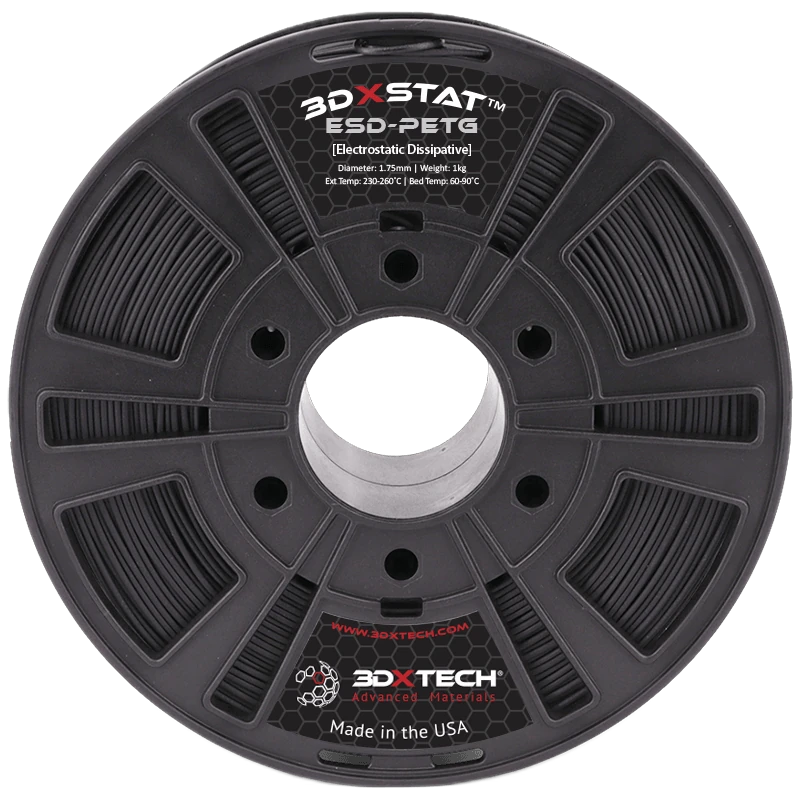
An advanced ESD-Safe compound engineered for critical applications that require electrostatic-discharge protection. 3DXSTAT™ ESD-PETG uses multi-wall carbon-nanotube (CNT) technology to hold a consistent, dissipative surface resistance of 107–109 Ω/sq — combined with the easy printing, chemical resistance, and low-warp behavior of premium PETG. Full specifications →
Made in the USA — ships from Rev1. Need 2.85 mm, 2 kg reels, or bulk / standing-order pricing? Call (248) 707-2950.
Verified ESD-safe PETG, with a published datasheet behind it.
3DXTech compounds 3DXSTAT™ ESD-PETG in Grand Rapids, Michigan using multi-wall carbon-nanotube technology, with published surface-resistance and mechanical data — no mystery filament. Rev1 Technologies is your authorized 3DXTech reseller and US support partner, Auburn Hills, Michigan.


Static-dissipative parts — without the guesswork.
Static charge kills sensitive electronics, attracts contamination, and disrupts precision handling. 3DXSTAT™ ESD-PETG is an advanced ESD-Safe compound built specifically to solve that: it drains static charge to ground at a controlled, dissipative rate rather than letting it build up on the part or discharge in a damaging spike. Built on premium PETG and multi-wall carbon-nanotube technology, it prints as easily as everyday PETG while giving you a datasheet-backed 107–109 Ω/sq surface resistance you can qualify against.
Carbon-nanotube technology for a consistent, dissipative surface.
A controlled static path — not an insulator, not a full conductor.
3DXTech builds 3DXSTAT™ ESD-PETG with cutting-edge multi-wall carbon-nanotube (CNT) additives and precision extrusion, so conductivity is uniform through the filament instead of a surface coating that wears off. The result sits squarely in the static-dissipative band — low enough to bleed off charge safely, high enough to avoid the hard discharge of a fully conductive part. That makes it the right pick for handling and enclosing electrostatic-sensitive devices.
Real ESD and mechanical properties, from a published TDS.
3DXTech's published values, generated from printed ISO test specimens — the same numbers shown on the manufacturer property chart below.
Target dissipative range (ASTM D257) — the ESD-safe window for handling static-sensitive parts.
Strength at break (ISO 527) — strong, functional parts, not brittle ESD plastic.
Stiffness under load (ISO 527) — dimensionally stable fixtures and housings.
Ductility (ISO 527) — superior toughness compared with ESD-ABS; parts flex before they fail.
Strong in bending (ISO 178) with a 1780 MPa flexural modulus.
Deflection temp at 0.45 MPa (ISO 75); glass transition (Tg) 80°C by DSC.
Prints like PETG — standard nozzle, no enclosure required.
3DXTech's recommended starting conditions. One useful tuning note: higher extruder temperatures tend to raise conductivity, while lower temperatures lower it — dial toward the top of the range if you need the most reliable dissipation.
Wide processing window; ~250°C is a good start. Run hotter for higher conductivity.
A heated bed around 70°C gives reliable first-layer grip; PETG-standard adhesion.
Low, near-isotropic shrinkage means no enclosure is needed — unlike ABS-based ESD.
No special hardware for the base polymer; a hardened nozzle adds life with CNT-loaded compounds.
Runs cleanly at 0.10 mm or higher — no special layer-height concerns.
Moisture absorption is ~3× lower than ABS; drying at 65°C for 4 hours keeps it consistent.
Static-safe parts for electronics, cleanroom, and the shop floor.

From wafer handling to static-free tooling.
Print the fixtures and enclosures that protect sensitive devices.
Because it combines datasheet ESD performance with the strength and chemical resistance of PETG, 3DXSTAT™ ESD-PETG is a natural fit for parts that touch or house electrostatic-sensitive components — semiconductor and HDD tooling, wafer handles and supports, connectors, sensor housings, and static-free jigs and fixtures. It ships in black on 750 g and 2 kg reels so you can standardize a profile and print on demand.
Check the reel fits your printer.
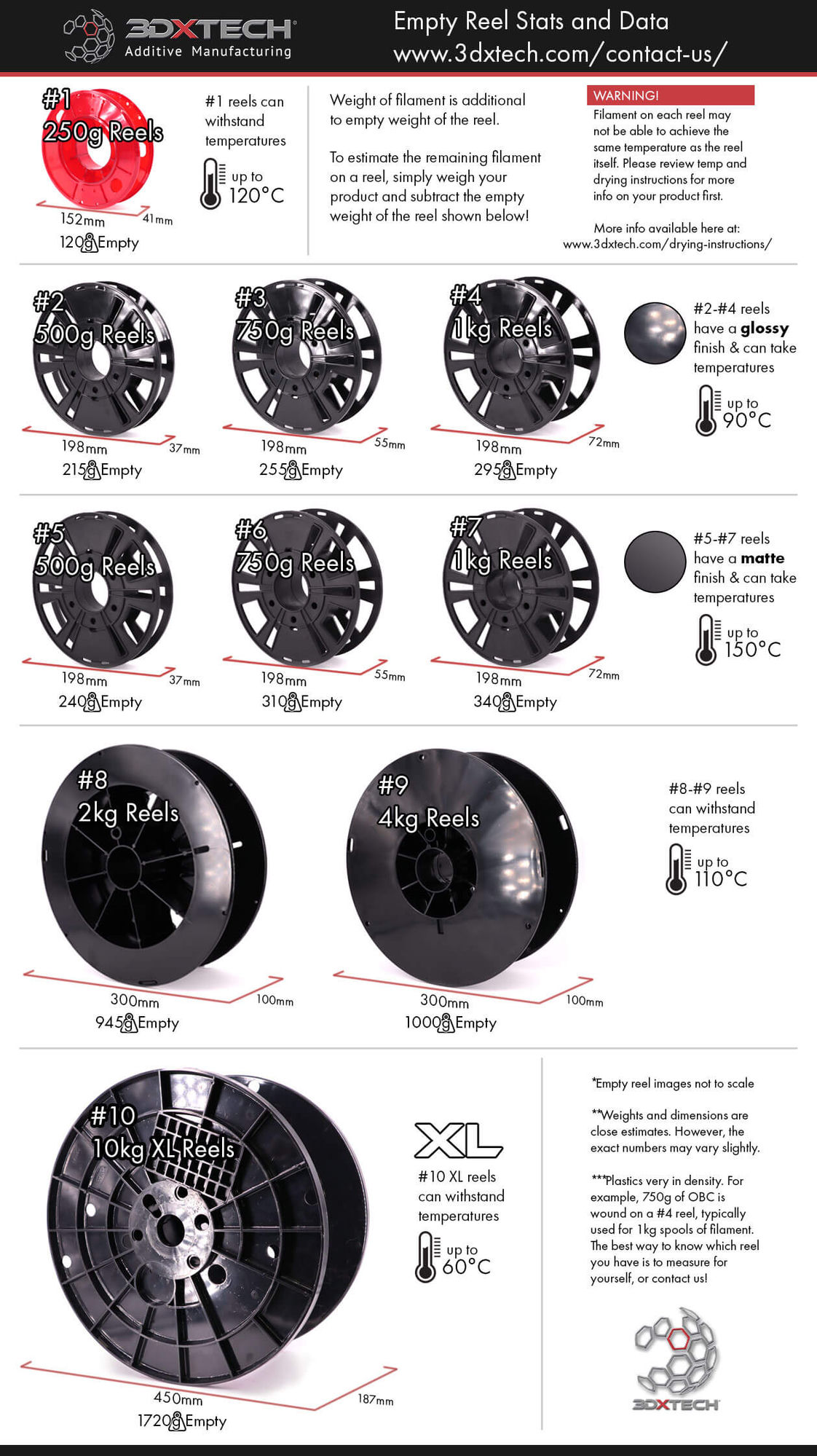
Standard spool dimensions — confirm it fits your AMS or dry box.
3DXTech ships ESD-PETG on consistent, standard reels.
Before you buy, check the outer diameter, width, and center bore against your printer's spool holder, automated material system, or drybox. Open the full 3DXTech reel infographic for the exact dimensions of the 750 g and 2 kg spools.
View reel dimensions →ESD-PETG vs. standard PETG vs. ESD-ABS.
Approximate positioning among common general-purpose and ESD filaments — confirm exact figures against each technical data sheet.
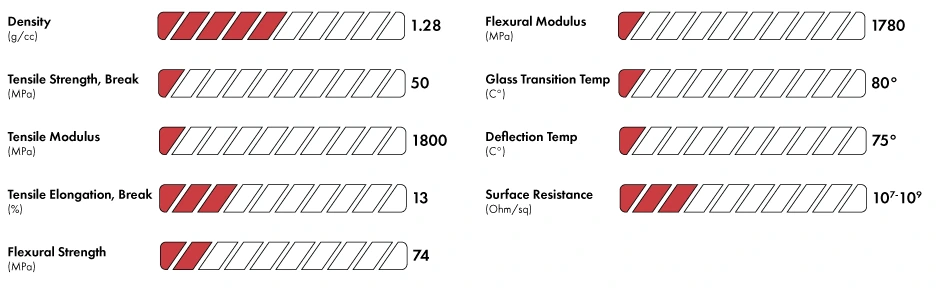
3DXTech's published property chart.
The quick-reference numbers, straight from the manufacturer — click the chart to enlarge it.
3DXTech publishes a property chart for 3DXSTAT™ ESD-PETG so you can size it up fast — surface resistance, tensile and flexural data, and thermal figures in one view. It's small on the page; click it to read the full-size version, and the same figures are in the readable specifications table below.
| 3DXSTAT ESD-PETG | Standard PETG | ESD-ABS | |
|---|---|---|---|
| ESD / surface resistance | 107–109 Ω/sq (dissipative) | Insulative (>1013) | 107–109 Ω/sq |
| Ease of printing | Easy (PETG-like) | Easy | Moderate |
| Enclosure needed | No | No | Recommended |
| Chemical resistance | High | High | Moderate |
| Moisture absorption | Low (~3× lower than ABS) | Low–moderate | Moderate |
| Ductility | High (13% elongation) | High | Moderate |
| Best for | ESD-safe handling, tooling, enclosures | Tough general-purpose parts | ESD parts needing higher heat |
Qualitative comparison among common filaments; confirm exact properties against each TDS. Prices vary by reel size and date.
3DXTech 3DXSTAT ESD-PETG Technical Data
RESOURCES
Datasheet & Print Support
Everything you need to qualify and print 3DXSTAT™ ESD-PETG.
WHY REV1 TECH
Authorized 3DXTech Reseller. Engineering-Materials Specialists.
Rev1 Technologies is an authorized 3DXTech reseller in Auburn Hills, MI, supplying genuine USA-made ESD filament with real print support.
We help you hit your ESD target, dial in the profile, and keep production running.
FAQ
3DXTech ESD-PETG — Common Questions
What surface resistance does ESD-PETG hold?
3DXTech targets a static-dissipative surface resistance of 107–109 Ω/sq (ASTM D257). That range bleeds off charge safely without the hard discharge of a fully conductive material — the standard window for handling static-sensitive electronics.
Do I need a special printer?
No exotic hardware. You need a heated bed (60–90°C) and a hotend that reaches 230–260°C. Unlike ESD-ABS, no enclosure is required because ESD-PETG has low, near-isotropic shrinkage.
Do I need a hardened nozzle?
The base polymer prints fine on a standard 0.4 mm brass nozzle. Because the compound is loaded with carbon nanotubes, a hardened or wear-resistant nozzle will extend nozzle life on high-volume runs.
How do print settings affect conductivity?
3DXTech's internal studies show that higher extruder temperatures tend to increase conductivity, while lower temperatures reduce it. If you need the most reliable dissipation, print toward the upper end of the 230–260°C range.
How is it different from ESD-ABS?
Both land in the same 107–109 Ω/sq band. ESD-PETG adds superior chemical resistance, higher ductility, roughly 3× lower moisture absorption, low printing odor, and no enclosure requirement. ESD-ABS is the pick when you need higher heat resistance.
What sizes and color are available?
Black, in 1.75 mm and 2.85 mm, on 750 g and 2 kg reels. Ask us about bulk and standing-order pricing.
Should I dry it before printing?
Yes — although moisture absorption is about 3× lower than ABS, drying at 65°C for around 4 hours gives the most consistent surface and dimensional results.
Is it made in the USA?
Yes — 3DXTech manufactures and compounds 3DXSTAT ESD-PETG in its 68,000 sq-ft facility in Grand Rapids, Michigan, with published data and lot traceability.
Does the ESD performance wear off?
No. Conductivity comes from carbon nanotubes dispersed throughout the polymer, not a surface coating — so the dissipative behavior is inherent to the part and doesn't rub off or wash away with handling. Print hot enough to develop full conductivity and it stays in the dissipative band.