SHINING 3D OptimScan 5M Plus High-Precision 3D Inspection Scanner
Lab-grade structured-light metrology on the bench — full-field, non-contact, and traceable.
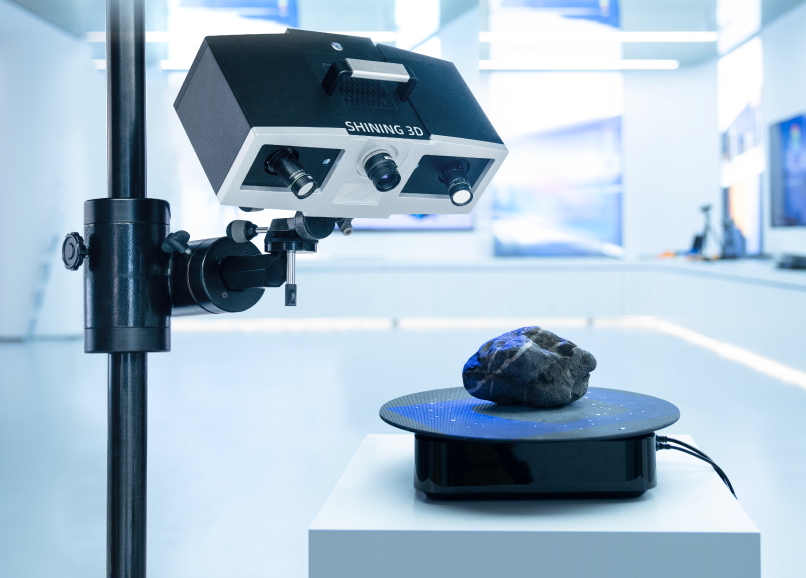
The OptimScan 5M Plus is a benchtop, blue-LED structured-light metrology scanner built for one job: trustworthy dimensional inspection of small, precise, high-value parts. A narrow-band blue light engine, three 5-megapixel industrial cameras, and 1080P DLP projection resolve fine geometry down to a 0.04 mm point distance, with single-shot accuracy reaching 0.005 mm. It is the instrument you reach for when calipers and CMM touch-probing are too slow and a handheld scanner is not precise enough. Full specifications →
Rev1 validates measurement requirements, accuracy targets, and inspection workflow before purchase. Authorized SHINING 3D reseller and support partner in the USA.
Certified Accuracy. Internationally Traceable.
The OptimScan 5M Plus carries an accuracy specification verified to VDI/VDE 2634 Part 3 in an ISO 17025–certified lab — the same standard procurement and quality teams cite when they need traceable optical-metrology numbers, not a vendor’s best-case marketing figure. Rev1 Technologies is your authorized SHINING 3D reseller and US support partner, Auburn Hills, Michigan.

Measurements you can put in a report.
Accuracy that is traceable, not aspirational
Single-shot accuracy reaches 0.005 mm (5 microns), backed by an accuracy specification verified to VDI/VDE 2634 Part 3 in an ISO 17025–certified lab — the same standard procurement and quality teams cite when they need traceable optical-metrology numbers. A built-in environmental vibration detection function watches the bench during capture and flags frames compromised by machine-shop floor vibration, foot traffic, or HVAC, so a borderline-stable environment doesn’t quietly corrupt a deviation map. The result is data you can hand to a customer, an auditor, or a first-article-inspection (FAIR) packet with confidence.
Three 5 MP cameras + 1080P projection.
Dense data that resolves the features that matter
Three sets of 5-megapixel industrial cameras work with a 1080P DLP projector to pack a dense, even cloud of points onto the part, resolving sharp edges, small radii, thread crests, draft angles, and engraved features that lower-resolution scanners blur or skip. Point distance goes as fine as 0.04 mm with the right lens — the difference between “the surface looks about right” and “this fillet is 0.08 mm out of profile.” For small, geometry-rich parts — connectors, brackets, molded housings — resolution is the spec that decides whether a defect is even visible in the data.
One head, three lens sets.
Flex from a fingertip part to a sheet-metal panel
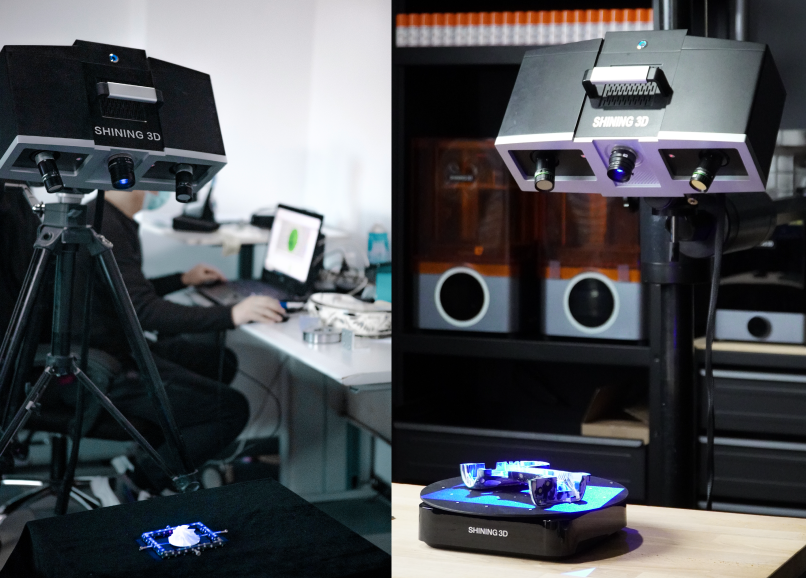
The 5M Plus adapts to part size by switching between three interchangeable industrial lens sets instead of forcing you to buy a different scanner for every job. A small lens set gives the finest point distance for the smallest parts; a larger set covers up to 400 × 300 mm per shot to keep scan counts — and stitching error — low on bigger components. Critically, all three lens sets share the same working distance, so swapping a lens does not mean re-fixturing the part, re-teaching a path, or refocusing. You change optics and keep scanning.
The “5M Plus” is a family, not a single config
“5M Plus” ships in multiple scan-range configurations selected by lens set. The 400 × 300 mm config (5M Plus-400) is shown as representative; smaller lens sets trade field size for finer point distance — down to ~0.04 mm — for the smallest, most detailed parts. Because all three lens sets share the same working distance, swapping does not require re-fixturing or refocusing. Rev1 specs the lens configuration to your parts as part of quoting.
Black and shiny parts in a single pass.
The surfaces that defeat other scanners — in one acquisition
High-contrast and difficult-finish surfaces are where most structured-light scanners fail: a glossy black housing next to a white label, or a part with both matte and reflective zones, normally forces multiple exposures or a spray-matting step. The 5M Plus’s HDR mode brackets exposure automatically and merges the result, capturing black, white, and high-contrast surfaces in one acquisition with complete, hole-free data. That means fewer dropouts, less rescanning, and — for many parts — no developer spray, preserving the as-manufactured surface for inspection.
Markers + GREC, automated.
Take operator skill out of the alignment
Alignment is where operator skill usually leaks into the data. The 5M Plus folds two correction stages into a one-click integrated module: an automatic markers-alignment step that registers overlapping scans without manual point-picking, and a GREC global-deviation-control module that minimizes cumulative error across the whole multi-scan dataset. Together they hold the global form true on parts that need many shots — so the 50th scan still lands where it should relative to the 1st. Less operator-to-operator variation, repeatable results, and high-precision data without a metrology PhD at the keyboard.
OptimScan capture → the inspection software you already trust.
A guided capture pipeline, then straight into GD&T
Native OptimScan software guides the operator end-to-end — calibration, capture, real-time preview, and data editing — with step-by-step prompts and AI-powered data cleanup that removes outliers and fills stray gaps intelligently. Resolution is adjustable across the three industrial lens sets, and a single scan completes in under 1.5 seconds. Outputs are ASC, STL, and OBJ, plus formats accepted by mainstream 3D and inspection packages — the geometry-first workflow keeps files lean and the pipeline focused on dimensional truth rather than appearance.
Rotate real OptimScan 5M Plus inspection data.
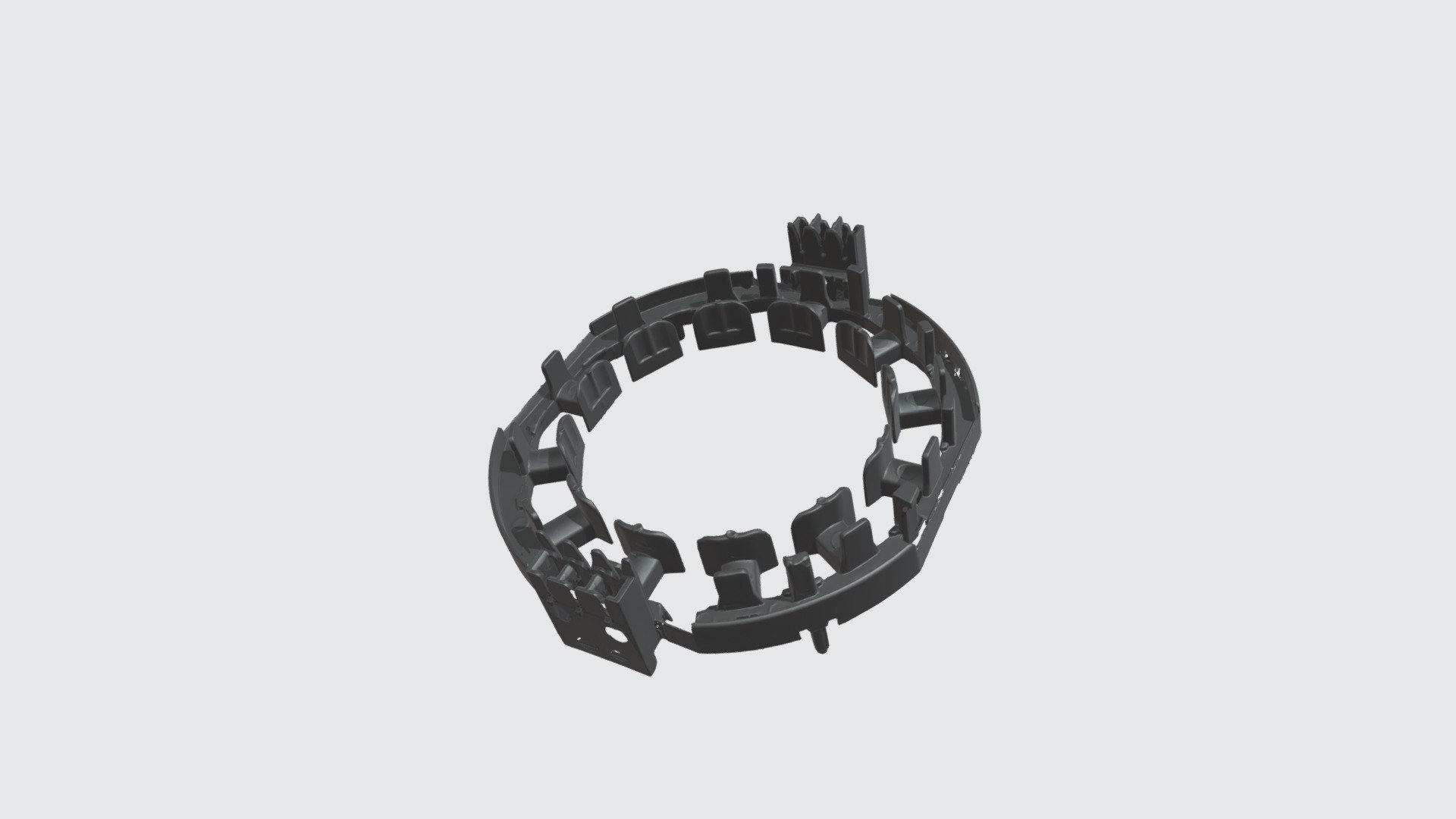
These are actual scan-result meshes captured on the OptimScan 5M Plus, published by SHINING 3D. Click to load each model and rotate it in 3D — the dense, even point cloud and fine feature resolution are visible directly in the geometry.
Where the OptimScan 5M Plus earns its place.
A metrology/QC instrument for small-to-medium, precise, high-value parts — not a large-object or handheld field scanner. Four industries where its accuracy, resolution, and HDR capture do the heavy lifting.
Civil Aviation
Aerospace parts are small-tolerance and high-consequence. The 5M Plus pairs its high-resolution cameras, blue-LED DLP projector, and high-end 3D-reconstruction algorithm to capture detailed, accurate data on small precise components — blades, brackets, fasteners, machined fittings — for surface-deviation analysis against nominal CAD and for documenting conformance on flight-critical hardware.
Automotive
Built around a 5 MP metrology-grade camera, adjustable scanning range, and accuracy to ~5 microns, the scanner handles the two questions automotive QC asks most: are the holes in position and is the surface in profile. It performs hole-position analysis and sheet-metal surface-deviation mapping on stampings, brackets, and trim, flagging springback and tooling drift before parts reach assembly.
Electronic & Electrical
For consumer-electronics and electrical parts, the 5M Plus inspects mobile-phone molds, back covers, and panels — exactly the glossy, fine-feature, tight-tolerance geometry that HDR and 5 MP resolution were built for. It verifies mold cavities against design, checks cosmetic surface flatness, and catches dimensional drift on housings and connectors where a few hundredths of a millimeter decide fit.
Engineering Machinery & Transportation
Across heavy machinery and transportation components, the scanner inspects parts of various sizes with consistent accuracy, checking weld scars, hole positions, and machined surfaces. The multi-lens range flexibility means one instrument covers a small bracket and a large casting section without compromising the precision the inspection report depends on.
OptimScan 5M Plus vs. benchtop blue-light metrology scanners.
The 5M Plus competes against premium European benchtop optical-metrology systems. All are legitimately certified to the same family of optical-metrology standards (VDI/VDE 2634), so the comparison is about traceable-peer positioning — not a budget substitute. Pricing for every unit here is by quotation; we name competitors only to position class and never publish their prices.
| Capability | OptimScan 5M Plus | ATOS Core (GOM / Zeiss) | Zeiss COMET | Hexagon Structured-Light |
|---|---|---|---|---|
| Class & accuracy basis | Benchtop blue-LED structured light; 0.005 mm single-shot, VDI/VDE 2634 Part 3 (ISO 17025) | Benchtop blue-light; VDI/VDE 2634-class certified | Benchtop blue-light; VDI/VDE 2634-class certified | Benchtop/stereo structured light; VDI/VDE 2634-class certified |
| Resolution / detail | 3 × 5 MP + 1080P; point distance to 0.04 mm | High-resolution sensor options | High-resolution sensor options | High-resolution sensor options |
| Range flexibility | 3 interchangeable lens sets, common working distance, no re-fixture on swap | FOV changed via measuring-volume / sensor swap | Measuring-volume options | Measuring-volume options |
| Difficult surfaces | HDR — black + white in one pass, often spray-free | Typically multi-exposure / matting | Typically multi-exposure / matting | Typically multi-exposure / matting |
| Relative acquisition cost | Lower up-price entry into certified benchtop metrology — by quotation | Premium-positioned — by quotation | Premium-positioned — by quotation | Premium-positioned — by quotation |
Honest takeaway: all four are true peers on traceability (VDI/VDE 2634), so the 5M Plus is a legitimate metrology instrument rather than a budget alternative. Its differentiators are the common-working-distance lens swap (faster part changeover) and HDR-in-one-pass (fewer reshoots on shiny parts), which together cut the two costs that dominate real inspection throughput: changeover time between part families and reshoot time on difficult finishes. Where the premium European systems often justify their price on brand-installed-base and service contracts, the 5M Plus argues on certified accuracy and resolution at a lower total cost of ownership — the same VDI/VDE 2634 traceability without the premium-tier acquisition cost. Ask Rev1 for an apples-to-apples comparison for your specific parts, and we will quote the lens configuration, software, and support package that matches your inspection workload.
SHINING 3D OptimScan 5M Plus Technical Data
RESOURCES
Downloads & Technical Support
Everything you need to qualify, certify, and run your OptimScan 5M Plus with confidence.
WHY REV1 TECH
Authorized SHINING 3D Reseller. Industrial Metrology Specialists.
Rev1 Technologies is an authorized SHINING 3D reseller headquartered in Auburn Hills, MI, with direct expertise in dimensional inspection, metrology, and quality-control workflows.
Rev1 Technologies serves manufacturers and QC teams across the USA. We don’t just ship boxes — we deploy, certify, train, and support your team so your OptimScan 5M Plus delivers traceable accuracy from day one.
OptimScan 5M Plus — questions buyers ask before quoting.
OptimScan capture → the inspection software you already trust.
A guided capture pipeline, then straight into GD&T
Native OptimScan software guides the operator end-to-end — calibration, capture, real-time preview, and data editing — with step-by-step prompts and AI-powered data cleanup that removes outliers and fills stray gaps intelligently. Resolution is adjustable across the three industrial lens sets, and a single scan completes in under 1.5 seconds. Outputs are ASC, STL, and OBJ, plus formats accepted by mainstream 3D and inspection packages — the geometry-first workflow keeps files lean and the pipeline focused on dimensional truth rather than appearance.
Rotate real OptimScan 5M Plus inspection data.
These are actual scan-result meshes captured on the OptimScan 5M Plus, published by SHINING 3D. Click to load each model and rotate it in 3D — the dense, even point cloud and fine feature resolution are visible directly in the geometry.
Where the OptimScan 5M Plus earns its place.
A metrology/QC instrument for small-to-medium, precise, high-value parts — not a large-object or handheld field scanner. Four industries where its accuracy, resolution, and HDR capture do the heavy lifting.
Civil Aviation
Aerospace parts are small-tolerance and high-consequence. The 5M Plus pairs its high-resolution cameras, blue-LED DLP projector, and high-end 3D-reconstruction algorithm to capture detailed, accurate data on small precise components — blades, brackets, fasteners, machined fittings — for surface-deviation analysis against nominal CAD and for documenting conformance on flight-critical hardware.
Automotive
Built around a 5 MP metrology-grade camera, adjustable scanning range, and accuracy to ~5 microns, the scanner handles the two questions automotive QC asks most: are the holes in position and is the surface in profile. It performs hole-position analysis and sheet-metal surface-deviation mapping on stampings, brackets, and trim, flagging springback and tooling drift before parts reach assembly.
Electronic & Electrical
For consumer-electronics and electrical parts, the 5M Plus inspects mobile-phone molds, back covers, and panels — exactly the glossy, fine-feature, tight-tolerance geometry that HDR and 5 MP resolution were built for. It verifies mold cavities against design, checks cosmetic surface flatness, and catches dimensional drift on housings and connectors where a few hundredths of a millimeter decide fit.
Engineering Machinery & Transportation
Across heavy machinery and transportation components, the scanner inspects parts of various sizes with consistent accuracy, checking weld scars, hole positions, and machined surfaces. The multi-lens range flexibility means one instrument covers a small bracket and a large casting section without compromising the precision the inspection report depends on.
OptimScan 5M Plus vs. benchtop blue-light metrology scanners.
The 5M Plus competes against premium European benchtop optical-metrology systems. All are legitimately certified to the same family of optical-metrology standards (VDI/VDE 2634), so the comparison is about traceable-peer positioning — not a budget substitute. Pricing for every unit here is by quotation; we name competitors only to position class and never publish their prices.
| Capability | OptimScan 5M Plus | ATOS Core (GOM / Zeiss) | Zeiss COMET | Hexagon Structured-Light |
|---|---|---|---|---|
| Class & accuracy basis | Benchtop blue-LED structured light; 0.005 mm single-shot, VDI/VDE 2634 Part 3 (ISO 17025) | Benchtop blue-light; VDI/VDE 2634-class certified | Benchtop blue-light; VDI/VDE 2634-class certified | Benchtop/stereo structured light; VDI/VDE 2634-class certified |
| Resolution / detail | 3 × 5 MP + 1080P; point distance to 0.04 mm | High-resolution sensor options | High-resolution sensor options | High-resolution sensor options |
| Range flexibility | 3 interchangeable lens sets, common working distance, no re-fixture on swap | FOV changed via measuring-volume / sensor swap | Measuring-volume options | Measuring-volume options |
| Difficult surfaces | HDR — black + white in one pass, often spray-free | Typically multi-exposure / matting | Typically multi-exposure / matting | Typically multi-exposure / matting |
| Relative acquisition cost | Lower up-price entry into certified benchtop metrology — by quotation | Premium-positioned — by quotation | Premium-positioned — by quotation | Premium-positioned — by quotation |
Honest takeaway: all four are true peers on traceability (VDI/VDE 2634), so the 5M Plus is a legitimate metrology instrument rather than a budget alternative. Its differentiators are the common-working-distance lens swap (faster part changeover) and HDR-in-one-pass (fewer reshoots on shiny parts), which together cut the two costs that dominate real inspection throughput: changeover time between part families and reshoot time on difficult finishes. Where the premium European systems often justify their price on brand-installed-base and service contracts, the 5M Plus argues on certified accuracy and resolution at a lower total cost of ownership — the same VDI/VDE 2634 traceability without the premium-tier acquisition cost. Ask Rev1 for an apples-to-apples comparison for your specific parts, and we will quote the lens configuration, software, and support package that matches your inspection workload.
SHINING 3D OptimScan 5M Plus Technical Data
RESOURCES
Downloads & Technical Support
Everything you need to qualify, certify, and run your OptimScan 5M Plus with confidence.
WHY REV1 TECH
Authorized SHINING 3D Reseller. Industrial Metrology Specialists.
Rev1 Technologies is an authorized SHINING 3D reseller headquartered in Auburn Hills, MI, with direct expertise in dimensional inspection, metrology, and quality-control workflows.
Rev1 Technologies serves manufacturers and QC teams across the USA. We don’t just ship boxes — we deploy, certify, train, and support your team so your OptimScan 5M Plus delivers traceable accuracy from day one.